The global landscape of data processing is undergoing a seismic shift. As Large Language Models (LLMs) and Generative AI applications become the cornerstone of modern enterprise, the infrastructure supporting these technologies—massive AI clusters—is evolving at a breakneck pace. We have moved rapidly from 100G and 400G to the current gold standard of 800G, with 1.6T (1.6 Terabits per second) already appearing on the horizon of 2026 and beyond.
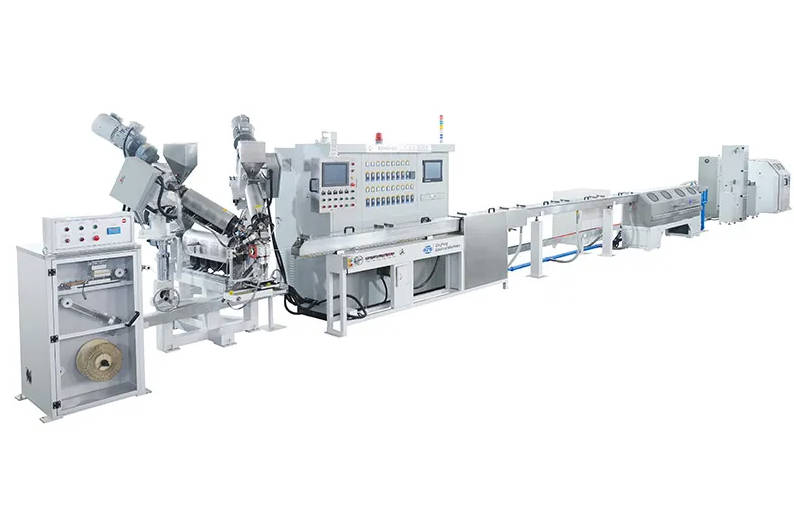
At these astronomical speeds, the “Physical Layer” of the network becomes the most significant bottleneck. Specifically, the high-speed copper cables (Direct Attach Cables – DAC) and Active Copper Cables (ACC/AEC) used to connect GPU-heavy servers must perform with near-perfect electrical characteristics. A high-speed taping machine is the most critical piece of equipment in the production of 800G and 1.6T cables because it ensures the precise application of shielding tapes, which is the only way to maintain signal integrity and prevent EMI in ultra-high-frequency environments.
I. Why 800G and 1.6T Change the Rules of Cable Manufacturing
In previous generations of networking, minor variations in cable construction were tolerable. At 10Gbps or even 100G, the signals were robust enough to handle slight imperfections in shielding. However, the transition to 800G and 1.6T introduces two major challenges: Skin Effect and Insertion Loss.
1. The Physics of Signal Loss
As frequency increases, the electrical signal tends to travel only on the “skin” or surface of the conductor. Any irregularity in the shielding—such as a tiny gap in the Mylar tape or a slight variation in wrapping tension—causes the signal to reflect or dissipate.
2. Tighter Tolerances for Signal Integrity (SI)
For 1.6T AI clusters, the margin for error is effectively zero. To meet the stringent requirements of 800G and 1.6T standards, high-speed taping machines must maintain a shielding overlap accuracy within ±0.1mm to ensure consistent impedance and minimize crosstalk.
3. EMI and Dense AI Racks
Modern AI clusters pack hundreds of GPUs into tight racks. The electromagnetic interference (EMI) generated by these components is intense. Without a high-precision, 360-degree shield applied by a high-speed taping machine, cables act as antennas, picking up noise that leads to high Bit Error Rates (BER) and system latency.
II. Technical Requirements: Comparing Cable Generations
To understand why an upgrade in manufacturing equipment is necessary, we must look at the technical specifications required for different speeds of cable assemblies.
| Feature | 400G (QSFP-DD) | 800G (OSFP/QSFP112) | 1.6T (OSFP-XD/SFP-DD) |
| Frequency Range | Up to 28 GHz | Up to 56 GHz | 112 GHz and beyond |
| Typical AWG | 26 – 30 AWG | 28 – 32 AWG | 30 – 34 AWG (Ultra-thin) |
| Shielding Overlap | 15% – 25% | 20% – 30% (High Precision) | >30% (Ultra-High Precision) |
| Tension Variance | ± 10% | ± 3% | < ± 1% |
| Taping Speed (RPM) | 1500 – 2500 RPM | 3000 – 5000 RPM | > 5000 RPM with Stability |
III. Core Technical Features of Professional High-Speed Taping Machines
When evaluating equipment for an 800G or 1.6T production line, specific technical benchmarks must be met to ensure the end product is “AI-Ready.”
1. Precision Active Tension Control
Traditional mechanical friction tensioning is insufficient for 1.6T production. The best high-speed taping machines utilize active servo-driven tension control systems that respond in milliseconds to changes in wire speed, ensuring the tape never stretches or deforms the delicate core wire. This is vital because even a 1% stretch in the copper core can change the cable’s impedance, leading to a failed SI test.
2. Digital Overlap and Pitch Management
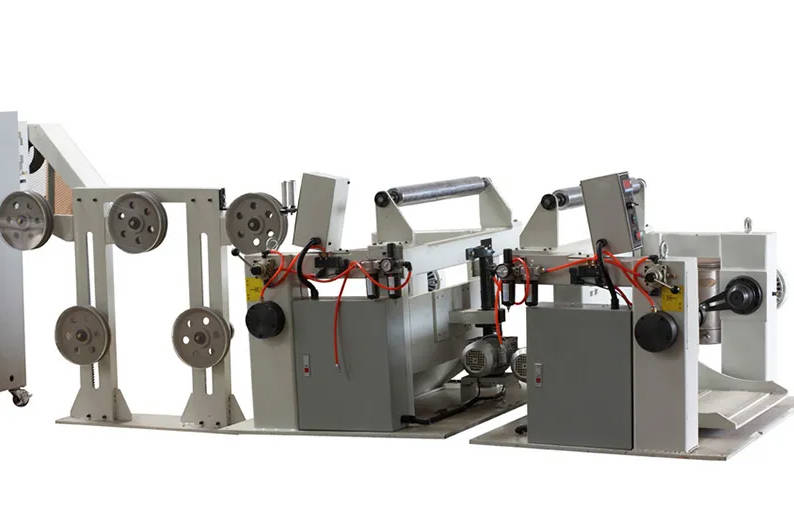
The “Pitch” (the distance between each wrap) must be perfectly synchronized with the line speed. High-speed taping machines use integrated PLC systems to link the wrapping head’s rotation speed (RPM) with the caterpillar’s pull speed. This synchronization ensures that the overlap rate remains constant regardless of whether the machine is ramping up or running at full speed.
3. Concentricity and High-Speed Stability
At speeds exceeding 4000 RPM, centrifugal force can cause the wrapping head to vibrate. Professional machines are built with dynamically balanced rotating parts and heavy-duty casting frames to dampen vibration. High-speed stability is essential for 1.6T cable manufacturing because vibration directly correlates to “jitter” in the signal path of the finished cable.
IV. Addressing Common User Pain Points & FAQs
For manufacturers entering the high-speed data market, several recurring questions arise regarding equipment selection and production efficiency.
Q: Why is my scrap rate so high when I increase the speed of my taping machine?
A: This is usually due to “Tension Spike.” When a machine accelerates, traditional tensioners cannot compensate fast enough, causing the tape to snap or the core to bend. Upgrading to a machine with active servo tensioning and dancer-arm feedback is the primary solution to reducing scrap rates in 800G cable production.
Q: Can one machine handle both 26AWG and 32AWG wires?
A: Yes, provided the machine has a wide enough tension range. However, 1.6T cables often use 30-34AWG (very thin). The machine must be sensitive enough to handle the low breaking strength of these ultra-thin wires while still maintaining high-speed throughput.
Q: How do I ensure consistency across a 5,000-meter batch?
A: Look for machines with Real-time Monitoring and Data Logging. If the tension or overlap deviates from the set parameters for even a second, the machine should flag that specific section of the cable for inspection or automatically stop.
V. Key Features to Look for in 1.6T-Ready Equipment
If you are a procurement manager or technical lead, ensure your next high-speed taping machine includes these “Next-Gen” features:
- Integrated CCD Vision Systems: Cameras that inspect the overlap quality in real-time.
- Dual-Head Configuration: For applying both the primary shielding (Aluminum foil) and secondary layers (Mylar or specialized films) in a single pass, increasing efficiency.
- Touch-Screen HMI: For easy recipe management; switching between 800G and 1.6T specs should take minutes, not hours.
- Industry 4.0 Compatibility: The ability to export production data to a centralized MES (Manufacturing Execution System) for full traceability.
VI. The Economic Impact: ROI of High-Precision Taping
Investing in a high-end taping machine is a strategic financial decision. While the initial capital expenditure (CAPEX) is higher than that of standard machines, the Return on Investment (ROI) is driven by three factors:
- Yield Improvement: In 800G production, the raw materials (silver-plated copper, high-end resins) are incredibly expensive. Increasing your production yield from 85% to 98% through better tension control can save hundreds of thousands of dollars in material costs annually.
- Certification Readiness: Tier 1 data center operators (such as Microsoft, Google, or Meta) require rigorous testing. Machines that provide data logs prove to these clients that your process is controlled.
- Future-Proofing: A machine capable of the precision required for 1.6T today will not need to be replaced when 3.2T standards emerge in the future.
VII. Future Outlook: Beyond 1.6T to 3.2T
As we look toward 2027 and 2028, the industry is already discussing 3.2T clusters. This will likely involve even more complex cable structures, potentially utilizing new dielectric materials and even tighter shielding requirements. High-speed taping machines will need to incorporate even more advanced sensors and perhaps AI-driven predictive maintenance to ensure that the physical infrastructure of the internet can keep up with the demands of artificial intelligence.
VIII. Conclusion
In the era of 800G and 1.6T AI clusters, the distance between “good enough” and “failure” is measured in microns. The high-speed taping machine is no longer a peripheral utility; it is the heart of the high-speed cable production line. By prioritizing precision tension control, digital overlap accuracy, and high-speed stability, manufacturers can position themselves as leaders in the AI infrastructure revolution.
Choosing the right high-speed taping equipment is not just about buying a machine; it is about securing the signal integrity of the world’s most advanced data networks.