I. Introduction: The 224G/448G Paradigm Shift in AI Networking
The global surge in Generative AI and Large Language Models (LLMs) has pushed data center bandwidth requirements to unprecedented levels. As we transition from 400G and 800G toward 1.6T networking architectures, the industry has arrived at a critical juncture: the move to 224Gbps and 448Gbps per lane signaling.
At these extreme frequencies, traditional Direct Attach Copper (DAC) cables face severe physical limitations due to signal attenuation. This has catalyzed the rise of Active Copper Cables (ACC) and Active Electrical Cables (AEC). While these cables integrate signal-boosting chips (Redrivers/Retimers), the fundamental performance of the assembly still rests on the quality of the raw bulk cable.
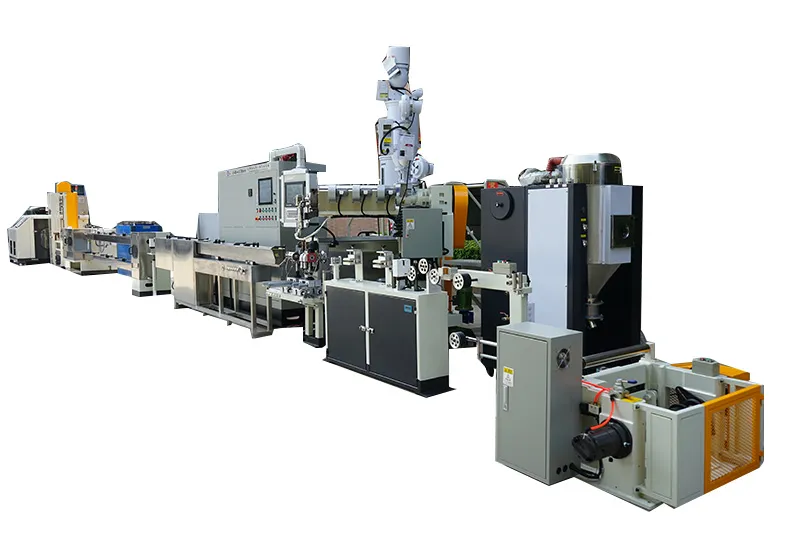
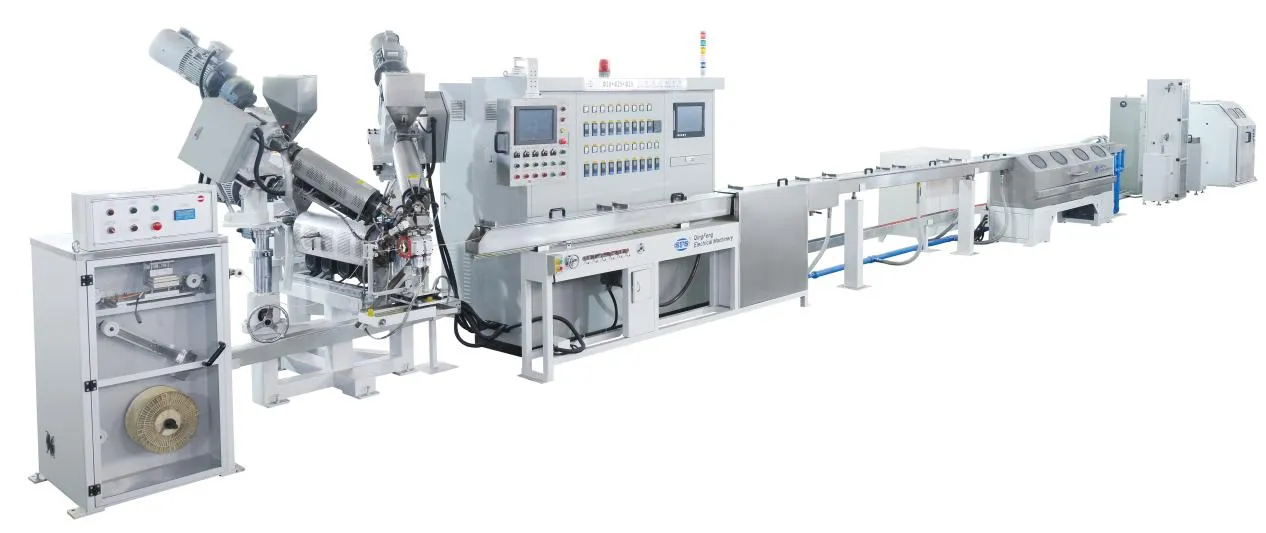
For 224G/448G ACC manufacturing, ultra-stable physical foaming of Teflon insulation is the critical process required to maintain the Dielectric Constant (εr), stabilize characteristic impedance, and minimize insertion loss across high-frequency spectrums. Without a high-precision Teflon Foaming Extrusion Production Line, manufacturers cannot meet the stringent Eye Diagram and Bit Error Rate (BER) requirements of the AI era.
II. The Physics of Signal Loss: Why “Standard” Lines Fail at 448G
In high-speed data transmission, the cable insulation is not merely a protective jacket; it is a dielectric medium that directly influences the speed and clarity of the electrical signal.
1. The Dielectric Challenge and Attenuation
The higher the frequency, the more the signal travels on the surface of the conductor (the “Skin Effect”) and interacts with the surrounding insulation. The Dielectric Constant (εr) and Dissipation Factor (Tan δ) of the insulation material determine how much energy is absorbed by the cable.
Teflon (PTFE/FEP/PFA) is the gold standard for 224G/448G applications because it offers the lowest dielectric constant and loss tangent among processable polymers, which is essential for reducing insertion loss in high-frequency PAM4 signaling.
2. Velocity of Propagation (VoP)
In 448G interconnects, timing is everything. The Velocity of Propagation is inversely proportional to the square root of the dielectric constant: VoP = 1 / √(εr). By using physical foaming—injecting nitrogen gas into the Teflon melt—we replace solid plastic with air (where εr is approximately 1.0). This raises the VoP, reduces the signal delay, and allows for thinner, more flexible cables that are necessary for high-density AI rack cabling.
3. Impedance Stability
Any variation in the foaming degree (the ratio of air to plastic) results in a change in the dielectric constant. In a 224G system, a microscopic fluctuation in the insulation diameter or foaming density causes an impedance mismatch. These mismatches trigger Return Loss (RL), where the signal reflects back to the source, closing the “Eye” in the signal diagram and causing data errors.
III. Solving Manufacturing Bottlenecks: QingFeng’s Engineering Solutions
Manufacturing a 224G-ready Twinax cable requires more than just an extruder; it requires a synchronized, high-precision ecosystem. QingFeng has engineered specific solutions to the most common bottlenecks in Teflon foaming extrusion.
1. High-Precision Gas Injection Control
Traditional foaming lines often suffer from “pulsing” in the gas flow. QingFeng’s proprietary Nitrogen Injection System utilizes ultra-high-pressure mass flow controllers to ensure uniform gas distribution, creating a consistent micro-cellular bubble structure with foaming rates up to 75%. This level of uniformity is the only way to ensure the stable 50 Ohm or 100 Ohm impedance required for 1.6T networking.
2. Advanced Thermal Management for Fluoropolymers
Teflon materials like FEP and PFA require high processing temperatures (up to 400°C) and are highly corrosive to standard steel. QingFeng utilizes specialized Hastelloy or high-nickel alloy screws and barrels and multi-zone PID temperature control to prevent material degradation. Precise cooling is equally vital; our graduated cooling troughs prevent “cell collapse,” ensuring the micro-bubbles remain intact as the material solidifies.
3. Real-Time Closed-Loop Feedback Systems
To achieve the ±0.01mm tolerance needed for 448G, QingFeng integrates laser micrometers and capacitance monitors directly into the line’s PLC.
The QingFeng automated control system adjusts the screw speed and haul-off tension in real-time based on capacitance and diameter deviations, virtually eliminating human error and maximizing yield for expensive Teflon raw materials.
Technical Comparison: Standard vs. 224G/448G Ready Extrusion Lines
IV. Addressing Manufacturer FAQs: Common Doubts in High-Speed Production
FAQ 1: How do we prevent cell collapse at high foaming rates?
Cell collapse usually occurs due to improper pressure differentials or sudden temperature drops. QingFeng’s “Pressure-Balanced” crosshead ensures that the nitrogen remains in solution until the exact moment the material exits the die. Combined with a multi-stage warm-water-to-cold-water cooling transition, this locks in the cellular structure before it can deform.
FAQ 2: Is the machine versatile enough for different Teflon grades?
Yes. Our screw designs are optimized for a wide range of Melt Flow Rates (MFR). Whether you are using low-MFR PFA for superior thermal stability or high-speed FEP for mass production, the QingFeng line can be tuned via the HMI to provide the optimal shear and pressure.
FAQ 3: How does the line reduce scrap during the ramp-up phase?
Teflon is expensive. QingFeng’s “Quick-Start” synchronization allows the foaming system to reach steady-state 30% faster than industry averages, significantly reducing the amount of out-of-spec scrap generated during the heat-up and tuning phases.
V. Beyond Extrusion: The Total 1.6T Production Ecosystem
While the Teflon Foaming Extrusion Line creates the core, the final performance of a 224G ACC cable depends on the subsequent steps.
- Taping and Shielding: The extruded core must be wrapped with silver-plated copper or aluminum foil. QingFeng’s High-Speed Taping Machines maintain constant tension to ensure that the wrapping process does not compress the foamed insulation, which would otherwise ruin the impedance and increase skew.
- Planetary Cabling: For multi-pair 800G/1.6T cables, the “Planetary” cabling method is preferred over traditional bunching to ensure zero-torsion on the high-frequency pairs, preserving the electrical integrity of the foamed Teflon.
VI. Conclusion: Your Gateway to the AI Supply Chain
The demand for 224G and 448G ACC is no longer a future prediction—it is a current requirement for the world’s leading AI chipmakers and cloud service providers. To compete in this “Formula 1” tier of cable manufacturing, the margin for error is zero.
Investing in a QingFeng Teflon Physical Foaming Extrusion Production Line is not just an equipment upgrade; it is a strategic move to secure your place in the AI infrastructure supply chain. By mastering signal integrity through ultra-stable foaming, you provide the “nervous system” that makes 1.6T AI clusters possible.
Ready to lead the 224G/448G market? Contact QingFeng today for a technical consultation and discover how our high-precision extrusion solutions can transform your production yield.