I. Introduction: The High-Speed Era and the Skew Challenge
In the landscape of modern telecommunications, we are witnessing a paradigm shift. As data centers migrate from 400G to 800G and look toward 1.6T architectures, the physical layer—the humble copper cable—is being pushed to its absolute physical limits. At QingFeng SFS, we have spent years collaborating with engineers who face the same recurring nightmare: Intra-pair Skew.
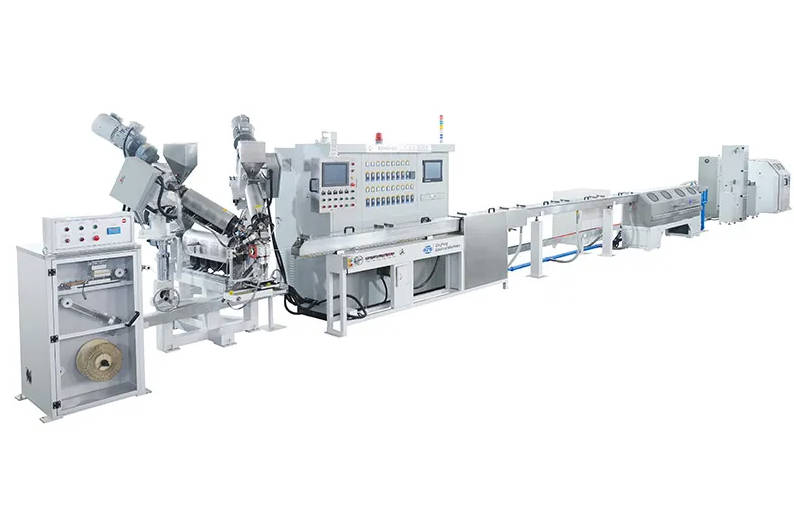
When you are manufacturing high-speed Direct Attach Copper (DAC) or Twinax cables, you aren’t just “wrapping tape” around wires. You are performing a high-precision balancing act. A taping machine is no longer just a piece of peripheral equipment; it is the heartbeat of your signal integrity strategy. This article explores why tension control is the most critical factor in eliminating skew and how the right wire taping machine technology can revolutionize your production yield.
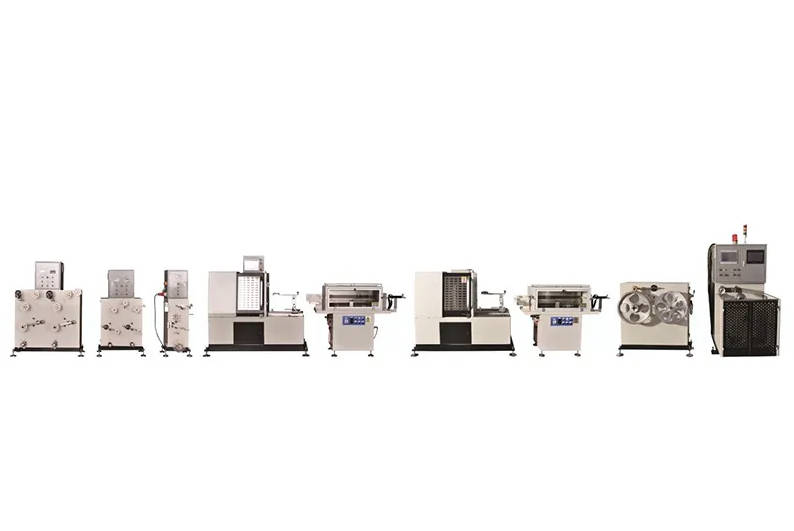
II. Understanding Intra-pair Skew: The “Silent Killer” of Signal Integrity
To solve a problem, we must first understand its nature. In a differential pair (Twinax), two conductors carry signals that are equal in magnitude but opposite in polarity. For the receiver to interpret the data correctly at 112G or 224G per lane, these two signals must arrive at the destination at the exact same time.
Intra-pair skew is the time of flight difference between the two signals in a differential pair, measured in picoseconds (ps). It is primarily caused by physical inconsistencies in the cable’s construction, where one conductor becomes “electrically longer” than its partner.
If the signals are out of sync by even 5 to 10 picoseconds, the “eye diagram” of the signal collapses. This leads to bit errors, failed certifications, and wasted materials. While conductor quality matters, the vast majority of skew issues are introduced during the wrapping process by the taping machine.
III. The Physics of Taping: Why Tension is Everything
Why does a mechanical automatic taping machine affect electrical performance? It comes down to the relationship between mechanical stress and the dielectric constant (Dk).
1. Mechanical Stress and Dielectric Compression
Twinax cables use sensitive insulation materials like Foam-PE or PTFE. These materials contain air pockets to lower the dielectric constant. If your wire and cable taping machine applies inconsistent tension, it compresses these air pockets.
- High Tension: Compresses the insulation, increasing the Dk and slowing the signal down.
- Low Tension: Leaves the insulation loose, maintaining a lower Dk and allowing the signal to travel faster.
2. Physical Path Length vs. Electrical Path Length
If your high-speed taping machine does not maintain identical tension on both cores of a Twinax pair, one core will be physically stretched or its insulation more compressed than the other. Even if both wires look identical to the naked eye, the signal perceives them as different lengths. This is the “hidden” cause of skew that keeps production managers up at night.
IV. The Role of Advanced Taping Machines in Solving Skew
At QingFeng SFS, we believe that “good enough” tension is no longer an option for the 800G era. Here is how advanced taping machine technology addresses these challenges:
1. Active Tension Control vs. Passive Braking
Most traditional machines use a friction-based “passive” brake. As the tape roll gets smaller, the tension naturally increases because the radius of the spool changes.
To eliminate intra-pair skew, an advanced taping machine must utilize active tension control, where servo motors and high-frequency sensors adjust the torque in real-time to maintain a constant tension within a tolerance of +/- 0.1N.
- Ultra-Responsive Mechanical Dancer Systems
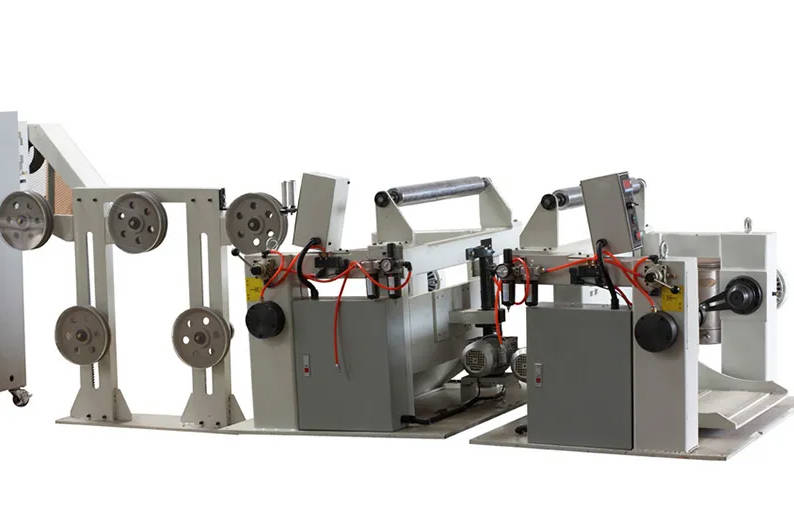
The “Dancer” is the gatekeeper of quality. In a QingFeng SFS taping machine, we achieve precision through superior mechanical engineering and low-inertia design rather than relying on complex electronic load cells.
Our dancer arms are constructed from ultra-lightweight alloys to minimize inertia, allowing the system to react instantly and physically to the slightest change in line speed. By utilizing a precision-tuned counterweight balancing system, the machine maintains a constant mechanical feedback loop. This purely physical responsiveness allows the dancer to absorb and neutralize tension spikes—caused by tape variations or vibration—in milliseconds. This ensures that the delicate foaming layer of the 800G Twinax core is never crushed, maintaining the structural integrity required for zero-error signal transmission.
3. Precision Wrapping Pitch
If the pitch (the distance between each wrap of tape) fluctuates, the shielding isn’t uniform. This creates “impedance discontinuities.” A precision automatic taping machine ensures that the linear speed of the cable and the rotational speed of the taping head are perfectly synchronized via a digital “electronic gear” system.
Technical Performance Comparison Table
The following table illustrates the impact of different machine types on Twinax cable performance:
| Feature | Manual/Passive Machine | QingFeng SFS Active Machine | Benefit to User |
| Tension Deviation | +/- 15% to 20% | +/- 1% to 2% | Consistent Signal Speed |
| Skew Performance | 15-20 ps/meter | < 5 ps/meter | Passes 800G/1.6T Specs |
| Max Head Speed | 600 – 800 RPM | 2000 – 3000 RPM | 3x Higher Productivity |
| Scrap Rate | High (due to Skew) | Ultra-Low | Significant Cost Savings |
V. Advanced Strategies: Beyond Basic Tension
To truly master Twinax production, we must look at the finer details of the shielding taping machine process.
1. The Centrifugal Force Factor
At high speeds (over 2000 RPM), centrifugal force pulls on the tape, effectively increasing the tension even if the brake is set correctly. QingFeng SFS machines feature “Centrifugal Compensation Logic.” As the head speeds up, the machine automatically reduces the motor torque to offset the outward pull, ensuring the tape touches the wire with the exact same pressure at 100 RPM as it does at 2500 RPM.
2. Material Memory and Environmental Control
PTFE and Aluminum Mylar have “memory.” If they are stretched during wrapping, they will try to shrink back later. If the taping machine isn’t perfectly calibrated, this shrinkage happens unevenly. We recommend maintaining a climate-controlled room (23°C +/- 2°C) to ensure the tape’s physical properties remain stable during the high-speed application.
VI. Addressing Common User Pain Points
“My cable passes testing at the beginning of the reel, but fails at the end. Why?”
This is almost always due to “Spool Diameter Decay.” In a basic wire wrapping machine, as the tape spool empties, the tension rises. This means the end of your cable run is wrapped tighter than the beginning. An active system from QingFeng SFS senses the spool diameter and adjusts the motor constantly to keep the tension “flat” from start to finish.
“How can I increase speed without ruining my skew?”
The secret is vibration dampening. If your high-speed taping machine vibrates, those micro-shocks are transferred to the tape tension. Using a machine with a heavy-duty cast-iron frame and dynamically balanced heads allows you to run at higher speeds while maintaining the “quiet” tension required for low-skew performance.
VII. Conclusion: A Sincere Partnership for Precision
At QingFeng SFS, we don’t just sell taping machines; we provide the mechanical foundation for digital communication. We know that behind every meter of cable you produce is a commitment to quality. By focusing on active tension control, vibration reduction, and synchronized precision, you can turn the “skew nightmare” into a competitive advantage.
Investing in a high-precision automatic taping machine is an investment in your yield, your reputation, and the future of high-speed connectivity. Let’s build a more connected world, one picosecond at a time.
FAQ: Essential Knowledge for Taping Machine Users
1. What is the ideal tension for Twinax taping?
There is no single “perfect” number, as it depends on the wire gauge and tape material. However, the key is consistency. Most 30AWG Twinax cables require tension between 2N and 5N. The goal of your taping machine should be to maintain your chosen setpoint with less than 2% variation.
2. How does the taping angle affect skew?
The taping angle (governed by the pitch) determines how much the shielding overlaps. An inconsistent angle creates “impedance bumps.” A high-speed taping machine with an electronic gearbox ensures the angle remains identical throughout the entire production run.
3. Why is “Active Payoff” better than “Passive Payoff”?
Passive payoff relies on the wire pulling the spool, which creates drag and tension spikes. Active payoff uses a motor to “feed” the wire to the machine, ensuring the wire taping machine never has to fight against the weight of the spool.
4. Can I upgrade my old machine to reduce skew?
While some mechanical parts can be refurbished, achieving the high-speed synchronization required for 800G demands the superior processing power of a modern motion controller. Unlike standard logic controllers, a dedicated motion control system manages complex multi-axis tension and speed ratios in real-time with microsecond precision. For the rigorous demands of 112G PAM4 signaling, a purpose-built automatic taping machine from QingFeng SFS—engineered with integrated motion control technology—is typically more cost-effective and reliable than attempting to retrofit legacy hardware that lacks the necessary response speed.
5. How often should I calibrate my tension sensors?
For high-speed DAC production, we recommend a weekly check using a calibrated hand-held tension meter to ensure the taping machine’s internal sensors are perfectly aligned with reality.