The year 2026 represents a transformative era for data center architecture. As artificial intelligence clusters transition toward PCIe 6.0 and early PCIe 7.0 protocols, the physical constraints of server interiors have reached a breaking point. High-density internal interconnects, such as MCIO (Mini Cool Edge IO) and SlimSAS, are now the industry standard, requiring cables that are thinner and more flexible to facilitate airflow while maintaining the signal integrity required for 112G PAM4 signaling.
For cable manufacturers, the most significant technical frontier is the production of ultra-fine 32AWG and 34AWG Twinax cables. At QingFeng SFS, we believe in a sincere approach to engineering: we recognize that moving to these gauges is an R&D-heavy journey. This article shares our insights into the technical challenges of the extrusion line and why success in this niche is built on mechanical stability rather than over-complicated automation.
1. The Miniaturization of AI Infrastructure: The Rise of 32AWG-34AWG
In a high-density AI rack, space is the most valuable commodity. Traditional 26AWG or 30AWG cables, while reliable for external Direct Attach Copper (DAC) solutions, are simply too bulky for internal routing. System designers are increasingly specifying 32AWG and 34AWG Twinax to ensure that cables can be routed around heat-intensive GPUs without obstructing cooling paths.
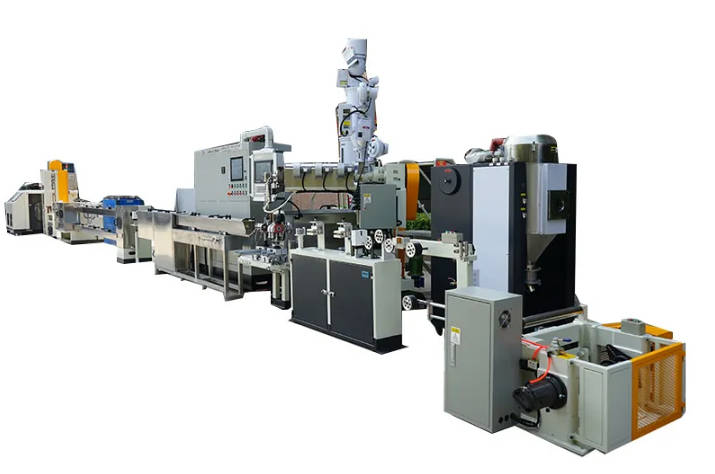
However, as the conductor diameter shrinks, the physical margin for error effectively vanishes. A specialized high-speed extrusion line for 32AWG Twinax must prioritize absolute mechanical repeatability and thermal stability, as even a 5-micron deviation in the insulation layer can lead to catastrophic impedance failure in high-frequency environments.
2. The Fragility Problem: Managing Tension Without Load Cells
One of the primary roadblocks in extruding 34AWG silver-plated copper is its extremely low tensile strength. It is remarkably easy to stretch or “neck” the conductor during the extrusion process. Stretching the conductor changes its cross-sectional area, which creates an immediate “impedance spike” that will fail signal integrity tests.
A common industry misconception is that high-precision electronic load cells are the best way to manage this. However, our R&D at QingFeng SFS suggests a different approach. For ultra-fine gauges, the latency of electronic sensors can be problematic; by the time a load cell detects a tension spike and sends a signal to the motor, the wire has often already undergone permanent deformation.
To maintain the integrity of 32AWG-34AWG Twinax conductors, the most reliable solution is a low-inertia mechanical dancer system built from ultra-lightweight alloys that reacts physically and instantaneously to tension changes.
The QingFeng SFS Mechanical Advantage:
- Physical Dampening: Our dancer arms use precision-balanced counterweights rather than complex electronic feedback loops, providing a “smooth” pull that neutralizes vibrations.
- Zero-Processing Lag: The mechanical dancer acts as a physical buffer, absorbing micro-fluctuations in line speed before they reach the fragile conductor.
- Consistent Handling: This approach ensures the conductor remains within its elastic limit throughout the entire run, from the pay-off to the final take-up.
3. The Micro-Foaming Challenge: Precision SFS Extrusion
To achieve the low Dielectric Constant (Dk) required for 112G PAM4 signaling, Physical Foaming via nitrogen injection is mandatory. We utilize a Skin-Foam-Skin (SFS) structure to balance electrical performance with mechanical toughness.
In an extrusion line dedicated to ultra-fine wire, the volume of plastic material being processed is incredibly small. This creates a thermal crisis: a tiny volume of molten plastic loses heat almost instantly upon exiting the crosshead. Maintaining a stable foaming rate on a 34AWG wire requires a level of temperature control that standard machines cannot provide.
Technical Target Comparison: Internal Interconnect R&D
| Technical Parameter | 30AWG Twinax | 32AWG/34AWG Twinax | Equipment Requirement |
| Conductor Diameter | ~0.254 mm | 0.203 mm – 0.160 mm | Low-Inertia Mechanical Pay-off |
| Foaming Rate | 50% – 60% | 65% – 75% | Precision Gas Injection Control |
| Insulation Thickness | ~0.25 mm | < 0.18 mm | Micro-Crosshead Precision |
| Concentricity | > 92% | > 95% | Manual Fine-Tuning Crosshead |
| OD Stability | ±0.010 mm | ±0.005 mm | Real-time Laser Monitoring |
| Capacitance Tolerance | ±1.5 pF/m | ±0.8 pF/m | Stable Melt-Flow Environment |
For 32AWG-34AWG production, we focus on a specialized micro-crosshead design that ensures the melt-flow remains laminar and uniform, even at the low output rates required for these extremely thin insulation layers.
4. The Brain of the Line: Motion Controllers vs. Standard PLC
While many manufacturers use standard PLCs for their extrusion lines, the synchronization required for 34AWG internal interconnects is far beyond standard logic processing. The relationship between the extruder screw speed and the capstan speed must be perfect.
QingFeng SFS extrusion lines utilize high-speed motion controllers rather than standard PLCs to achieve microsecond-level synchronization across all motor axes, which is the only way to prevent microscopic diameter variations.
Unlike a PLC, which processes logic in cycles, a motion controller treats the entire line as a single, unified physical system. If the take-up speed shifts by a fraction of a percent, the extruder screw and capstan adjust simultaneously in real-time. This level of synchronization is critical for reducing “startup scrap” and maintaining the ±0.005mm OD stability required for high-speed Twinax.
5. Addressing Skew: The R&D Journey for 800G Internal Links
Intra-pair skew (the timing difference between two wires in a pair) is the most frequent cause of 800G cable failure. While skew is often measured at the final assembly, it is almost always caused by inconsistencies during the extrusion line phase.
At QingFeng SFS, we want to be sincere with our users: As of 2026, 800G (112G PAM4) signaling for 34AWG internal cables is still in the intensive R&D and verification phase. Achieving the repeatability needed for 800G is a process of constant refinement.
How We Optimize for Skew in R&D:
- Batch Repeatability: Since we produce single cores, we focus on the absolute stability of the environment. We aim for the “A” core and the “B” core—even if produced hours apart—to have identical physical properties.
- Gradient Cooling: Our cooling troughs use a multi-stage thermal gradient. We avoid “thermal shock” by gradually lowering the water temperature, which prevents the foaming structure from contracting unevenly.
- Material Uniformity: We recommend only high-end FEP or PFA resins with ultra-stable Melt Flow Rates (MFR) to ensure the dielectric constant remains uniform over the entire length of the cable.
6. Choosing the Right Extrusion Line: The Reality of Yield
When selecting an extrusion line for MCIO or SlimSAS production, the most important metric is not the machine’s top speed, but its Total Cost of Yield. Because silver-plated copper and high-performance resins are expensive, a high scrap rate will quickly make your production unprofitable.
For internal interconnect manufacturing, success depends on an extrusion line that is easy to maintain and physically stable, as consistent manual precision is more reliable than “automated” systems that the industry has yet to perfect.
We prioritize a user-friendly crosshead design that allows your operators to manually fine-tune the concentricity to 95% or higher with minimal downtime. We believe that a sincere partnership involves providing a machine that your team can truly master.
Conclusion: Partnering for the High-Speed Future
The move to 32AWG and 34AWG for AI interconnects is one of the most difficult transitions in the wire and cable industry. It is a world where success is measured in microns and picoseconds.
At QingFeng SFS, we don’t just provide hardware; we provide a foundation for your R&D. We understand that the path to 800G and 1.6T connectivity is challenging, and we are committed to providing the extrusion line stability and technical transparency needed to help you lead in the AI era. Let’s build the future of high-density connectivity together, grounded in real-world engineering and sincere collaboration.
FAQ: High-Speed Internal Cable Manufacturing
Q1: Why is physical foaming mandatory for MCIO/SlimSAS cables?
A: At 112G PAM4 frequencies, chemical foaming is too irregular. Physical foaming with nitrogen allows for a lower Dielectric Constant (Dk) and a much more uniform cell structure, which is essential for signal integrity.
Q2: How do you prevent 34AWG conductor stretching without electronic sensors?
A: We use ultra-lightweight mechanical dancer arms. These provide instantaneous physical feedback and dampening, ensuring the tension remains within the conductor’s elastic limit without the delay of electronic signal processing.
Q3: How does a motion controller help in ultra-fine wire production?
A: It provides microsecond-level synchronization between the extruder and the puller. This prevents the microscopic “thickenings” or “thinnings” in the insulation that cause impedance fluctuations and signal reflections.
Q4: Is 800G on 34AWG Twinax ready for mass production?
A: It is currently in the R&D and verification phase. While the equipment can produce these gauges, achieving the consistency required for 800G mass-production yields is a process of technical optimization that many manufacturers are still navigating.
Q5: What is the most important factor for reducing intra-pair skew?
A: Repeatability. The extrusion line must be stable enough to produce the “A” core and “B” core with identical physical and electrical properties, specifically focusing on diameter consistency and foaming density.