
The year 2026 has brought us to a critical junction in data center evolution. As AI workloads move from experimental phases to massive-scale commercial deployment, the infrastructure supporting them has undergone a fundamental shift. We are now firmly in the era of PCIe 6.0. With its transition to PAM4 (Pulse Amplitude Modulation 4-level) signaling, PCIe 6.0 offers a staggering 64 GT/s per lane, but it brings manufacturing challenges that are far more complex than the PCIe 5.0 era.
For cable manufacturers, the pressure is concentrated on internal interconnects like MCIO (Mini Cool Edge IO) and SlimSAS. These cables must be thinner, more flexible, and electrically perfect. At QingFeng SFS, we’ve spent years in the lab refining the extrusion line technology required for these next-generation cables. This article is a sincere technical sharing of what it takes to manufacture PCIe 6.0-ready Twinax, focusing on the precision required at the very start of the process.
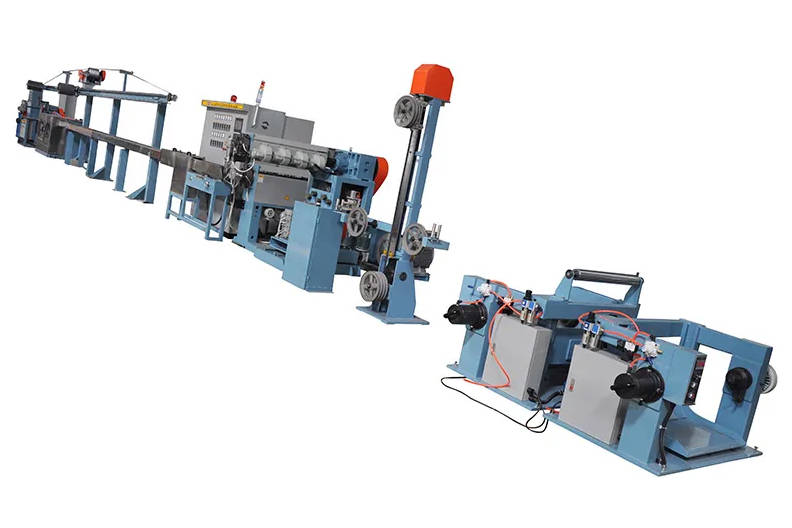
1. Why PCIe 6.0 is a “Reinvention” of the Extrusion Process
Moving to PCIe 6.0 is not just a standard upgrade; for the extrusion line, it is a total reinvention. PAM4 signaling is significantly more sensitive to “noise” and signal reflections than the older NRZ (Non-Return to Zero) method. Any microscopic physical variation in the cable becomes an electrical disaster at 64 GT/s.
To successfully manufacture PCIe 6.0 Twinax cables, an extrusion line must maintain a concentricity of over 95% and an Outer Diameter (OD) stability of ±0.005mm to prevent the signal reflections that disrupt PAM4 integrity.
If your extrusion process cannot hit these numbers consistently, your yield for MCIO and SlimSAS cables will remain prohibitively low, regardless of how good your downstream taping or cabling machines are.
2. Handling Fragile 32AWG-34AWG Conductors: The Tension Dilemma
PCIe 6.0 internal links almost exclusively use ultra-fine 32AWG and 34AWG silver-plated copper. These conductors are incredibly fragile. A common mistake in the industry is relying on electronic load cells to manage tension. However, in our R&D at QingFeng SFS, we have found that electronic sensors often suffer from processing “lag.”
For ultra-fine 34AWG Twinax extrusion, a low-inertia mechanical dancer system is superior to electronic load cells because it provides instantaneous physical dampening that prevents conductor “necking” or stretching.
By using ultra-lightweight alloys and precision-balanced counterweights, our dancers react to line speed changes at the speed of physics—not the speed of a signal processor. This ensures the conductor remains within its elastic limit, preserving its cross-sectional area and, consequently, its impedance stability.
3. Mastering Physical Foaming on a Micro-Scale
To achieve the low Dielectric Constant (Dk) required for PCIe 6.0, Physical Foaming (Nitrogen Injection) is non-negotiable. Most internal interconnects use a Skin-Foam-Skin (SFS) structure. The challenge is that with 34AWG wire, the volume of plastic is so small that it loses heat the moment it leaves the crosshead.
Technical Performance Comparison: High-Speed Internal Interconnects
| Requirement | PCIe 5.0 (30-32AWG) | PCIe 6.0 (32-34AWG) | QingFeng SFS Solution |
| Foaming Rate | 50% – 65% | 65% – 75% | Precision Nitrogen Gas Control |
| OD Stability | ±0.010 mm | ±0.005 mm | High-Speed Motion Control |
| Concentricity | > 92% | > 95% | Manual Micro-Adjust Crosshead |
| Capacitance Tolerance | ±1.5 pF/m | ±0.8 pF/m | Stable Melt-Flow Thermal Control |
| Conductor Handling | Standard Tension | Ultra-Low Tension | Low-Inertia Mechanical Dancer |
Achieving a stable 70% foaming rate on a 34AWG conductor requires an extrusion line with an ultra-stable melt-flow environment and high-pressure nitrogen injection that can be finely tuned to the micro-gram.
4. The Shift to Motion Controllers: Why Standard PLCs Fail
In the era of PCIe 6.0, the “brain” of your extrusion line matters more than ever. Many older machines use standard PLCs to sync the extruder screw and the capstan. While fine for power cables, PLCs operate on scan cycles that are too slow for ultra-fine high-speed data cables.
QingFeng SFS utilizes dedicated motion controllers instead of standard PLCs to achieve microsecond-level synchronization, ensuring the ratio between screw output and line speed remains perfectly constant during the entire production run.
This level of synchronization eliminates the “micro-pulsing” of the insulation layer. Even a microscopic pulse in the insulation thickness creates a periodic defect that can cause a “spike” in Return Loss at specific frequencies—a death sentence for a PCIe 6.0 cable.
5. The Truth About Concentricity and Skew
A common doubt among users is whether they need “Auto-Correction” crossheads. We want to be sincere with you: for 34AWG Twinax, automated correction is largely a myth. The wires are too thin and move too fast for current sensors to adjust the die in real-time without causing more problems than they solve.
For PCIe 6.0 manufacturing, a high-precision, manually adjustable micro-crosshead is the most reliable tool for achieving 95% concentricity, as it allows for a stable, locked-in setup that does not drift during high-speed runs.
Furthermore, intra-pair skew (the timing difference between two wires) is born at the extruder. Since we produce single cores, we focus on Batch Repeatability. By making “Wire A” and “Wire B” under identical thermal and pressure conditions, we ensure they are a perfect match when they reach the cabling stage.
6. Navigating the R&D Frontier: A Shared Journey
At QingFeng SFS, we believe in technical transparency. It is important to acknowledge that mass-producing 34AWG Twinax for PCIe 6.0/800G applications is currently in the intensive R&D and verification phase across the global industry. We don’t just sell you a machine and walk away. We invite our users to treat us as a technical partner. We work together to test different FEP/PFA resins, optimize cooling trough gradients to prevent “thermal shock” to the foam, and refine the tension settings for each specific gauge. Scaling to 64 GT/s is a shared journey of engineering.
7. Operational Excellence: The Total Cost of Yield
When choosing a high-speed extrusion line, don’t just look at the price tag. Look at the Yield. Silver-plated copper and high-performance resins (like FEP) are extremely expensive. If your line produces 20% scrap during startup or due to tension spikes, it will never be profitable.
The most cost-effective extrusion line for PCIe 6.0 is one that emphasizes mechanical stability and ease of operation, allowing your team to reach “steady-state” production with minimal material waste.
FAQ: Key Takeaways for Technical Teams
Q1: Why are mechanical dancers better than load cells for PCIe 6.0 cables? A: Load cells have a processing delay. For ultra-fine 34AWG wire, even a millisecond of delay can result in the conductor stretching (necking) before the motor can adjust. Mechanical dancers react instantly.
Q2: What is the benefit of a Motion Controller over a standard PLC? A: Motion controllers provide much faster synchronization (microsecond level) between the screw and capstan. This prevents the microscopic diameter variations that cause signal reflections in PAM4 signaling.
Q3: Can I achieve 800G/PCIe 6.0 standards with chemical foaming? A: No. Chemical foaming is too irregular. Physical Nitrogen foaming is the only way to achieve the high foaming rates and uniform cell structure required for 112G/lane (PCIe 6.0) electrical performance.
Q4: Is “Auto-Correction” necessary for 34AWG extrusion? A: In our experience, no. A high-precision manual crosshead is more stable. “Auto-correction” for such thin wires often introduces instability. Manual precision, once locked in, provides the best consistency.
Q5: What is the current status of 34AWG for PCIe 6.0? A: It is in the R&D and verification phase. While the equipment is capable, achieving high mass-production yields requires careful optimization of materials and process parameters.
Q6: How does QingFeng SFS help with Intra-pair Skew? A: By focusing on the absolute repeatability of our single-core extrusion. We ensure that every meter of core produced is identical in diameter and foaming density, making them easy to match into pairs.
Q7: How do you prevent the foam structure from collapsing in thin-wall insulation? A: Through precise thermal gradient management in our cooling troughs. We cool the wire gradually to prevent “thermal shock,” which keeps the micro-cells of the foam intact.