A cable extrusion line is used to apply insulation, sheathing, coating, or jacketing materials around conductors, wire cores, or cable structures during wire and cable manufacturing. For cable manufacturers, choosing the right extrusion line affects product quality, production efficiency, material compatibility, diameter control, concentricity, energy use, and long-term operating cost.
A suitable cable extrusion line should not be selected only by extruder size or machine price. Buyers need to evaluate the complete production requirement, including cable type, insulation material, conductor size, production speed, dimensional tolerance, cooling method, online inspection, control system, factory layout, and supplier technical support.
For wire and cable manufacturers planning new production capacity or upgrading existing equipment, QingFeng SFS provides cable extrusion line solutions for different cable manufacturing applications. This buying guide explains what to check before purchasing a cable extrusion line and how to compare machine configurations more effectively.
What Is a Cable Extrusion Line?
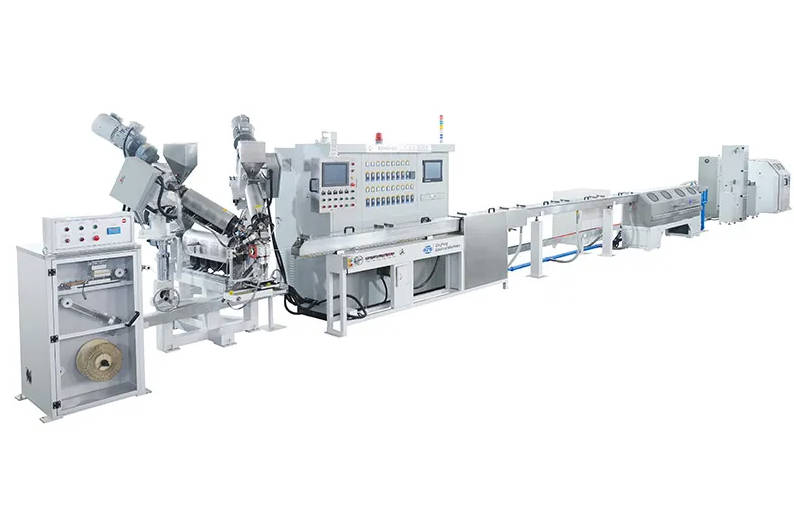
A cable extrusion line is a complete production system that melts polymer material and applies it around a conductor, wire core, or cable core. Depending on the product, the extrusion process may be used for primary insulation, outer sheathing, jacketing, coating, foaming insulation, or multi-layer co-extrusion.
A typical cable extrusion line may include:
| Main Section | Function |
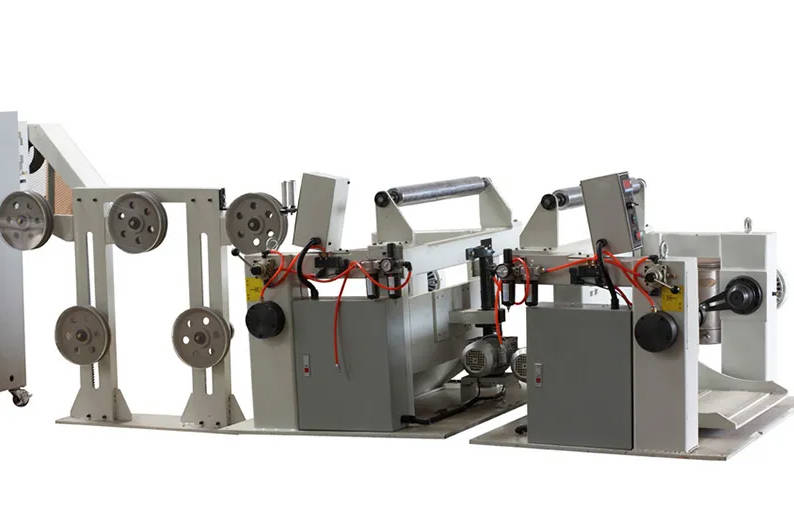
| Pay-off system | Feeds conductor, wire, or cable core into the extrusion line |
| Preheating unit | Prepares conductor surface temperature before extrusion |
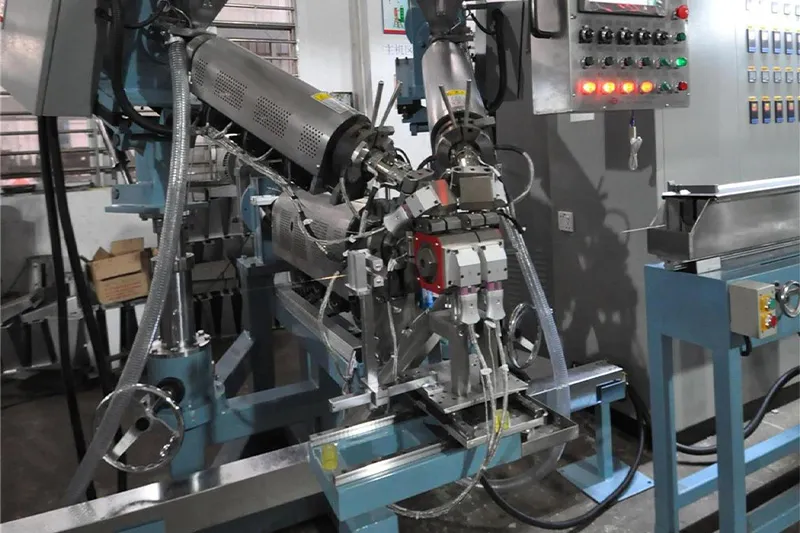
| Extruder | Melts and pushes polymer material forward |
| Crosshead and tooling | Applies material around the conductor or cable core |
| Cooling trough | Cools and stabilizes the extruded layer |
| Diameter measuring system | Monitors outer diameter during production |
| Spark tester | Checks insulation defects in many production setups |
| Capstan or traction unit | Controls line speed and pulling stability |
| Take-up system | Winds finished wire or cable onto a spool |
| Control system | Manages temperature, speed, alarms, and production parameters |
The performance of a cable extrusion line depends on the coordination of the full line, not only the extruder itself.
If the pay-off tension is unstable, the tooling is not aligned, the cooling is inconsistent, or the take-up tension is too high, the final cable may still show defects even when the extruder is technically powerful.
Common Applications of Cable Extrusion Lines
Cable extrusion lines are used across many wire and cable products. Before purchasing equipment, buyers should clearly define the application because different cable types require different line configurations.
| Application | Common Extrusion Purpose | Key Equipment Focus |
| Power cable | Insulation and outer sheathing | Material output, cooling, wall thickness control |
| Communication cable | Insulation, jacket, or foamed dielectric layer | Diameter control, concentricity, process stability |
| Automotive cable | Insulation and protective jacket | Flexibility, heat resistance, production consistency |
| EV high-voltage cable | Insulation, shielding-related layers, jacketing | Safety, material compatibility, stable quality |
| Medical cable | Flexible insulation or jacket extrusion | Clean production, material stability, fine cable handling |
| LAN and data cable | Insulation and outer jacket | Diameter control, speed, surface quality |
| High-temperature wire | Fluoropolymer or special material extrusion | Temperature control, screw design, tooling stability |
| Solar PV cable | Insulation and jacket extrusion | Weather resistance, crosslinking compatibility, stable production |
For this reason, a “standard” cable extrusion machine may not fit every product. A factory producing medical cable may care more about fine cable handling and clean production, while a power cable manufacturer may focus more on output, jacket thickness, cooling capacity, and long production runs.
Key Factors to Consider Before Buying a Cable Extrusion Line
1. Cable Type and Product Structure
The first buying question should be: what cable will the line produce?
A cable extrusion line for primary insulation is different from a jacket extrusion line. A line for fine medical wire is different from a line for power cable sheathing. A line for fluoropolymer material is different from a line for PVC or PE.
Buyers should prepare basic product information:
| Information | Why It Matters |
| Cable type | Determines extrusion purpose and machine configuration |
| Conductor size | Affects pay-off, preheating, tooling, and line speed |
| Insulation or jacket thickness | Affects extruder output and cooling requirement |
| Finished outer diameter | Determines tooling and measuring system |
| Production speed target | Affects extruder capacity and line layout |
| Tolerance requirement | Determines control and inspection configuration |
| Downstream process | Helps plan take-up, cooling, and integration |
Without this information, it is difficult for a supplier to recommend the correct cable extrusion line.
2. Material Compatibility
Material selection has a major impact on extruder design, screw configuration, temperature control, tooling, cooling, and final product quality.
Common materials used in cable extrusion may include:
| Material | Common Use | Buying Consideration |
| PVC | Jacket and insulation in many general cables | Good processability, cost-sensitive applications |
| PE | Communication cable insulation and jackets | Diameter stability and surface quality matter |
| XLPE compound | Crosslinkable cable insulation | Process and crosslinking compatibility should be considered |
| TPE / TPU | Flexible cables and special applications | Requires suitable temperature and tension control |
| Nylon | Protective coating or special cable structures | Material drying and process stability matter |
| FEP / PFA / ETFE | High-temperature and high-performance cables | Requires higher temperature control and suitable tooling |
| LSZH compound | Low-smoke halogen-free cable jacket | Processing window and surface quality should be checked |
| Foaming materials | Data, communication, or high-frequency cable insulation | Requires foaming stability and diameter control |
A cable extrusion line should be selected according to the actual material system, not only the cable diameter.
If a factory plans to process multiple materials, it should discuss whether the extruder, screw, barrel, crosshead, heating system, and cooling design can support the required material range.
3. Extruder Size and Output Capacity
Extruder size is important, but it should not be selected blindly. A larger extruder does not automatically mean better production. If the extruder is too large for a fine wire application, process stability may become difficult. If it is too small for thick jacket extrusion, output may not meet production demand.
Buyers should evaluate:
| Factor | Why It Matters |
| Screw diameter | Affects output range and material processing capacity |
| L/D ratio | Influences plasticization and melting stability |
| Motor power | Supports extrusion torque and output |
| Material type | Different materials require different processing conditions |
| Required line speed | Determines whether output is sufficient |
| Layer thickness | Affects material consumption and cooling requirement |
| Product range | Determines whether one line can cover multiple cable types |
The supplier should help calculate a reasonable configuration based on material, cable size, and production speed target.
Cable Diameter Control and Concentricity
Diameter control is one of the most important quality factors in cable extrusion. If the outer diameter fluctuates, the cable may fail dimensional inspection or show unstable performance in downstream processes. For insulation extrusion, concentricity is also critical because the conductor should remain centered inside the insulation layer.
Good diameter control depends on stable extruder output, accurate tooling, consistent line speed, controlled cooling, and reliable traction.
Common diameter and concentricity issues include:
| Problem | Possible Cause | What to Check |
| Outer diameter fluctuation | Unstable output or line speed | Extruder speed, traction, pressure stability |
| Eccentric insulation | Poor tooling alignment | Crosshead, tip, die, conductor guide |
| Oval cable shape | Uneven cooling or take-up tension | Cooling trough, cable path, take-up |
| Rough surface | Poor plasticization or contamination | Material, screw, temperature settings |
| Shrinkage | Cooling or material behavior | Cooling temperature and line speed |
| Wall thickness variation | Conductor not centered | Tooling alignment and conductor tension |
For buyers producing precision cables, online diameter monitoring and stable process control should be considered. In many cable factories, dimensional quality is not only a final inspection issue; it should be controlled during production.
Single-Layer, Multi-Layer and Foaming Extrusion Lines
Cable extrusion lines can be configured for different layer structures. Buyers should understand these options before selecting equipment.
| Extrusion Type | Typical Application | Main Advantage | Key Requirement |
| Single-layer extrusion | Standard insulation or jacket | Simple structure and easier operation | Stable output and tooling alignment |
| Dual-layer extrusion | Combined insulation or jacket structures | Supports functional layer design | Co-extrusion coordination |
| Three-layer extrusion | Advanced cable structures | Better material combination possibilities | More precise control and setup |
| Foaming extrusion | Communication and data cable insulation | Lower effective dielectric structure in many designs | Foam stability and diameter control |
| Fluoropolymer extrusion | High-temperature wire and special cable | Supports demanding applications | Temperature control and special tooling |
For factories with a narrow product range, a simpler line may be more practical. For manufacturers producing high-value or diversified cable products, multi-layer or specialized extrusion capability may be worth considering.
Control System and Automation
The control system affects production stability, operator efficiency, and repeatability. A modern wire extrusion line may include PLC control, HMI touchscreen operation, speed synchronization, temperature monitoring, alarms, recipe storage, and online inspection integration.
Important control functions may include:
| Control Function | Practical Benefit |
| Zone temperature control | Maintains material processing stability |
| Speed synchronization | Coordinates extruder, capstan, and take-up |
| Recipe storage | Reduces setup variation between operators |
| Alarm system | Helps detect process abnormalities early |
| Online diameter feedback | Supports real-time quality monitoring |
| Production length counting | Helps manage orders and material usage |
| Data recording | Supports traceability and process improvement |
For repeat production, a stable control system can be as important as mechanical structure.
If operators must manually adjust many parameters without records, batch-to-batch consistency may depend too much on individual experience.
Cooling, Traction and Take-Up Design
Many buyers focus on the extruder and ignore cooling, traction, and take-up. This is a mistake. These sections directly affect final cable dimensions, surface finish, and winding quality.
Cooling System
The cooling system sets the extruded material and stabilizes the cable shape. Poor cooling may cause shrinkage, ovality, surface defects, or internal stress. For some materials, cooling conditions must be controlled carefully to avoid dimensional instability.
Traction Unit
The traction unit controls line speed and pulling force. If traction speed fluctuates, insulation thickness may change. If pulling force is excessive, the cable may stretch or deform.
Take-Up System
The take-up system winds finished cable onto a spool. Poor take-up tension can damage the cable after extrusion. For fine wire or soft jacket materials, gentle and stable take-up is especially important.
What Affects Cable Extrusion Line Price?
Cable extrusion line price depends on configuration, material requirements, automation level, and customization needs. Buyers should compare quotations carefully because two lines with the same general name may have very different specifications.
| Price Factor | How It Affects Cost |
| Extruder size and output | Larger capacity usually increases cost |
| Material compatibility | High-temperature or special materials require stronger configuration |
| Single-layer or multi-layer design | Co-extrusion increases complexity |
| Foaming capability | Requires additional process control |
| Online inspection | Diameter measurement and spark testing add cost |
| Control system | Automation and recipe functions affect price |
| Pay-off and take-up type | Different spool sizes and tension systems affect configuration |
| Cooling length and layout | Longer or specialized cooling increases line design cost |
| Custom tooling | Product-specific tooling affects total project cost |
| Installation and support | Commissioning, training, and service may affect total value |
Buyers should not only compare the initial price. A cheaper machine may become more expensive if it causes unstable quality, high scrap, downtime, or limited product capability.
Buying Checklist for Wire and Cable Manufacturers
Before requesting a quotation, prepare a clear technical requirement sheet. This makes supplier communication faster and more accurate.
| Requirement | Information to Prepare |
| Product type | Insulation wire, jacketed cable, power cable, data cable, medical cable, etc. |
| Material | PVC, PE, XLPE, TPE, TPU, Nylon, FEP, PFA, ETFE, LSZH, etc. |
| Conductor size | Minimum and maximum conductor diameter |
| Finished cable size | Target outer diameter and tolerance |
| Layer structure | Single layer, dual layer, three layer, foamed, or jacketed |
| Line speed | Required stable production speed |
| Quality control | Diameter measurement, spark testing, concentricity inspection |
| Spool size | Pay-off and take-up requirements |
| Factory layout | Available space and line direction |
| Power supply | Local voltage, frequency, and utility conditions |
| Support needs | Installation, operator training, spare parts, after-sales service |
A professional supplier should ask these questions before recommending a cable extrusion machine.
Common Mistakes When Buying a Cable Extrusion Line
Mistake 1: Choosing Only by Machine Price
Price matters, but the lowest quotation may not provide the right configuration. For industrial cable production, long-term stability, material compatibility, and service support should be considered.
Mistake 2: Overlooking Material Requirements
A machine that works for PVC may not be suitable for fluoropolymer extrusion. A line for jacket extrusion may not be precise enough for fine insulation extrusion.
Mistake 3: Ignoring Diameter and Concentricity Control
Cable quality depends on dimensional stability. If the line cannot control diameter and concentricity, the factory may face high scrap or customer complaints.
Mistake 4: Buying a Line Without Considering Future Products
If the factory plans to expand into new cable types, the extrusion line should leave reasonable room for material, diameter, or speed upgrades.
Mistake 5: Underestimating Installation and Training
Even a good machine requires correct installation, commissioning, and operator training. Without process support, production startup may take longer than expected.
How to Choose a Reliable Cable Extrusion Line Supplier
A good supplier should understand wire and cable production, not just machine assembly. When evaluating suppliers, buyers should check technical communication, customization capability, manufacturing quality, service support, and experience with similar cable applications.
Important questions include:
| Supplier Question | Why It Matters |
| Have you supplied similar extrusion lines before? | Confirms application experience |
| Can the line process our material? | Verifies material compatibility |
| What diameter tolerance can the line support in practice? | Checks quality capability |
| Can the line be customized for our layout? | Supports factory planning |
| What online inspection options are available? | Improves process control |
| What installation and training support do you provide? | Reduces startup risk |
| How are spare parts supplied? | Supports long-term operation |
| Can you help with tooling and process setup? | Improves production readiness |
QingFeng SFS offers wire and cable extrusion line solutions for manufacturers producing different cable products. Buyers can also visit the QingFeng SFS official website to learn more about company capabilities and cable manufacturing equipment categories.
FAQ
What is a cable extrusion line used for?
A cable extrusion line is used to apply insulation, sheathing, coating, or jacketing material around conductors, wires, or cable cores. It is widely used in power cable, communication cable, automotive cable, data cable, medical cable, and industrial cable production.
How do I choose a cable extrusion line?
To choose a cable extrusion line, confirm your cable type, material, conductor size, finished diameter, layer structure, speed target, tolerance requirement, online inspection needs, factory layout, and supplier support capability.
What materials can a cable extrusion machine process?
A cable extrusion machine may process PVC, PE, XLPE compounds, TPE, TPU, Nylon, FEP, PFA, ETFE, LSZH, and other cable materials depending on the extruder design, screw configuration, temperature range, and tooling.
What affects cable extrusion line price?
Cable extrusion line price is affected by extruder size, material compatibility, output capacity, single-layer or multi-layer configuration, foaming capability, online inspection, automation level, pay-off and take-up design, and customization needs.
What is the difference between a wire extrusion line and a cable extrusion line?
A wire extrusion line often applies insulation to single conductors or smaller wire products, while a cable extrusion line may apply jackets or sheaths to larger cable cores. The exact difference depends on product structure and production purpose.
Why is diameter control important in cable extrusion?
Diameter control is important because outer diameter, wall thickness, and concentricity affect cable quality, material usage, downstream processing, and customer inspection. Poor diameter control may lead to scrap or unstable product performance.
Can one extrusion line produce different cable types?
In some cases, one extrusion line can produce different cable types if the material range, tooling, extruder output, cooling, and take-up configuration are suitable. Buyers should confirm the required product range before purchasing.
Conclusion
Choosing a cable extrusion line is a technical and commercial decision for wire and cable manufacturers. Buyers should not only compare machine price or extruder size. They should evaluate cable type, material compatibility, production speed, diameter control, concentricity, automation, factory layout, quality inspection, and supplier support.
A suitable cable extrusion line helps manufacturers improve production consistency, reduce defects, support more cable applications, and build long-term manufacturing capability. Before purchasing, prepare a clear technical requirement sheet and discuss the full production process with the supplier.
QingFeng SFS provides cable extrusion line solutions for wire and cable manufacturers looking for reliable equipment for insulation, sheathing, jacketing, foaming, and special cable production applications.