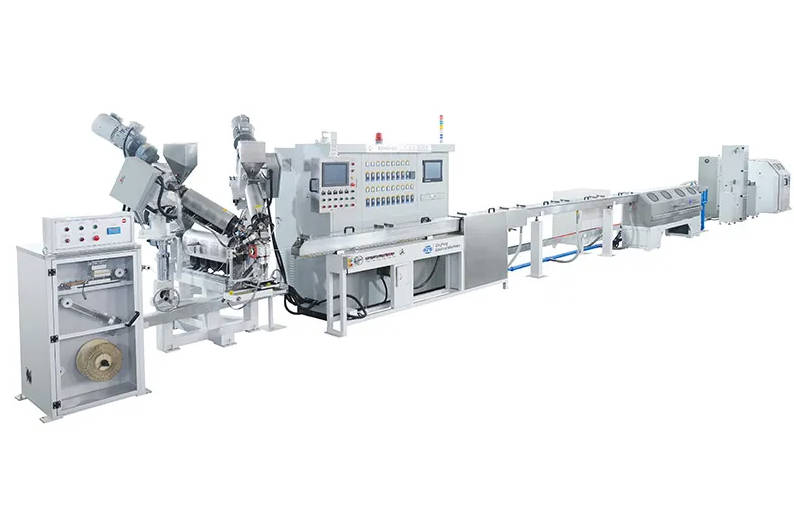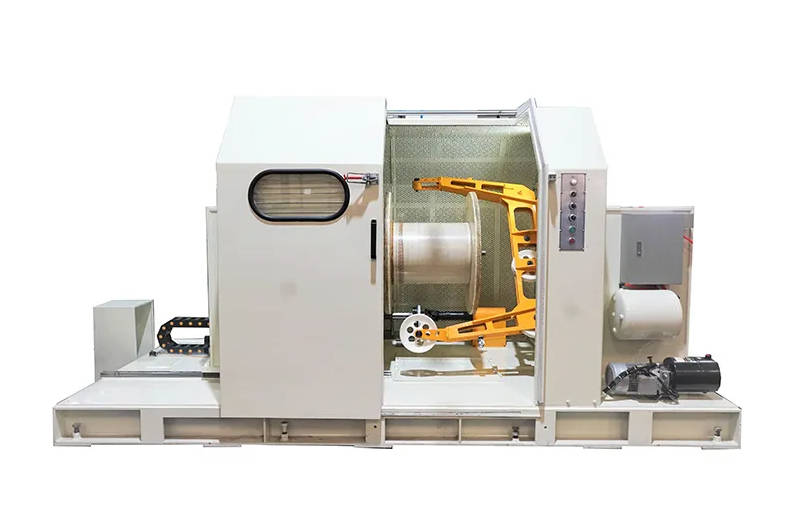
I. Introduction
The relentless surge in data center traffic, driven by Artificial Intelligence (AI), Machine Learning (ML), and 5G expansion, has pushed networking speeds to unprecedented levels. As we transition from 56G PAM4 to 112G and now the emerging 224G per-lane architectures, the physical layer—specifically the high-speed copper cabling—faces extreme technical scrutiny. In the world of high-frequency signal transmission, the “Twinax” cable is the backbone of Direct Attach Cables (DAC) and Active Copper Cables (ACC).
For manufacturers, the difference between a high-performing cable and a failed batch often lies in the precision of the taping process. Taping is the critical stage where shielding and insulation layers (such as PTFE or Mylar) are wrapped around the conductor core. While horizontal machines have been the industry workhorse for decades, Vertical High-speed Taping Machines have emerged as the gold standard for 112G/224G cable manufacturing due to their ability to maintain mechanical concentricity and tension stability without the interference of gravitational sagging.
This article provides a comprehensive technical comparison to help B2B buyers and production engineers understand why vertical configuration is becoming a non-negotiable requirement for next-generation high-speed data cables.
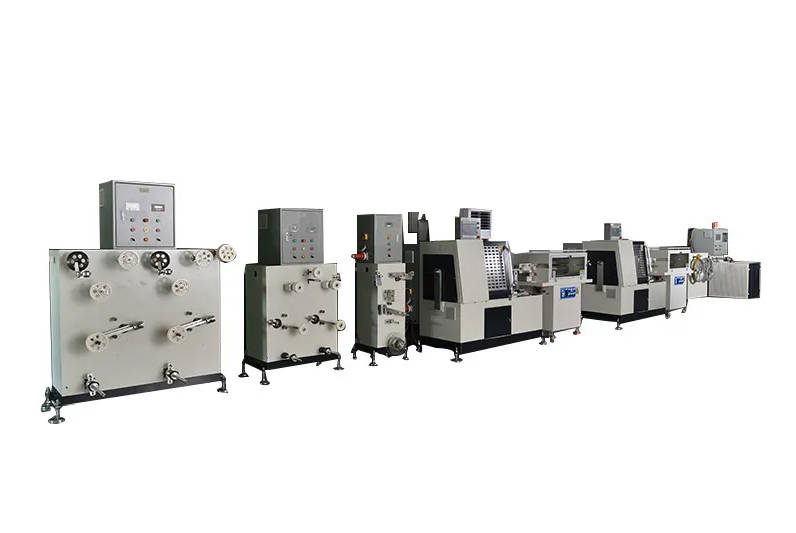
II. Understanding the Fundamentals: Horizontal vs. Vertical Designs
The primary difference between these two systems lies in the orientation of the cable path and the taping head’s rotation axis.
Horizontal Taping Machines
In a horizontal setup, the cable travels parallel to the ground. This configuration is widely used for traditional power cables, low-frequency data cables, and thicker industrial wires. Because the cable rests on its own weight across the span of the machine, it is subject to gravitational pull.
Vertical High-speed Taping Machines
In a vertical machine, the cable moves vertically (usually from bottom to top). The taping heads rotate around this vertical axis. This design is specifically engineered to eliminate the “catenary effect” (the natural curve a cable makes when suspended horizontally), which is the enemy of high-frequency signal integrity.
Technical Comparison Table
| Feature | Horizontal Taping Machine | Vertical High-speed Taping Machine |
| Primary Application | General purpose, low-to-mid frequency | 112G/224G Twinax, high-frequency DAC |
| Gravity Impact | High (leads to core sagging) | Zero to Minimal (Gravity-neutral) |
| Tension Precision | $\pm 5-10\%$ | $\pm 1-2\%$ (Closed-loop) |
| Max Rotation Speed | 1000 – 2000 RPM | 2500 – 6000+ RPM |
| Floor Space | Large linear footprint | Compact vertical footprint |
| Signal Integrity | Suitable for < 28G | Essential for 112G/224G |
III. Why Vertical Taping is Superior for 112G/224G Cables
When dealing with 112G or 224G signals, the margin for error in cable geometry is measured in microns. Any slight deviation in the wrapping can lead to catastrophic failures in Signal Integrity (SI).
1. Minimal Core Distortion and “Sag” Elimination
Vertical high-speed taping machines are superior for 112G/224G manufacturing because they eliminate gravitational deflection of the cable core, ensuring that the taping material is applied with 360-degree uniformity. In horizontal machines, the weight of the wire causes it to sag slightly between supports. When the taping head rotates, it applies more pressure on the “top” of the sag and less on the “bottom,” resulting in an oval-shaped cross-section rather than a perfect circle. For 224G cables, this slight eccentricity causes impedance mismatches.
2. High-Precision Tension Control for Ultra-Thin Materials
Modern 224G cables often use extremely thin PTFE (Polytetrafluoroethylene) or specialized aluminized Mylar tapes. These materials are fragile. Vertical taping machines utilize advanced servo-driven active payoff systems that maintain constant tension even at speeds exceeding 4000 RPM, preventing tape elongation or breakage. Horizontal machines often rely on mechanical friction brakes, which are too inconsistent for the delicate requirements of 112G+ production.
3. Superior Concentricity and Overlap Consistency
Signal reflection is a major issue in high-speed cables. If the “pitch” (the distance between each wrap) or the “overlap” percentage varies, it creates periodic defects. The vertical orientation allows for a more stable “taping point.” Because the cable is not vibrating or bouncing due to horizontal tension, the taping head can apply the film with a precision overlap of $\pm 0.1mm$.
IV. Technical Features Every Vertical Taping Buyer Should Look For
If you are sourcing a machine for 112G or 224G production, a standard vertical taper isn’t enough. You need specific high-end features to ensure the cable meets IEEE and OIF standards.
A. Closed-Loop Servo Control
The taping head and the linear capstan must be perfectly synchronized. Look for machines where the taping head speed and the cable take-up speed are governed by a unified PLC (Programmable Logic Controller). This ensures that even during acceleration and deceleration, the wrapping pitch remains identical.
B. Active Tension Sensing
The best vertical taping machines for 112G/224G use non-contact laser or ultrasonic sensors to monitor the diameter of the tape roll and adjust the torque of the payoff motor in real-time. This maintains a “zero-fluctuation” tension environment, which is critical for preventing the “crushing” of the foam dielectric.
C. Advanced “De-Twisting” Mechanisms
When manufacturing Twinax cables (two insulated conductors wrapped together), any internal torsion (twist) will degrade the signal. High-quality vertical machines include a de-twisting payoff to ensure the conductors remain perfectly parallel before the shielding tape is applied.
V. Solving Common User “Pain Points” in High-Frequency Production
Manufacturers upgrading to 112G/224G often encounter three specific technical hurdles. Here is how the vertical machine addresses them:
Problem 1: Impedance Fluctuation
- The Cause: Variations in the pressure applied by the tape onto the dielectric layer.
- The Vertical Solution: Because the vertical path is stable, the “radial force” of the tape is consistent. This keeps the differential impedance within the strict $\pm 2 \Omega$ tolerance required for 112G/224G standards.
Problem 2: Return Loss Peaks (Structural Return Loss)
- The Cause: Periodic unevenness in the taping pitch creates a “grating effect” that reflects signals at specific frequencies.
- The Vertical Solution: The vibration-dampened vertical tower ensures that the taping pitch is perfectly linear. By eliminating periodic mechanical errors, vertical taping machines push the Return Loss (RL) peaks well outside the operating frequency of the cable.
Problem 3: Material Yield and Scrap Rates
- The Cause: Breaking of thin 0.02mm Mylar tapes during high-speed starts.
- The Vertical Solution: Soft-start algorithms and low-inertia taping heads allow the machine to reach 5000 RPM smoothly, significantly reducing scrap costs when using expensive silver-plated conductors and specialized films.
VI. Productivity vs. Precision: The Investment Decision
When to stay with Horizontal:
- Producing Category 5e or Category 6 Ethernet cables.
- Standard industrial wiring where Signal Integrity is not the primary KPI.
- Budget-sensitive projects where 10G – 25G speeds are the target.
When to upgrade to Vertical:
- Manufacturing DAC or ACC for AI data centers.
- Developing internal server cables (SlimSAS, MCIO) for PCIe Gen 6 or Gen 7.
- Any application requiring 112G PAM4 or 224G PAM4 transmission.
The Return on Investment (ROI) for a vertical high-speed taping machine is realized through “First Pass Yield.” While the initial capital expenditure is higher than horizontal machines, the reduction in failed batches (which are extremely expensive due to the cost of silver-plated copper) typically pays for the machine within the first 12–18 months of high-volume production.
VII. Conclusion
In the 112G/224G era, the physical cable is no longer just a “wire”; it is a complex microwave waveguide. The mechanical precision required to maintain signal integrity at 100GHz+ frequencies leaves no room for the limitations of horizontal taping.
Vertical High-speed Taping Machines provide the gravity-neutral environment, ultra-precise tension control, and high-RPM stability necessary to produce the next generation of Twinax cables. For manufacturers looking to compete in the AI-driven data center market, transitioning to vertical taping technology is the most critical step in ensuring product compliance and manufacturing excellence.