I. Introduction: The High-Frequency Barrier in the AI Era
The rapid expansion of artificial intelligence (AI) clusters and high-performance computing (HPC) has pushed the networking industry into the era of 1.6T connectivity. To achieve these staggering speeds, data centers are migrating toward 224Gbps and 448Gbps per lane signaling using PAM4 modulation. For cable manufacturers, this transition represents a fundamental shift in the difficulty of production.
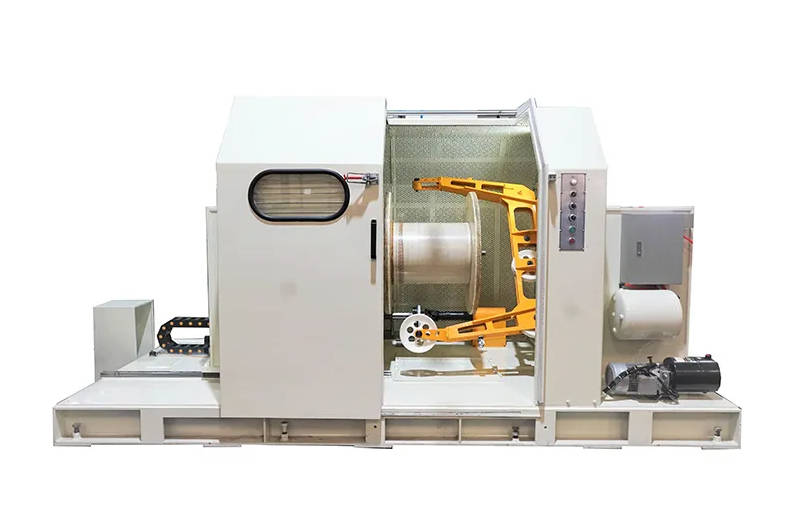
In the 448G landscape, the most common reason for cable assembly failure is not the conductor or the connector—it is Intra-pair Skew. While extrusion provides the foundation, the final shielding process is where many manufacturers lose their competitive edge. Eliminating intra-pair skew in 448G high-speed cables requires a high-speed taping machine that offers sub-picosecond precision through active tension control and synchronized mechanical movement.
This article explores how a precision high-speed taping machine acts as the “secret weapon” for manufacturers aiming to supply the world’s leading AI server providers.
II. The Mechanics of Skew: How Taping Affects Signal Timing
In a Twinax cable (the heart of an Active Copper Cable, or ACC), signals travel in differential pairs. For the data to be decoded correctly at 448Gbps, the signals on both wires must arrive at the receiver at exactly the same time.
1. Physical Length Mismatch (ΔL)
If a taping machine applies inconsistent tension during the shielding process, one core wire may be stretched more than its partner. Even a difference of 0.5mm in a 1-meter cable can be catastrophic.
The primary cause of intra-pair skew in 448G Twinax production is uneven taping tension, where as little as 1mm of physical stretch difference can result in approximately 5 picoseconds of skew, effectively closing the PAM4 signal eye.
2. Dielectric Compression and Impedance
High-speed cables rely on highly-foamed Teflon (PTFE) insulation. This foam is mostly air and is physically delicate. If the taping machine wraps the shielding foil too tightly, it crushes the air cells. This increases the local Dielectric Constant (εr) and drops the impedance. If one wire is crushed more than the other, the velocity of propagation (VoP) changes between the two wires, creating electrical skew even if the physical lengths are identical.
III. Engineering the Solution: Features of a High-Speed Precision Taping Machine
To manufacture cables that pass 448G certification, a standard taping machine is insufficient. Manufacturers require an advanced high-speed taping system engineered for stability and sub-micron accuracy.
1. Active Servo Tension Control vs. Passive Braking
Legacy machines use friction brakes or magnetic clutches, which are “reactive” and inconsistent.
High-precision taping machines for 448G production utilize active servo-controlled tension systems with closed-loop feedback, maintaining wrapping force with an accuracy of ±1g regardless of the spool diameter or production speed. This prevents the core wires from experiencing the “tugging” effect that leads to stretching.
2. Centrifugal Force Compensation
At speeds of 3,000 to 4,000 RPM, the mass of the shielding tape spool generates significant centrifugal force. Without compensation, this force would naturally pull the tape tighter as the machine spins faster. QingFeng machines integrate dynamic balancing and centrifugal sensors to auto-adjust the servo torque, ensuring the tape tension at 4,000 RPM is identical to the tension at 100 RPM.
3. Synchronized Overlap Precision
The overlap of the shielding foil (typically 25% or 50%) must be perfectly consistent. Any variation creates a “periodic structure” that causes the cable to act like a filter, reflecting signals at specific high-frequency points.
A precision high-speed taping machine achieves 0.1% overlap consistency by digitally synchronizing the taping head’s rotation with the haul-off caterpillar via a high-speed fieldbus (like EtherCAT).
Technical Comparison: Legacy vs. QingFeng High-Speed Taping Machines
| Feature | Legacy Taping Machine | QingFeng 448G Precision Taping Line |
| Max Rotation Speed | 1,500 – 2,000 RPM | 3,500 – 4,500 RPM |
| Tension Control Method | Manual/Friction Brake | Active Servo Closed-Loop |
| Tension Accuracy | ±15g | ±1g – 2g |
| Intra-pair Skew Result | > 8 ps/m | < 2 ps/m (Sub-Picosecond) |
| Overlap Consistency | ±5% | ±0.1% |
| Scrap Rate (Start-up) | High (Manual Tuning) | Low (Auto-Sync Algorithms) |
IV. Technical Deep Dive: Solving Return Loss (SRL) via Taping
While skew is the primary concern, Structural Return Loss (SRL) is the secondary hurdle. SRL occurs when there are periodic imperfections in the cable. If the taping head has even a slight “wobble” or if the tape angle shifts during production, it creates an impedance “spike” every few millimeters.
At 448G, these spikes resonate and can completely block signal transmission at certain frequencies (the “Suck-out” effect). High-speed taping machines eliminate SRL spikes by utilizing precision-ground ceramic guides and ultra-stable bearing structures that eliminate mechanical vibration during high-speed rotation.
V. Solving Manufacturer FAQs: Common Doubts in High-Speed Taping
FAQ 1: How can we increase RPM without increasing scrap rates?
The key is the “Soft-Start” and “Soft-Stop” algorithm. QingFeng machines synchronize the acceleration of the taping head and the haul-off unit so that the tape tension remains constant during speed changes. This allows manufacturers to run at 4,000 RPM without snapping the fragile silver-plated copper foil.
FAQ 2: What is the primary cause of “Spikes” in our Return Loss tests during taping?
Periodic “Spikes” are almost always caused by mechanical vibration or inconsistent overlap. If your taping head is not dynamically balanced, it will vibrate at specific frequencies, creating a “pattern” on the cable that ruins the SRL test.
FAQ 3: How do we handle ultra-thin, fragile foils without frequent breakage?
Fragile foils (like 0.02mm aluminum foil) require low-inertia tape paths. QingFeng machines use lightweight carbon-fiber guide arms and precision rollers to reduce the force required to pull the tape, preventing breaks during high-speed operation.
VI. Productivity Meets Precision: The QingFeng 448G Ecosystem
For a 1.6T data center cable, the taping process is the bridge between a high-quality extruded core and a finished, high-value assembly.
- Tension Control: Prevents skew and impedance drops.
- High RPM: Ensures the production line is economically viable for mass production.
- Reliability: Reduces the use of expensive raw materials (Teflon and Silver-plated foil).
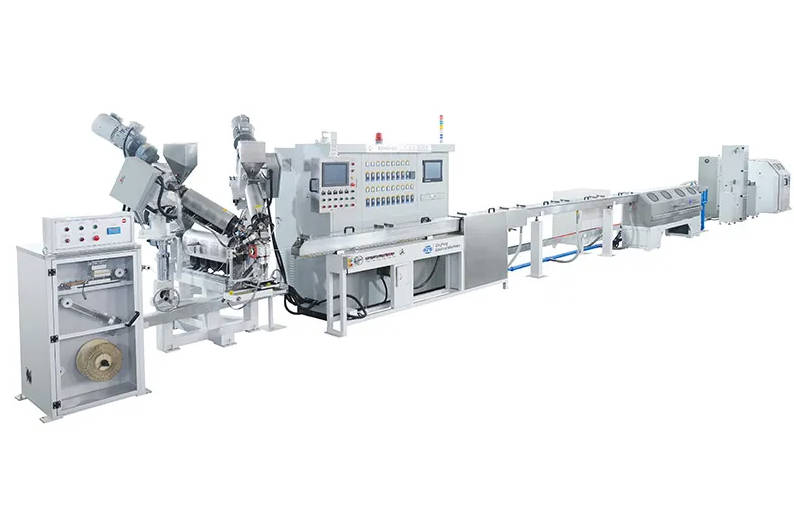
By integrating the QingFeng Taping Machine with our Planetary Cabling and Extrusion lines, manufacturers can achieve a “Zero-Torsion” production flow, which is the only way to ensure the long-term reliability of 800G and 1.6T Active Copper Cables.
VII. Conclusion: Investing in Precision
As the industry moves toward 448G per lane, the “entry ticket” for cable manufacturers has become much more expensive in terms of technical requirements. You cannot solve a picosecond problem with a millisecond machine.
The precision taping advantage lies in the machine’s ability to maintain absolute mechanical and tension symmetry, ensuring that the cable’s electrical performance remains as perfect as the initial design. For companies aiming to lead the AI hardware revolution, a high-speed, precision taping machine is not an option—it is a necessity.
Ready to eliminate skew and dominate the 448G market? Contact QingFeng (勤飞机械) today to learn how our active tension technology can revolutionize your high-speed cable production.