To choose the right cable extrusion line for your factory, you should first define your cable type, insulation or jacket material, conductor size range, finished cable diameter, required production speed, quality tolerance, factory layout, automation level, and future product plan. A cable extrusion line is not a single machine purchase. It is a production system that directly affects cable quality, output efficiency, material usage, operating cost, and long-term manufacturing flexibility.
For wire and cable manufacturers, the wrong extrusion line can create many hidden problems: unstable diameter, poor concentricity, surface defects, insufficient output, difficult material changeover, high scrap rate, or limited ability to produce new cable types. The right cable extrusion line should match your current products while leaving reasonable room for future factory development.
QingFeng SFS provides cable extrusion line solutions for wire and cable manufacturers that need equipment for insulation, sheathing, jacketing, foaming, and special cable production. This guide explains how to evaluate a cable extrusion line before investing in new equipment or upgrading an existing production line.
What Is a Cable Extrusion Line?
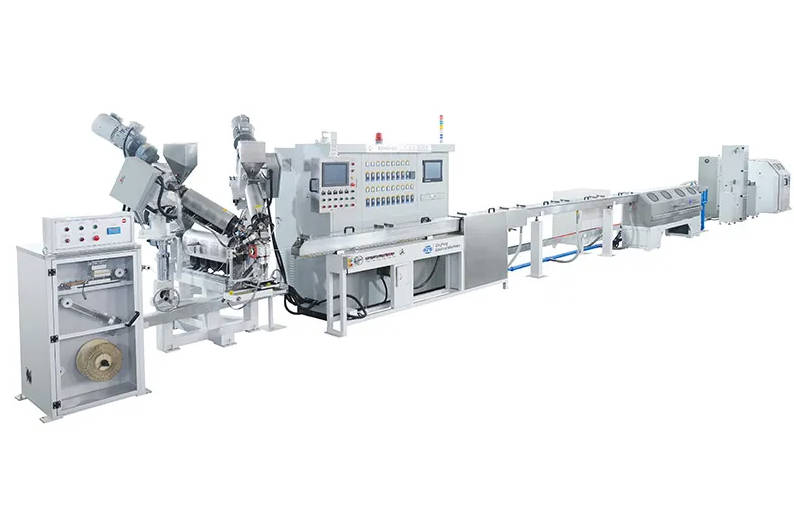
A cable extrusion line is a complete production system used to apply polymer material around conductors, wire cores, or cable cores. The extrusion process can be used for primary insulation, outer jacket extrusion, protective sheathing, foamed insulation, coating, or multi-layer cable structures.
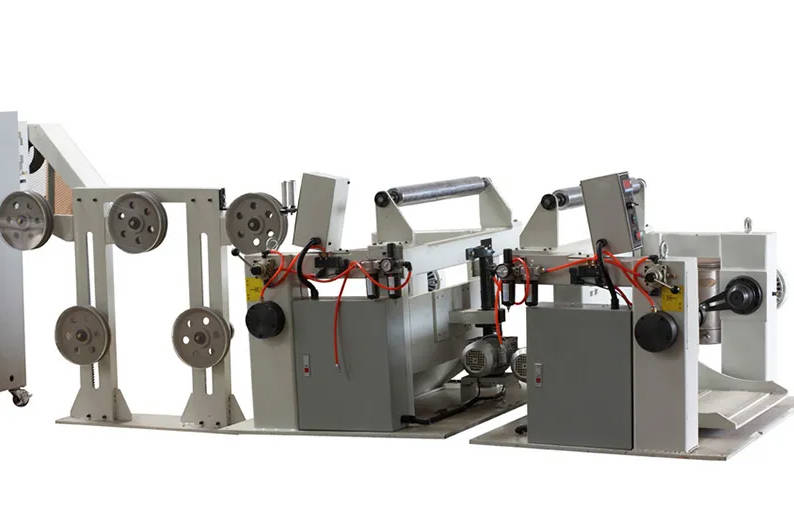
A typical cable extrusion line may include:
| Line Section | Main Function |
| Pay-off system | Feeds conductor, wire, or cable core into the line |
| Preheating unit | Stabilizes conductor temperature before extrusion |
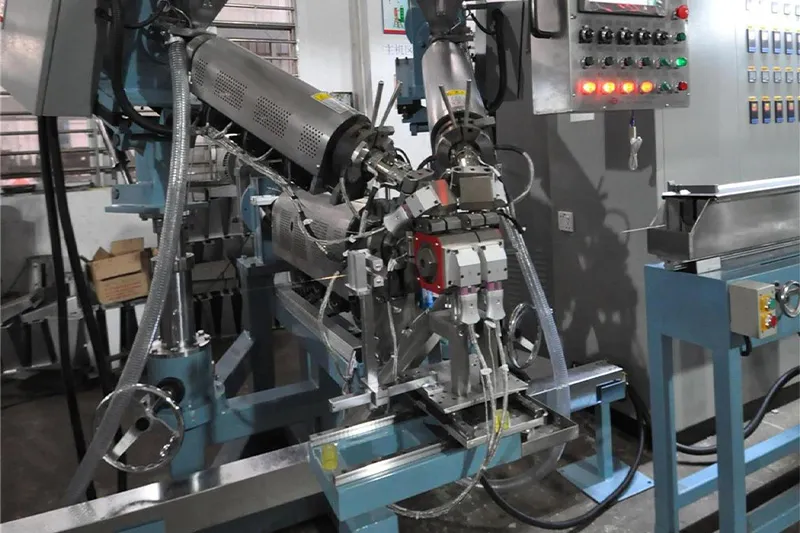
| Extruder | Melts and pushes polymer material through the system |
| Crosshead and tooling | Applies insulation or jacket around the cable |
| Cooling trough | Cools and shapes the extruded layer |
| Diameter measuring system | Monitors outer diameter during production |
| Spark tester | Detects insulation defects in many cable processes |
| Capstan or traction unit | Controls pulling speed and line stability |
| Take-up system | Winds finished cable onto reels or spools |
| Control system | Manages temperature, speed, alarms, and process parameters |
A cable extrusion line should be evaluated as a complete production system, not only by the extruder model or screw diameter.
Even if the extruder is powerful, the final cable quality may still be poor if the cooling system, traction control, tooling alignment, or take-up tension is not suitable.
Start With Your Cable Product Type
The first step in choosing a cable extrusion line is to define what your factory will produce. Different cable products require different machine configurations.
| Cable Product Type | Main Extrusion Requirement | Key Selection Focus |
| Building wire | Insulation extrusion | Stable speed, simple operation, cost efficiency |
| Power cable | Insulation and jacket extrusion | Output capacity, cooling length, wall thickness control |
| Communication cable | Insulation and sheathing | Diameter control, surface quality, concentricity |
| LAN / data cable | Insulation and jacket extrusion | Speed, dimensional accuracy, stable take-up |
| Automotive cable | Insulation and protective jacket | Material compatibility, flexibility, heat resistance |
| EV high-voltage cable | Insulation and jacket layers | Safety, precision, material process stability |
| Medical cable | Fine insulation or jacket extrusion | Clean production, fine wire handling, stable tension |
| High-temperature cable | Fluoropolymer extrusion | Temperature control, screw design, special tooling |
| Solar PV cable | Insulation and jacket extrusion | Weather-resistant material processing and quality control |
A factory producing general PVC building wire does not need the same extrusion line as a factory producing FEP high-temperature wire or medical cable. Before requesting a quotation, buyers should prepare product drawings, cable diameter range, material requirements, and expected production output.
Define Whether You Need Insulation, Sheathing, or Jacketing
Cable extrusion lines can serve different purposes. Confusing these purposes may lead to the wrong equipment choice.
| Extrusion Purpose | Description | Typical Requirement |
| Primary insulation extrusion | Applies insulation directly around the conductor | Good concentricity, diameter control, conductor guiding |
| Core wire extrusion | Produces insulated cores for later cabling | Stable output and repeatable insulation thickness |
| Sheathing extrusion | Applies protective layer over cable core | Larger output and good surface quality |
| Jacket extrusion | Applies outer cable jacket | Material compatibility, cooling, appearance control |
| Coating extrusion | Applies thin protective or functional coating | Precise tooling and stable line speed |
| Foaming extrusion | Produces foamed insulation layer | Foam stability, pressure control, diameter monitoring |
| Multi-layer extrusion | Applies two or more layers together | Co-extrusion coordination and process control |
The correct extrusion line configuration depends on whether you are producing insulation, sheath, jacket, coating, foamed layer, or multi-layer cable structure.
For example, insulation extrusion often requires better conductor centering and wall thickness control. Jacket extrusion may require stronger output capacity and longer cooling. Foaming extrusion may require additional process control to stabilize foam structure.
Match the Extrusion Line With Your Cable Materials
Material compatibility is one of the most important buying factors. A wire extrusion machine suitable for PVC may not be suitable for high-temperature fluoropolymer materials. A line designed for soft TPE cable may not be optimized for XLPE or LSZH compounds.
Common cable materials include:
| Material | Common Use | Equipment Consideration |
| PVC | General insulation and jacket | Common processing, cost-sensitive production |
| PE | Communication cable insulation and jacket | Diameter control and surface finish matter |
| XLPE compound | Crosslinkable cable insulation | Requires process compatibility with crosslinking method |
| TPE / TPU | Flexible cable jacket and special cables | Needs suitable tension and temperature control |
| Nylon | Protective coating and special cable structures | Drying and stable processing are important |
| LSZH compound | Low-smoke halogen-free jacket | Processing window and surface quality should be controlled |
| FEP / PFA / ETFE | High-temperature and special cables | Requires higher temperature control and suitable tooling |
| Foaming materials | Data and communication cable insulation | Requires stable foaming and diameter control |
When discussing with a supplier, do not only say “we need a cable extrusion line.” Provide the exact material type and product application. This helps the supplier recommend the right screw, barrel, heating system, crosshead, tooling, cooling design, and control system.
Determine Your Required Production Capacity
Production capacity should be based on real factory requirements, not only the highest possible machine speed. A high-speed cable production line is useful only when it can maintain stable diameter, surface quality, and take-up quality at the required working speed.
Key capacity questions include:
| Question | Why It Matters |
| What cable diameter range will you produce? | Affects extruder output and cooling needs |
| What insulation or jacket thickness is required? | Affects material consumption and extrusion capacity |
| What material will be used? | Different materials have different processing speeds |
| What daily or monthly output is needed? | Helps size the line correctly |
| How many shifts will the factory run? | Affects machine duty and automation needs |
| How often will products change? | Affects setup time and flexibility |
| What quality tolerance must be maintained? | Limits practical production speed |
A larger extruder may provide higher output, but it may not be ideal for small-diameter precision wire. A smaller extruder may provide better control for fine cables but may not meet output demand for larger jackets. The right capacity is a balance between product range, speed, stability, and investment cost.
Evaluate Diameter Control and Concentricity
Diameter control and concentricity are key indicators of cable extrusion quality. Poor diameter control may cause customer rejection, unstable downstream processing, or excessive material consumption. Poor concentricity may lead to uneven insulation thickness and weak points.
Important quality factors include:
| Quality Factor | Why It Matters |
| Outer diameter stability | Ensures dimensional consistency and material control |
| Wall thickness consistency | Supports insulation strength and product reliability |
| Concentricity | Keeps the conductor centered in the insulation |
| Roundness | Improves appearance and downstream process stability |
| Surface smoothness | Reduces defects and improves cable appearance |
| Shrinkage control | Helps maintain final cable dimensions |
| Online monitoring | Detects process drift before large scrap occurs |
A good wire and cable extrusion line should support stable material output, accurate tooling alignment, controlled cooling, smooth traction, and suitable measurement options.
Consider Factory Layout and Line Integration
Many buyers focus on machine specifications but forget factory layout. A cable production line must fit the factory’s available space, workflow, utilities, and future expansion plan.
Before buying, check:
| Layout Factor | Why It Matters |
| Available line length | Cooling trough, traction, and take-up require space |
| Material feeding area | Supports efficient material handling |
| Reel loading and unloading | Affects labor efficiency and safety |
| Operator access | Supports setup, inspection, and maintenance |
| Power supply | Must match local voltage and equipment needs |
| Compressed air and water | Required for some line functions |
| Cooling water circulation | Affects process stability |
| Future expansion | Prevents layout limitations later |
For new factories, the extrusion line should be planned together with upstream and downstream equipment. For upgraded factories, the supplier should understand existing space, reel size, power conditions, and production workflow.
Automation and Control System Requirements
The control system affects repeatability, operator efficiency, and production stability. For modern cable manufacturing equipment, useful automation features may include temperature control, line speed synchronization, recipe storage, online diameter monitoring, alarm systems, and production data recording.
| Control Feature | Practical Value |
| PLC control | Improves line coordination |
| HMI touchscreen | Makes operation easier |
| Recipe storage | Reduces setup variation between products |
| Temperature zone control | Supports stable material processing |
| Speed synchronization | Coordinates extruder, capstan, and take-up |
| Online diameter feedback | Helps detect dimensional drift |
| Alarm system | Alerts operators to abnormal conditions |
| Production length counting | Supports order management |
| Data recording | Helps process tracking and improvement |
For factories with frequent product changes, recipe storage can reduce operator errors. For precision cable production, online monitoring can help improve consistency. For high-volume production, automation can reduce dependence on manual adjustment.
Compare Standard and Customized Cable Extrusion Lines
Some factories can use a standard configuration, while others need customized equipment. The right choice depends on product complexity and production goals.
| Option | Suitable For | Advantages | Limitations |
| Standard extrusion line | Common cable products with stable requirements | Shorter delivery time, simpler configuration | Less flexible for special applications |
| Customized extrusion line | Special materials, special cable sizes, or unique layout | Better fit for production needs | Requires more technical communication |
| Multi-purpose line | Factories producing several cable types | Flexible product range | May require more setup and tooling changes |
| Specialized line | High-temperature, medical, foaming, or precision cable | Better process control for target application | Higher technical and investment requirements |
If your factory plans to produce only one simple cable type, a standard line may be practical. If your factory produces special cables or plans to enter higher-value markets, customization may be necessary.
What Affects Cable Extrusion Line Cost?
Cable extrusion line cost depends on equipment configuration, material requirement, output capacity, automation, inspection systems, and customization. Buyers should compare the full configuration, not just the machine name.
| Cost Factor | Impact on Price |
| Extruder size | Larger output usually increases cost |
| Material type | High-temperature or special materials require stronger configuration |
| Layer structure | Multi-layer or co-extrusion increases complexity |
| Foaming capability | Adds process control and system requirements |
| Cooling system | Longer or special cooling design increases cost |
| Online inspection | Diameter measurement and spark testing add cost |
| Automation level | PLC, HMI, recipe storage, and data functions affect price |
| Pay-off and take-up design | Reel size and tension control affect configuration |
| Custom tooling | Product-specific tooling affects total project cost |
| Installation and training | Adds value but should be considered in total investment |
The cheapest cable extrusion machine is not always the lowest-cost choice if it causes high scrap, unstable output, or limited product capability.
A better evaluation method is to compare total production value: stable output, lower defect rate, material saving, product flexibility, service support, and long-term reliability.
Buying Checklist Before Requesting a Quotation
To get an accurate quotation, prepare a clear requirement list before contacting suppliers.
| Requirement | Details to Provide |
| Cable product | Building wire, power cable, LAN cable, automotive cable, medical cable, PV cable, etc. |
| Extrusion purpose | Insulation, jacket, sheath, coating, foaming, or multi-layer |
| Material | PVC, PE, XLPE, TPE, TPU, Nylon, LSZH, FEP, PFA, ETFE, etc. |
| Conductor size | Minimum and maximum conductor diameter |
| Finished cable diameter | Target OD and tolerance |
| Production speed | Expected stable working speed |
| Layer thickness | Insulation or jacket wall thickness |
| Reel size | Pay-off and take-up requirements |
| Quality inspection | Diameter measurement, spark test, concentricity control |
| Factory layout | Available space and line direction |
| Utilities | Power, water, air, and environmental conditions |
| Support needs | Installation, commissioning, training, spare parts |
Providing this information helps the supplier recommend a cable extrusion line that matches the real production requirement instead of giving a general quotation.
Common Mistakes When Choosing a Cable Extrusion Line
Mistake 1: Selecting by Price Only
Low initial price may lead to higher operating cost if the line creates unstable quality, high scrap, downtime, or limited material compatibility.
Mistake 2: Choosing an Extruder Without Considering the Full Line
The extruder is important, but cooling, traction, take-up, tooling, control system, and inspection equipment also affect final cable quality.
Mistake 3: Ignoring Future Product Plans
A factory may start with one cable type but later expand into other products. If the line has no flexibility, future upgrades may become expensive.
Mistake 4: Underestimating Material Processing Requirements
Special materials such as fluoropolymers, LSZH compounds, foaming materials, or flexible elastomers may require specific machine design and process control.
Mistake 5: Not Planning Installation and Training
Even a good cable extrusion machine needs proper installation, commissioning, and operator training. Without support, production startup may take longer and create unnecessary waste.
How to Choose a Reliable Cable Extrusion Line Supplier
A reliable supplier should understand both machine design and cable production process. When comparing suppliers, buyers should evaluate technical communication, customization ability, manufacturing quality, after-sales service, and experience with similar cable applications.
Important supplier evaluation questions include:
| Question | Why It Matters |
| Have you supplied similar cable extrusion lines before? | Confirms application experience |
| Can you process our required material? | Verifies technical compatibility |
| Can the line meet our diameter and tolerance needs? | Checks quality control capability |
| Can you design the line for our factory layout? | Supports installation planning |
| What inspection systems can be integrated? | Improves process monitoring |
| What training is included? | Helps operators start production smoothly |
| How are spare parts supplied? | Supports long-term operation |
| Can you support tooling and process setup? | Reduces startup risk |
QingFeng SFS provides cable production line and extrusion equipment for different wire and cable manufacturing applications. Buyers can also visit the QingFeng SFS official website to learn more about company capabilities and equipment categories.
FAQ
What is a cable extrusion line?
A cable extrusion line is a production system used to apply insulation, sheathing, coating, or jacket material around conductors, wire cores, or cable cores. It is widely used in wire and cable manufacturing.
How do I choose the right cable extrusion line for my factory?
To choose the right cable extrusion line, define your cable type, material, conductor size, finished diameter, layer structure, production speed, tolerance requirements, factory layout, automation needs, and supplier support requirements.
What is the difference between a wire extrusion machine and a cable extrusion line?
A wire extrusion machine often refers to equipment for insulating individual conductors or smaller wire products. A cable extrusion line may include a more complete system for insulation, sheathing, jacketing, cooling, testing, traction, and take-up.
What materials can a cable extrusion machine process?
Depending on the machine configuration, a cable extrusion machine may process PVC, PE, XLPE compounds, TPE, TPU, Nylon, LSZH, FEP, PFA, ETFE, and other cable materials.
What affects the price of a cable extrusion line?
The price is affected by extruder size, material compatibility, production capacity, layer structure, foaming capability, automation level, online inspection, pay-off and take-up design, custom tooling, and service support.
Why is diameter control important in cable extrusion?
Diameter control is important because it affects cable quality, material usage, customer inspection, downstream processing, and product consistency. Poor diameter control may cause scrap or unstable cable performance.
Can one cable extrusion line produce different cable products?
In some cases, one cable extrusion line can produce different products if the extruder, tooling, cooling, control system, and take-up configuration are suitable. However, buyers should confirm the product range before purchasing.
Conclusion
Choosing the right cable extrusion line for your factory requires a clear understanding of your cable products, materials, production capacity, quality requirements, layout conditions, and future development plan. A suitable line should provide stable extrusion, accurate diameter control, reliable traction, proper cooling, practical automation, and long-term service support.
For wire and cable manufacturers, equipment selection should not be based only on machine price or extruder size. The real value of a cable extrusion line comes from stable production, lower scrap, material compatibility, product flexibility, and supplier support.
QingFeng SFS offers cable extrusion line solutions for manufacturers looking to build or upgrade wire and cable production capacity.