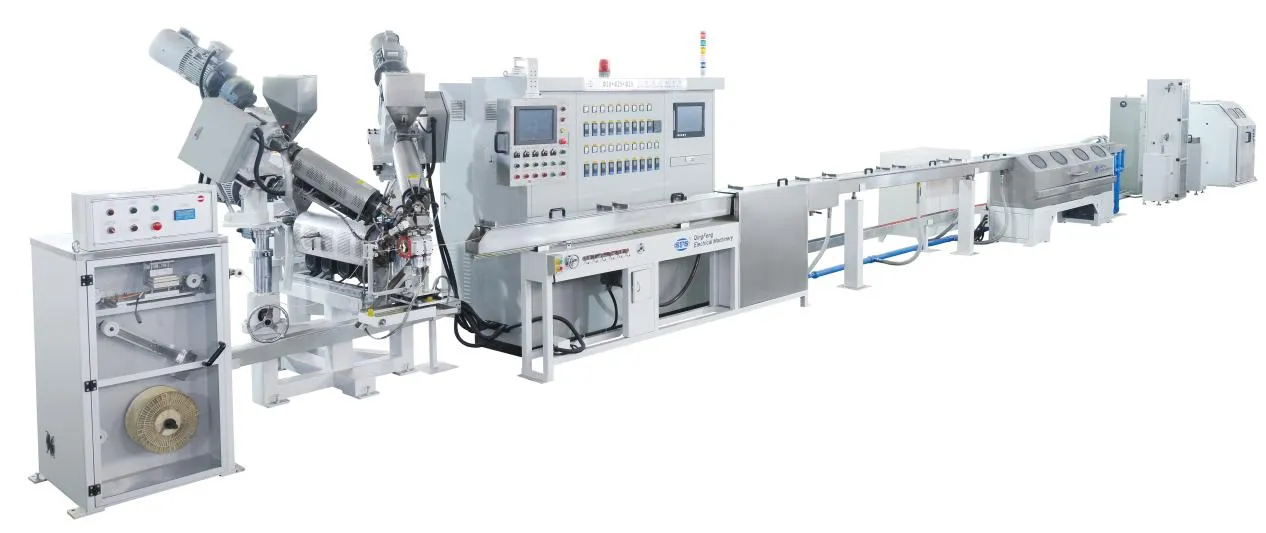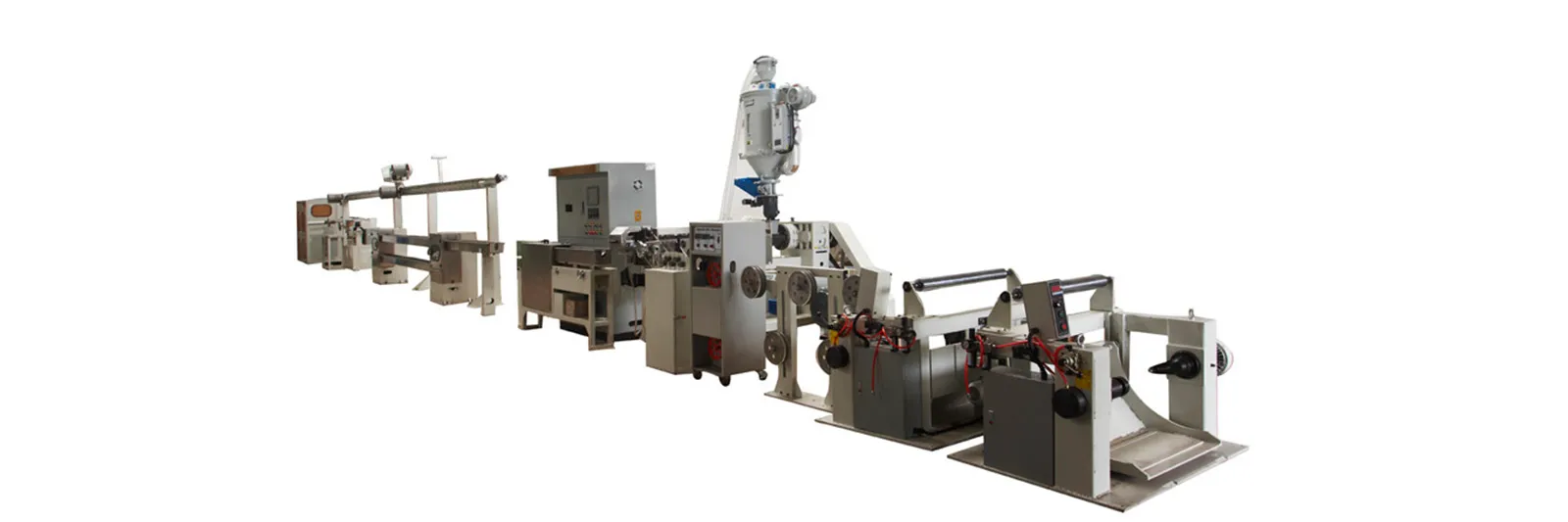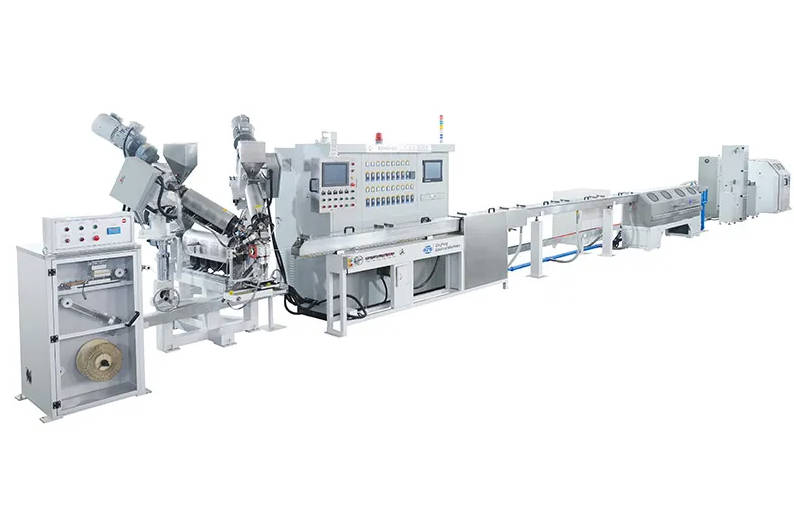
A solar / PV cable is not a commodity PE cable. The standard 25-year service life, the dual-layer insulation and jacket construction, and the EN 50618 / IEC 62930 / TÜV 2 PfG 1169 requirements on weather and flame resistance all change the equipment that the line needs. This guide walks through why a dedicated PV cable extrusion line is justified, the seven segments from pay-off to take-up, the material and crosslinking choice (XLPO, EB crosslinking vs peroxide crosslinking), the equipment parameters to lock into the RFQ, the in-line QC priorities, and the supplier-confirmation checklist before signing.
Why Solar Cables Need a Dedicated Extrusion Line
A PV cable sees continuous outdoor exposure: UV, temperature cycling between roughly −40 °C and +90 °C, moisture, and ozone. The EN 50618 and IEC 62930 standards require the cable to deliver 25 years of service under those conditions, and the flame-retardant jacket has to pass the relevant vertical and horizontal flame tests. Those constraints drive two structural choices: dual-layer construction (inner insulation plus outer jacket), and a crosslinked insulation material such as XLPO rather than commodity thermoplastic PE.
A standard commodity PE house wire line does not give you the crosslinking step, the dual-layer precision, the UV-stable jacket material, or the in-line QC stations required to run PV cable consistently. For buyers evaluating a new line, the starting assumption is that you are planning a PV cable extrusion line specifically, not adapting an existing low-voltage line.
Line Configuration: from Pay-Off to Take-Up
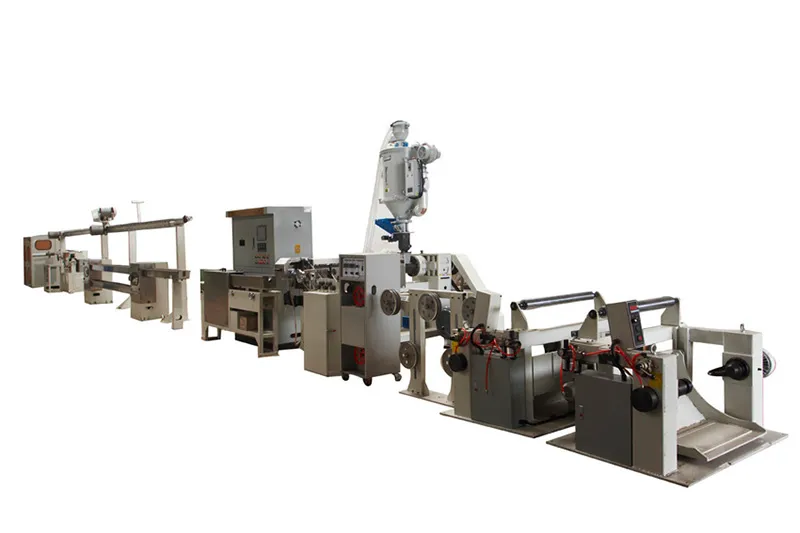
A complete PV cable extrusion line is a chain of seven segments. Most map directly to a generic power-cable line, but the crosslinking and dual-layer stations are the parts that differ most.
| Segment | Role | Key control point | Notes for PV cable |
|---|---|---|---|
| 1. Pay-off | Feeds the tinned copper conductor from spool | Tension stability, dancer control | Match the pay-off to the spool size and conductor diameter |
| 2. Preheater / annealer | Removes moisture and stress-relieves the conductor | Temperature uniformity across the bundle | Especially relevant for stranded conductors |
| 3. First extruder + crosshead | Inner insulation extrusion (XLPO) | Melt temperature, screw speed, line-speed ratio | Screw L/D matched to XLPO; tight eccentricity |
| 4. Crosslinking zone | Crosslinks the insulation (EB or peroxide route) | Dose uniformity / steam temperature profile | Decided once for the line; dictates layout space |
| 5. Cooling trough 1 | Solidifies the inner insulation | Water temperature, immersion length | Longer trough for thicker XLPO walls |
| 6. Second extruder (jacket) | Outer sheath with UV-stable, flame-retardant compound | Melt temperature, concentricity | Required for dual-layer construction |
| 7. Spark test + take-up | Final QC, then wind onto spool | Spark voltage, line-speed stability, traverse pitch | Often combined with diameter and capacitance scan |
For a full end-to-end view of how the segments fit together, see how an extrusion line is laid out from pay-off to take-up.
Insulation Material and the Crosslinking Route
PV cable insulation is typically XLPO (crosslinked polyolefin), which delivers the thermal, UV, and aging resistance that PE alone cannot. Crosslinking is what gives XLPO its property set, and the two main routes are:
- Electron-beam (EB) crosslinking: the extruded insulation passes through an electron beam, which crosslinks the polymer. The reaction is fast, the dose is controllable, and the line layout needs space for the irradiation device between the first extruder and the cooling trough. This is the route that brings irradiation equipment into the line layout.
- Peroxide (chemical) crosslinking: the insulation compound contains a peroxide that decomposes in a steam or hot-air curing section downstream of the extruder. The line does not need irradiation equipment, but the curing section is long and the process is sensitive to temperature profile.
Both routes deliver crosslinked insulation that meets EN 50618 / IEC 62930 when run correctly. The choice between them is more about line layout, capital cost, and product mix than about cable performance: EB gives a compact crosslinking section and tight dose control; peroxide avoids the irradiation capex and the related safety infrastructure but takes more floor space and tighter process control.
Key Equipment Requirements Checklist
Before issuing the RFQ, lock the following parameters into the spec. They are the ones that determine whether the line can run PV cable cleanly, and they are easier to specify up front than to change after delivery.
- Screw L/D ratio matched to XLPO rather than commodity PE; XLPO is more shear-sensitive.
- Barrel material and wear resistance suitable for the filled and flame-retardant compounds used in PV jackets.
- Number of temperature control zones on each extruder: enough to hold a tight melt window along the barrel.
- Crosshead design for dual-layer concentricity; concentricity affects dielectric strength and jacket fit.
- Spark tester voltage range covering PV cable insulation thickness; typically higher than commodity house wire.
- Tension control on pay-off, capstan, and take-up: tight tension windows are needed to keep XLPO from stretching unevenly before crosslinking.
- Cooling trough length and water-temperature control matched to the line speed and wall thickness.
- In-line diameter and eccentricity measurement on both insulation and jacket.
- In-line capacitance scan to flag material or process drift.
- Recipe storage in the PLC for at least the planned product mix, with a defined process for adding new recipes.
Treat exact values for screw L/D, spark voltage, and trough length as design targets to be confirmed with the supplier against your specific cable design; the configuration details depend on the conductor range, the line speed you are targeting, and the standard you intend to certify against.

In-Line Quality Control
PV cable carries continuous current outdoors for 25 years, so on-line QC is part of the cable, not an optional extra. The QC stations to specify in the RFQ:
- Insulation outside diameter and concentricity, typically a laser micrometer or X-ray head.
- Spark test on the inner insulation at a voltage appropriate to the wall thickness and the standard.
- Capacitance / impedance scan on the insulated core; catches foaming, voids, or material drift before the jacket covers them.
- Jacket outside diameter and concentricity after the second extruder.
- Spark test on the sheathed cable at a lower voltage than the inner-insulation test.
- Sample retention: cut length samples at the start, middle, and end of each batch for hot-set, gel-content, and accelerated aging tests in the lab.
These stations should be specified together with the extruder in the RFQ. Retrofitting a continuous capacitance scan or a sample-retention cut after the line is built is more expensive than specifying it up front.

What to Confirm with Your Supplier
Beyond the equipment parameters, walk through this commercial-and-documentation checklist with the supplier before signing:
- Acceptance test scope and conditions: which EN 50618 / IEC 62930 / TÜV 2 PfG 1169 tests will be demonstrated at FAT, and which are the buyer’s responsibility at SAT.
- Reference cable recipes: number of pre-set recipes (conductor size, insulation grade, jacket grade) included, and the process for adding new ones.
- Spare parts list: critical wear parts (screws, barrels, crosshead tips, spark electrodes, capstan belts) and the recommended replacement interval.
- Installation and training: who installs the line on site, how many days of operator training are included, and whether the supplier provides a commissioning engineer in person.
- Documentation package: mechanical drawings, electrical schematics, PLC source, P&ID, and CE / declaration files in editable formats.
- Warranty and response time: warranty period on mechanical and electrical components, and the supplier’s stated response time for remote and on-site support.
- Future-proofing: ability to add a printer, a second extruder, or an irradiation device later without rebuilding the line.
For buyers who want help evaluating trade-offs between suppliers or matching this checklist to a specific PV cable design, installation and training from an experienced equipment maker can save weeks of back-and-forth at the RFQ stage, and cable making machine applications across new-energy and grid products provide context for product-mix decisions.
FAQ
Can a standard PE extrusion line produce PV cables?
Not directly. PV cable needs crosslinked XLPO insulation, UV-stable jacket material, dual-layer construction, and the in-line QC stations required for outdoor 25-year service. A standard commodity PE house wire line is missing the crosslinking step, the dual-layer precision, and the QC stations. PV cable production is a re-specification rather than a drop-in change.
Is electron beam crosslinking compulsory for PV cables?
No. EN 50618 and IEC 62930 require crosslinked insulation, but they do not mandate the EB route. Peroxide (chemical) crosslinking is also accepted when the process is properly controlled. The choice between EB and peroxide is about line layout, capital cost, and product mix rather than about meeting the standard.
What tests confirm the insulation is properly crosslinked?
Three tests are typically used: hot-set test (load the sample at elevated temperature and measure elongation), gel content (the fraction of crosslinked polymer versus extractable fraction), and accelerated aging under heat and pressure. Document each batch’s results so they can be traced back to the production run.
What output should I expect from a PV cable extrusion line?
Output depends on line speed, conductor size, insulation thickness, and whether the crosslinking section is in line with the extrusion. Faster lines are possible on smaller conductors with thinner walls; slower lines are typical for the larger conductor sizes used in utility-scale PV. Confirm specific output figures with the supplier against your target cable design rather than relying on generic catalog values.
Conclusion
A PV cable extrusion line is justified by the 25-year outdoor service life, the dual-layer construction, and the EN 50618 / IEC 62930 requirements that a commodity PE line cannot meet. The line configuration flows from the cable design: dual extruders for inner insulation and outer jacket, a crosslinking section between them, and in-line QC for diameter, spark, capacitance, and sample retention. The choice between EB and peroxide crosslinking is a layout-and-cost decision, not a standards-compliance decision. Specifying screw L/D, temperature zones, spark voltage, cooling setup, sensor models, and recipe storage in the RFQ is cheaper than retrofitting them later, and the supplier’s RFQ response should cover acceptance tests, recipes, spare parts, training, documentation, warranty, and future upgrade paths.
For a configuration review or quotation, share the target annual capacity, the conductor size range you plan to run, the standard you intend to certify against (EN 50618, IEC 62930, TÜV 2 PfG 1169), and whether the line should include EB crosslinking or run a peroxide route. With those inputs, an experienced equipment maker can map the seven segments above to your specific line and flag the trade-offs that matter for your product mix.