The year 2026 marks a pivotal moment in the evolution of global data centers. With the explosive growth of Generative AI, large language model (LLM) training, and the commercial rollout of 1.6T networking, the demand for 800G Direct Attach Copper (DAC) cables has reached an unprecedented peak. However, for many cable manufacturers, the journey from 400G to 800G has been fraught with technical hurdles.
At QingFeng SFS, we believe that the foundation of a high-yield 800G production line isn’t just a collection of machines—it is an understanding of high-frequency physics. This article is written for engineers and plant managers who are navigating the complexities of scaling Twinax cable manufacturing and are looking for a sincere, technical partner to optimize their Extrusion Line performance.
1. The 800G Reality Check: Why “Standard” is No Longer Enough
In the 400G era, the industry operated largely on 56G PAM4 signaling. Moving to 800G means jumping to 112G PAM4 per lane. At these frequencies, copper cables behave more like high-precision waveguides than simple wires. Every microscopic imperfection in the insulation or the conductor becomes a source of signal reflection.
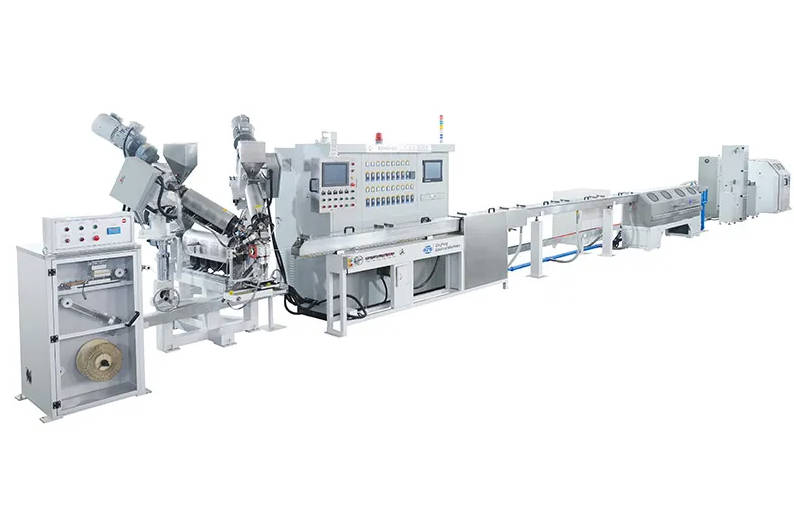
To scale 800G DAC production successfully, manufacturers must utilize a high-precision extrusion line capable of ±1% capacitance stability and physical foaming rates exceeding 70% to ensure 112G/lane signal integrity.
Without this level of precision, the “Golden Sample” you produced in the lab will never translate to mass production. Your yield rate will plummet, and the cost of scrap will erase your profit margins.
2. The Heart of the Process: The High-Precision Extrusion Line
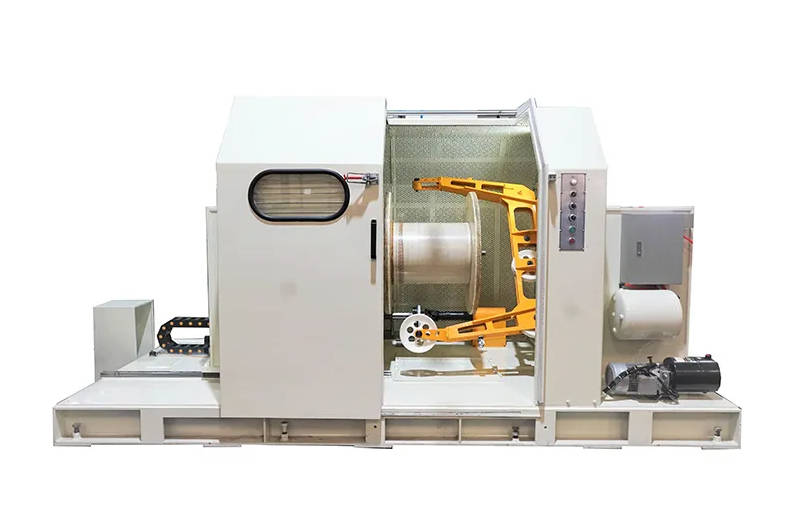
If the Planetary Cable Machine or the Taping Machine provides the structure of the cable, the Extrusion Line provides its soul. The insulation layer of a Twinax cable is the most critical component for controlling Characteristic Impedance.
Mastering the Skin-Foam-Skin (SFS) Structure
For 800G DAC, solid insulation is no longer an option due to high dielectric loss. Modern production requires Physical Foaming using nitrogen injection. At QingFeng SFS, we advocate for the Skin-Foam-Skin (SFS) or Skin-Foam co-extrusion method.
- Inner Skin: Provides a perfect bond to the silver-plated copper conductor, preventing moisture ingress and oxidation.
- Foam Layer: The “Engine” of the signal. By injecting nitrogen, we create micro-cells that lower the Dielectric Constant (Dk), allowing signals to travel faster and with less attenuation.
- Outer Skin: Provides the mechanical toughness needed for subsequent Taping and Twisting processes.
Technical Requirement Comparison: 400G vs. 800G Manufacturing
| Parameter | 400G DAC (56G PAM4) | 800G DAC (112G PAM4) | Required Equipment Feature |
| Impedance Tolerance | ±5 Ω | ±3 Ω (or tighter) | High-sensitivity feedback loop |
| Foaming Rate | 45% – 60% | 65% – 80% | Precision Nitrogen Injection |
| Concentricity | > 92% | > 96% | Automated Crosshead Adjustment |
| OD Stability | ±0.01mm | ±0.003mm | Laser Micrometer Integration |
| Capacitance Control | ±1.5 pF/m | ±0.5 pF/m | Online Capacitance Bridge |
3. Addressing the “Fine-Wire” Dilemma (30AWG to 32AWG)
As AI racks become more densely packed, the demand for thinner, more flexible cables like 30AWG and 32AWG Twinax has skyrocketed. However, extruding insulation on such thin conductors introduces the risk of “necking” or stretching.
The secret to high-yield ultra-fine Twinax extrusion is the synchronization between the Pay-off tension and the Extruder screw speed, ensuring that the conductor is never subjected to erratic mechanical stress that could alter its electrical properties.
QingFeng SFS Extrusion Lines incorporate dual-loop tension control systems. This ensures that from the moment the wire leaves the pay-off until it is wound onto the take-up reel, the tension remains constant within a range of ±2 grams. This is the level of sincerity we bring to the engineering—knowing that 800G success is measured in grams and microns.
4. Solving the “Zero-Skew” Challenge
Intra-pair Skew is the time difference between the two signals traveling in a differential pair. Even a few picoseconds of delay can cause an 800G transceiver to fail. While skew is often blamed on the Bunching and Twisting Machine, it actually begins at the Extrusion Line.
If the two insulated cores (the “A” and “B” wires) have even a 0.5% difference in their Dielectric Constant or diameter, they will never be in sync.
How to Prevent Skew at the Source:
- Tandem Production: Producing both cores simultaneously on a dual-head extrusion line ensures they experience identical thermal and pressure conditions.
- Raw Material Homogeneity: Using high-end FEP or PFA resins with consistent MFR (Melt Flow Rate).
- Cooling Trough Gradient: Gradual cooling prevents “thermal shock” which can cause random variations in the foaming structure.
5. The Critical Role of Irradiation and Outer Jacketing
Once the Twinax pairs are taped and bundled using a Planetary Cable Machine, the final outer jacket must be applied. In 2026, AI data centers are hotter than ever.
Utilizing Irradiation Equipment for cross-linking the outer jacket is essential for 800G DACs to meet the LSZH (Low Smoke Zero Halogen) and high-temperature requirements of modern AI server clusters.
Irradiation transforms the molecular structure of the jacket, allowing it to withstand temperatures up to 125°C without melting or deforming. This ensures that the high-precision internal Twinax structure—which we worked so hard to extrude—remains protected for years of 24/7 operation.
6. Scaling Up: Why a “Full Range” Solution Matters
Many customers ask us: “Can I just buy the Extrusion Line and use my old bunching machines?”
Our sincere advice is this: 800G is a chain; it is only as strong as its weakest link. If you have a world-class Extrusion Line but a low-precision Taping Machine, the mechanical pressure during taping will crush your foaming layer, ruining the impedance you just carefully controlled.
A Full Range of Network Cable Equipment from QingFeng SFS ensures that every machine speaks the same language. Our PLC systems are integrated, meaning the data from the Extruder can inform the settings of the Planetary Cable Machine, creating a smart factory environment that minimizes human error.
FAQ: Quick Review for High-Speed Cable Manufacturers
Q1: What is the biggest cause of failure in 800G DAC mass production?
A: Inconsistency in Characteristic Impedance. This is usually caused by unstable physical foaming or poor concentricity during the extrusion process.
Q2: Can I use chemical foaming for 800G Twinax?
A: No. Chemical foaming creates inconsistent cell sizes and leaves chemical residues that increase signal loss. Physical Nitrogen Injection is mandatory for 112G PAM4 signaling.
Q3: How does QingFeng SFS help reduce scrap rates?
A: Our lines feature Auto-Correction Crossheads and online X-ray monitoring. If the OD or concentricity drifts by even 2 microns, the system automatically adjusts in real-time without stopping the line.
Q4: Is 32AWG really viable for 800G?
A: Yes, for shorter reaches (up to 1.5 meters). However, it requires extreme tension control in the Extrusion Line to avoid conductor elongation.
Conclusion: Partnering for the 1.6T Future
The transition to 800G is not just a change in labels; it is a fundamental shift in how we manufacture cables. At QingFeng SFS, we don’t just provide the hardware. We provide the Extrusion Line expertise, the material science knowledge, and the “Full Range” integration needed to make your factory a leader in the AI era.
Scaling up is challenging, but with the right precision and a sincere partner, your 800G yield rates can reach 95% and beyond. Let’s build the future of connectivity, one micron at a time.