I. Introduction: The 1.6T Multi-Pair Challenge
The architecture of modern AI data centers is undergoing a seismic shift. As Generative AI models grow exponentially, the demand for bandwidth has moved beyond the capabilities of 400G and 800G systems. We are now entering the era of 1.6T connectivity, which utilizes eight lanes of 224Gbps or 448Gbps (PAM4) signaling. For cable manufacturers, this evolution is not merely about making wires faster; it is about managing the extreme physical complexity of multi-pair aggregation.
Manufacturing a single high-quality 224G Twinax core is a feat of engineering, but combining four or eight of these pairs into a single high-density cable—such as those used in NVIDIA GB200 NVLink interconnects—introduces a new set of risks. Traditional cabling methods that involve high-speed twisting often compromise the delicate electrical properties of the internal cores.
Zero-torsion cabling, achieved through high-precision planetary cable machines, is the only viable manufacturing method for 1.6T multi-pair aggregation because it prevents internal mechanical stress from crushing the fragile physical foaming layers and distorting signal integrity. Without the “back-twist” technology found in a planetary machine, the high-frequency performance of a 1.6T cable will degrade during the assembly process, leading to failed certification and high scrap rates.
II. The Physics of Torsion: Why Twisting Destroys 448G Signals
To understand why a Planetary Cable Machine is indispensable, one must look at the microscopic structure of a high-speed Twinax core. These cores rely on a high-foaming Teflon (PTFE) insulation layer, which is essentially a matrix of microscopic air bubbles.
1. Mechanical Stress on Physical Foaming
In a standard “rigid” or “drum” strander, the supply bobbins are fixed. As the machine rotates to bundle the pairs together, each pair is forced to twist around its own axis—a phenomenon known as torsion.
When a high-speed Twinax pair is subjected to mechanical torsion during cabling, the torsional force crushes the micro-cellular air bubbles in the Teflon insulation, leading to localized density changes and immediate impedance fluctuations.
2. Impedance Mismatches and Return Loss
The characteristic impedance of a high-speed cable (typically 100 Ohms) is determined by the distance between the two conductors and the dielectric constant of the insulation. Torsion disrupts both.
- Geometric Distortion: Twisting forces the parallel conductors to shift relative to each other.
- Dielectric Shifting: Crushed air cells increase the local dielectric constant (εr).
Even a 1% deviation in the cross-sectional geometry of a 448G Twinax pair can result in a 3-5 Ohm impedance shift, triggering severe Structural Return Loss (SRL) and “suck-outs” at high frequencies.
III. Planetary vs. Rigid Cabling: The “Back-Twist” Advantage
The fundamental difference between cabling technologies lies in how they handle the orientation of the supply bobbins.
1. Standard Cabling (The “Corkscrew” Effect)
In a rigid strander or a double-twist buncher, the core wires are “cranked” into a bundle. If you were to draw a line along the top of a core wire before it entered a rigid machine, that line would spiral around the wire after it exited. This internal “corkscrew” stress remains trapped inside the finished 1.6T cable, causing it to kink, curl, and—most importantly—fail high-frequency tests.
2. The Planetary Cabling Principle (100% Back-Twist)
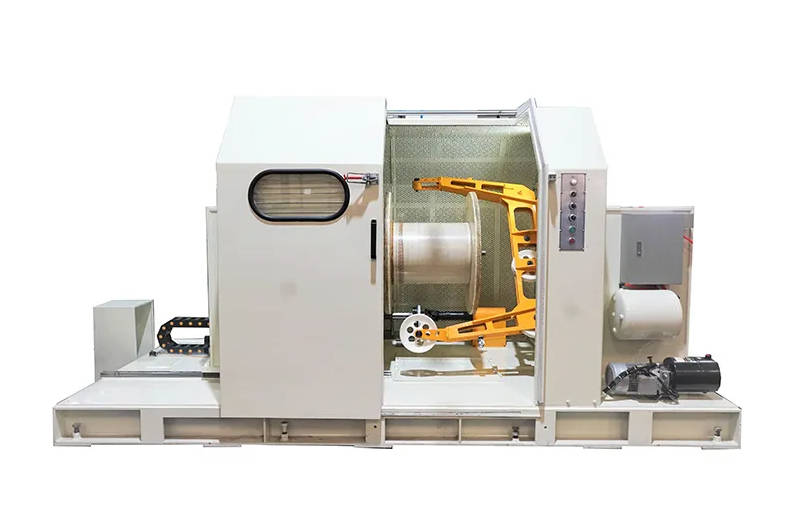
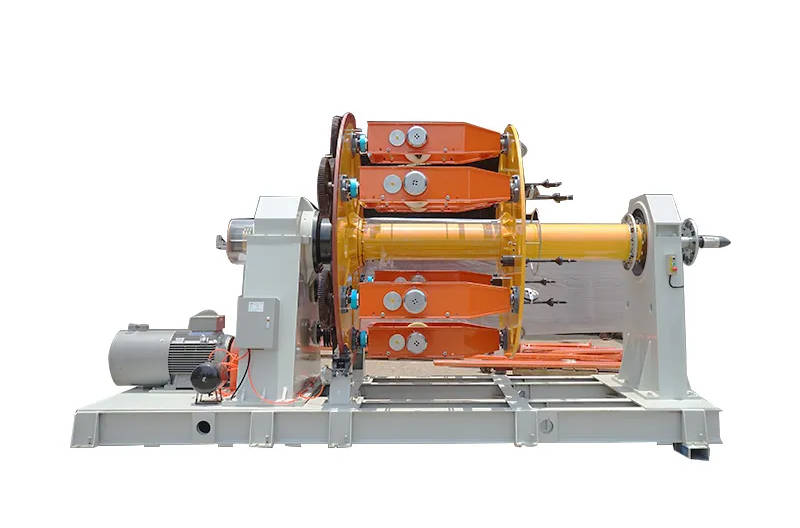
A Planetary Cable Machine utilizes a specialized cage where the bobbins are mounted on “planetary” cradles. As the cage rotates, the cradles perform a counter-rotation.
The 100% back-twist mechanism of a planetary machine ensures that each Twinax pair remains in a fixed horizontal orientation throughout the cabling process, resulting in zero-torsion and zero mechanical stress on the core insulation. This “stress-free” assembly is the gold standard for 800G and 1.6T cable manufacturing.
Comparison: Rigid Stranding vs. QingFeng SFS Planetary Cabling
| Feature | Rigid/Drum Strander | QingFeng SFS Planetary Cable Machine |
| Torsion Level | High (100% Torsion) | Zero (100% Back-Twist) |
| Impact on Foaming | Significant Crushing | No Compression/Deformation |
| Impedance Stability | ±5 to ±10 Ohms | ±1 Ohm (High Precision) |
| Structural Return Loss | High Risk of Spikes | Clean Signal Profile |
| Cable Flexibility | Stiff/Prone to Kinking | Highly Flexible/Stable |
| Core Material | Low-Speed/Power Only | High-Frequency Twinax (224G/448G) |
IV. QingFeng SFS Engineering: Precision Features of the Planetary Cable Machine
QingFeng SFS () has designed its planetary cabling systems specifically for the “Zero-Torsion” requirements of the AI infrastructure market.
1. Programmable Back-Twist Ratios
Different cable designs (e.g., combining Twinax pairs with power wires or fillers) require different handling. QingFeng SFS’s planetary machines feature a programmable back-twist ratio, allowing manufacturers to toggle between 0% and 100% back-twist via the HMI to optimize for different high-speed cable constructions.
2. Active Constant Tension Pay-off
A major challenge in planetary cabling is the mass of the cage. As the cage spins, the inertia can cause tension spikes.
The QingFeng SFS Planetary Cable Machine utilizes an active servo-controlled pay-off system that maintains constant tension within ±2g, preventing longitudinal stretching of the core during 1.6T multi-pair aggregation.
3. High-Stability Cage and Zero Vibration
At 448G, any mechanical vibration during cabling creates “periodic defects” in the cable. QingFeng SFS cages are dynamically balanced and utilize high-precision bearings to ensure a vibration-free environment, even at maximum RPMs. This stability is critical for maintaining a perfectly uniform Lay Length (Pitch).
V. Addressing Manufacturer FAQs: Common Pain Points in Multi-Pair Assembly
FAQ 1: Can we use a high-speed double-twist machine for 800G/1.6T to save time?
Technically, you can, but your yield will be devastatingly low. Double-twist machines introduce extreme torsion. For 10G or 40G cables, this might be acceptable. For 448G, the signal is too sensitive to the resulting impedance spikes. The time you save in production will be lost in rejected batches. A planetary machine is a quality-first investment.
FAQ 2: How does planetary cabling affect Intra-pair Skew?
By ensuring zero-torsion, you ensure that the two conductors within the Twinax pair remain perfectly parallel and equal in length. A planetary machine prevents the “inner-wire-shorter” syndrome that occurs in rigid twisting, thereby maintaining the sub-picosecond skew performance achieved during the taping stage.
FAQ 3: How do we manage the drain wire and fillers in a planetary setup?
QingFeng SFS machines are modular. We can integrate specialized pay-offs for drain wires and fillers that bypass the back-twist cage or follow it synchronously. This ensures that the overall geometry of the 1.6T bundle remains symmetrical and compact.
VI. The 1.6T Ecosystem: Integrating the Full Production Line
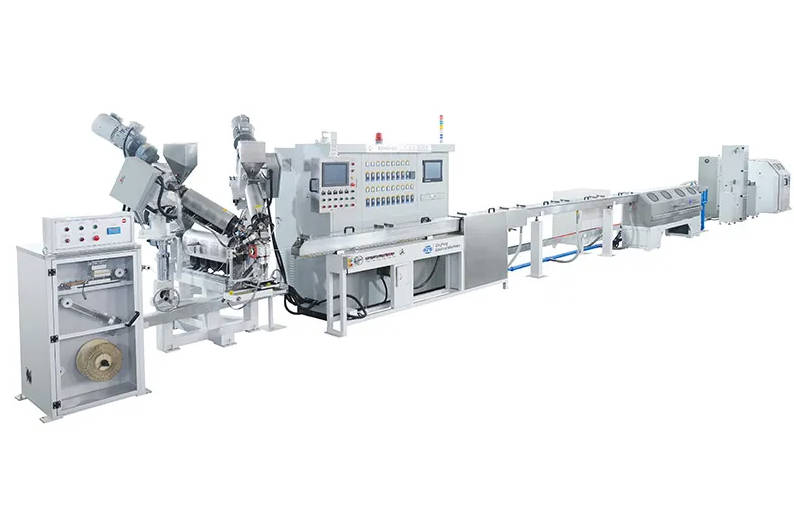
The Planetary Cable Machine is the “Quality Gatekeeper” of the factory. However, its success depends on the stages that come before it.
- Upstream Quality: You must start with high-quality cores from the QingFeng SFS Teflon Foaming Line and Precision Taping Machine.
- Cabling Precision: The planetary machine bundles these cores without adding stress.
- Downstream Protection: The bundled cable is then passed to the Sheathing/Jacket line, where QingFeng SFS’s low-tension extrusion ensures the final jacket does not overheat or squeeze the newly formed bundle.
VII. Conclusion: The Foundation of AI Connectivity
In the race to build the world’s fastest AI networks, the physical cable is often the bottleneck. 1.6T networking requires a level of mechanical “gentleness” that traditional machines simply cannot provide.
Investing in a QingFeng SFS Planetary Cable Machine is the only way to ensure zero-torsion reliability for multi-pair Twinax aggregation, protecting your high-frequency signal integrity from the supply bobbin to the final reel. As AI clusters scale to 1.6T and beyond, precision planetary cabling will be the defining difference between a Tier-1 supplier and the rest of the market.