I. Introduction: The 448G Era and the Precision Mandate
The global shift toward 800G and 1.6T networking architectures has placed unprecedented demands on physical layer components. As data rates climb to 448G per lane (using PAM4 signaling), the margin for error in cable manufacturing has virtually vanished. For manufacturers of Direct Attach Copper (DAC) cables and Twinax assemblies, the primary technical hurdle is no longer just conductivity—it is Signal Integrity (SI).
Specifically, Structural Return Loss (SRL) has emerged as the “make-or-break” metric for high-speed cable certification. Traditional cable wrapping methods that were sufficient for 10G or even 100G are now failing to meet the rigorous standards of the 448G era. To solve this, the industry is pivoting toward vibration-free high-speed taping machines, which address the mechanical root causes of electrical failure.

II. Understanding SRL Spikes: The “Silent Killer” of High-Speed Data
Before exploring the machine solutions, one must understand the enemy. Structural Return Loss (SRL) is a measure of the power of a signal reflected back toward the source due to periodic variations in the physical structure of the cable. In a Twinax cable, these variations often occur in the dielectric wrapping or the shielding tape.
The Physics of Periodic Imperfections
When a high-speed signal travels through a conductor, it is extremely sensitive to changes in impedance. If a taping machine applies tape with a slight inconsistency every 5mm, that 5mm periodicity acts as a “grating.” At specific frequencies, these reflections add up constructively, creating a massive “spike” in return loss.
Google Featured Snippet Candidate:
SRL spikes in 448G Twinax cables are caused by repetitive mechanical inconsistencies during the taping process. These periodic variations in tape overlap or tension create localized impedance mismatches that reflect signals at specific gigahertz (GHz) frequencies, potentially leading to catastrophic data packet loss in high-speed networking environments.
The 448G Performance Gap
At 448G, the Nyquist frequency is significantly higher than in previous generations. This means that even microscopic physical deviations—previously ignored—now fall directly within the operating frequency band of the cable, rendering the entire assembly useless for high-end data center applications.
III. The Root Cause: How Machine Vibration Dictates Cable Quality
Most cable manufacturers overlook the correlation between the mechanical vibration of their equipment and the electrical performance of their product. However, in high-speed taping, vibration is the primary architect of SRL spikes.
1. Mechanical Resonance and Taping Pitch
Every rotating component in a taping machine has a resonant frequency. If the taping head, which spins at thousands of RPM, is not perfectly balanced, it introduces a rhythmic “wobble.” This wobble translates into a rhythmic variation in the “pitch” (the distance between each wrap of the tape).
2. Centrifugal Forces and Tension Instability
As production speeds increase to meet market demand, the centrifugal forces on the tape bobbin grow exponentially. In standard machines, this force causes the tension arm to flutter.
- Result: The tape is applied tightly for one millisecond and loosely the next.
- Effect: This creates a “pumping” effect on the cable’s diameter, leading to periodic impedance swings.
3. Frequency Correlation Table
The following table demonstrates how machine speed (RPM) directly impacts the frequency at which SRL spikes appear:
| Head Speed (RPM) | Line Speed (m/min) | Taping Pitch (mm) | Estimated SRL Spike Frequency (GHz)* |
| 800 | 4.0 | 5.0 | ~22 – 25 GHz |
| 1,500 | 7.5 | 5.0 | ~22 – 25 GHz |
| 2,500 | 12.5 | 5.0 | ~22 – 25 GHz |
Note: As RPM increases, the ability to dampen vibration becomes the only way to keep SRL spikes outside of the critical signal band.
IV. Engineering the Solution: Vibration-Free High-Speed Taping
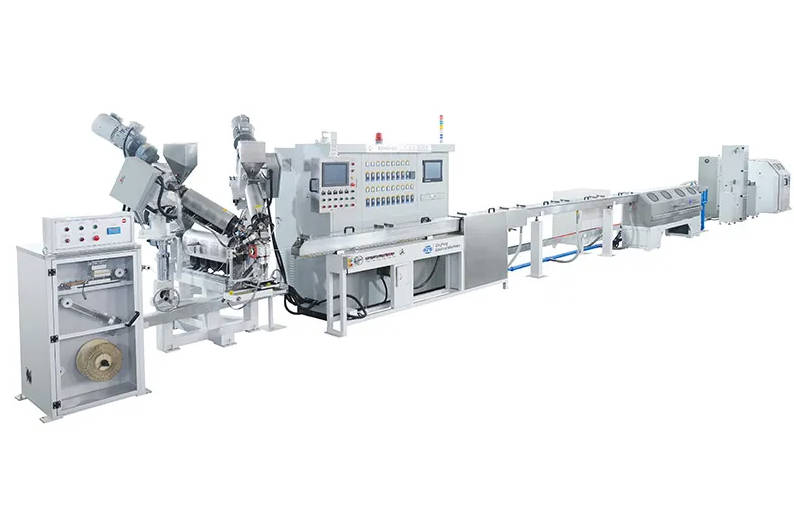
To solve the SRL crisis, High-Speed Taping Machines must be engineered with a “vibration-zero” philosophy. This involves a total redesign of the mechanical path.
Dynamic Balancing Technology
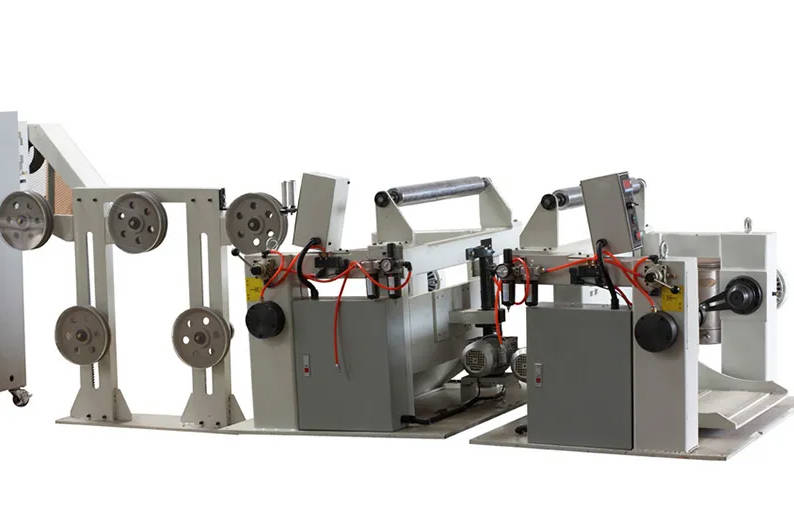
Modern high-end taping heads utilize automatic dynamic balancing systems. Similar to how high-end car tires are balanced, these heads use sensors to detect micro-vibrations in real-time and adjust internal counterweights. This ensures that even at 6,000 RPM, the head remains as still as a precision watch.
Active Tension Control Systems
A standard “passive” brake system cannot react fast enough to the vibrations of a high-speed line. Active Tension Control uses closed-loop feedback loops.
- Sensors: Continuously measure tape tension at the point of application.
- Actuators: Adjust the payout speed in microseconds to compensate for any mechanical flutter.
This results in a tension deviation of less than ±0.2 grams, ensuring a perfectly uniform dielectric layer.
Frame Rigidity and Damping
The machine’s structural foundation is paramount. Utilizing integrated cast-iron frames instead of welded steel provides superior vibration damping. By prioritizing high-precision dynamic balancing and optimized structural rigidity in the taping head, the system minimizes mechanical resonance and prevents vibration transfer to the Twinax core, ensuring the high-precision stability required for 448G production.
V. Performance Benchmarks: 112G vs. 224G vs. 448G
What is the actual benefit of upgrading to a vibration-free system? The data shows a clear divergence in quality as the industry pushes toward 448G.
Comparative Quality Analysis
| Metric | Standard Taping Machine | Vibration-Free High-Speed Machine | Impact on 448G Signal |
| Overlap Precision | ±15% | ±1.5% | Eliminates periodic impedance gaps |
| Tension Variance | ±5.0g | ±0.2g | Ensures stable capacitance across cable |
| Max Stable RPM | 1,200 – 1,500 | 3,000 – 3,500 | >2x Increase in production throughput |
| SRL Spike Margin | < 2dB | > 10dB (Clearance) | Full compliance with IEEE 802.3df |
Google Featured Snippet Candidate:
The primary advantage of vibration-free high-speed taping machines is the ability to maintain tension precision within ±0.2 grams and overlap accuracy within ±1.5% at high RPMs. This mechanical stability ensures that Structural Return Loss (SRL) remains well below the thresholds required for 448G and 800G Twinax cable certification.
VI. Addressing Common User Concerns (The FAQ)
Q1: Does increasing production speed automatically degrade my SRL?
A: With traditional machines, yes. With vibration-free technology, no. Because the system is dynamically balanced and uses active tensioning, you can actually achieve better SRL results at 5,000 RPM than a standard machine achieves at 1,000 RPM.
Q2: How does the machine handle ultra-thin PTFE tapes?
A: 448G cables often use LPTFE (Low-density PTFE) which is extremely fragile. High-speed machines use non-contact air-cushion guides to ensure the tape is never stretched or deformed before it hits the cable core.
Q3: What is the ROI of a higher-priced vibration-free machine?
A: The ROI is found in the Scrap Rate. For 448G cables, the cost of materials (silver-plated copper, specialized PTFE) is immense. If a standard machine produces a 20% failure rate due to SRL spikes, a vibration-free machine usually pays for itself within 6 months by reducing that scrap rate to near zero.
VII. Conclusion: Future-Proofing Twinax Production
The road to 1.6T networking is paved with precision. As the industry moves beyond 448G per lane, the “mechanical-to-electrical” relationship will only become more critical. Manufacturers who continue to use legacy taping equipment will find themselves locked out of the Tier-1 data center supply chain.
Investing in vibration-free high-speed taping technology is no longer a luxury; it is a fundamental requirement for anyone serious about high-speed Twinax production. By eliminating the mechanical sources of SRL spikes, you ensure that your cables aren’t just “good enough” for today, but are ready for the 1.6T demands of tomorrow.