I. Introduction: The Conductor—The First Frontier of 448G
As the global digital infrastructure moves toward the 1.6T networking standard, the pressure on physical layer components has reached a breaking point. With single-lane transmission speeds jumping to 224Gbps and 448Gbps (PAM4), traditional manufacturing tolerances are no longer sufficient. In this high-stakes environment, the focus often shifts to the complex extrusion of Teflon or the precision of active components, yet the most critical foundation is often overlooked: the conductor.
The manufacturing of high-speed internal cables, such as Twinaxial (Twinax) and Active Copper Cables (ACC), begins at the bunching stage. High-precision bunching is the critical first step in 448G cable production, ensuring that the silver-plated copper (SPC) conductors maintain their geometric and surface integrity to prevent signal attenuation at extreme frequencies. For AI data centers, where millions of meters of high-speed interconnects are deployed, even a slight defect in the conductor’s silver layer can lead to a massive failure in Bit Error Rate (BER) testing. This article explores why the High-Precision Bunching Machine is the ultimate guardian of conductor quality in the 448G era.
II. The Science of the “Skin Effect”: Why Surface Integrity is Everything
To understand why bunching precision is so vital, one must understand the physics of high-frequency electrical propagation.
1. Understanding High-Frequency Propagation
As signal frequencies increase, the current no longer flows through the center of the conductor. Instead, it migrates toward the outer edge. This phenomenon is known as the Skin Effect.
In 448G transmission systems, the “Skin Depth” is so shallow that the electrical signal travels almost exclusively within the silver-plated layer on the surface of the copper conductor. Consequently, the quality of that silver surface—its smoothness, thickness, and continuity—directly dictates the Signal Integrity (SI) of the entire cable assembly.
2. The Penalty of Surface Damage
During a standard bunching process, wires are subjected to friction, tension, and bending.
- Micro-scratches: Any mechanical contact that scratches the silver layer increases surface roughness, leading to higher insertion loss.
- Silver Peeling: If the bunching bow or guides are not optimized, the silver plating can flake off, creating “Silver Dust” and leaving the underlying copper exposed. Copper has higher resistance than silver, causing immediate signal degradation.
- Resistance Fluctuations: Inconsistent bunching leads to variations in the DC Resistance (DCR), which disrupts the balance of the differential pair in 448G Twinax cables.
III. Major Challenges in High-Speed SPC Bunching
Manufacturers of 448G internal cabling face a unique set of obstacles when handling Silver-Plated Copper (SPC). Silver is a soft, ductile metal that is highly susceptible to mechanical damage.
1. The Fragility of the Silver Layer
Silver plating is typically measured in microns. Traditional bunching machines, designed for standard power or low-speed data cables, often use hardened steel guides or rough ceramic paths. For SPC, these materials act like sandpaper, stripping the expensive silver coating and ruining the conductor’s high-frequency potential before it even reaches the extruder.
2. Tension-Induced Stretching
Excessive or fluctuating tension during the twisting process causes “necking” or stretching of the individual strands.
Excessive bunching tension thins the silver-plating layer and reduces the cross-sectional area of the conductor, resulting in unpredictable impedance mismatches in 448G and 1.6T cabling systems.
3. Pitch (Lay Length) Inconsistency
The “Lay Length” (the distance of one full twist) must be perfectly uniform. If the pitch varies, the mechanical flexibility and electrical inductance of the conductor will fluctuate. This leads to Intra-pair Skew and Phase Jitter, which are the primary enemies of PAM4 signaling at 448Gbps.
4. Geometric Defects: “Birdcaging”
“Birdcaging” occurs when the outer strands of a bunched conductor are loose or unevenly tensioned, causing them to bulge outward. This defect makes it impossible to achieve a high-quality, uniform Teflon Physical Foaming layer during extrusion, as the irregular shape of the conductor creates air gaps and impedance spikes.
IV. QingFeng SFS Engineering Solutions: The High-Precision Bunching Advantage
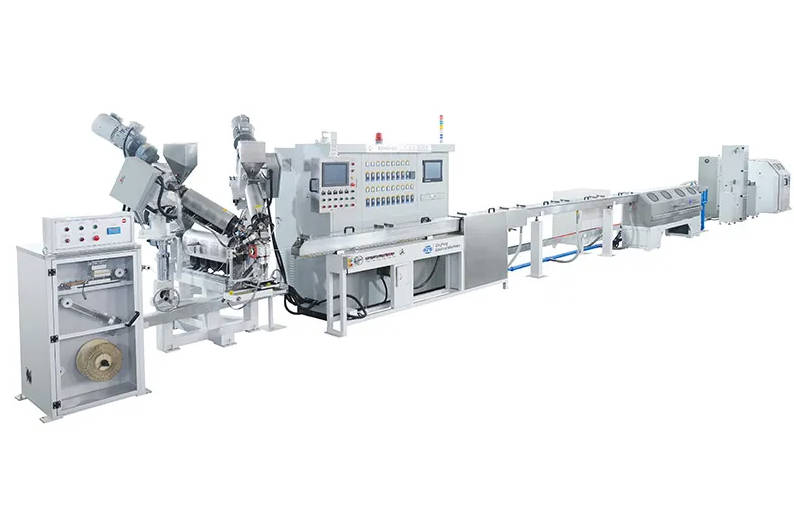
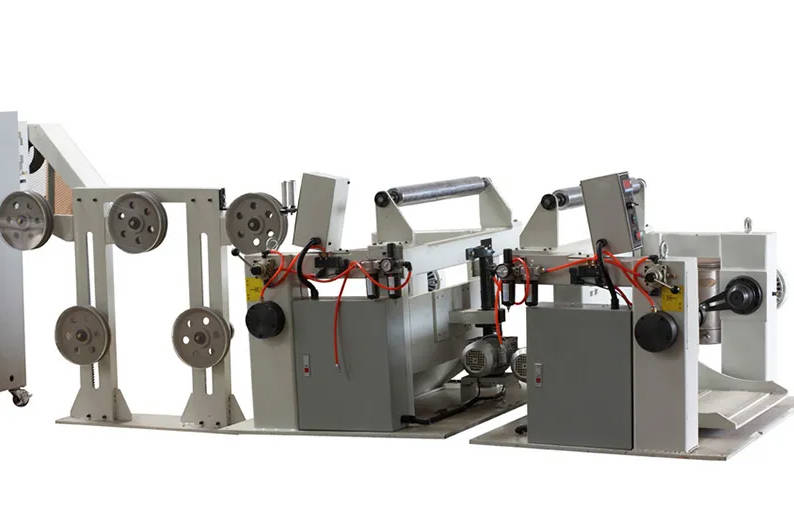
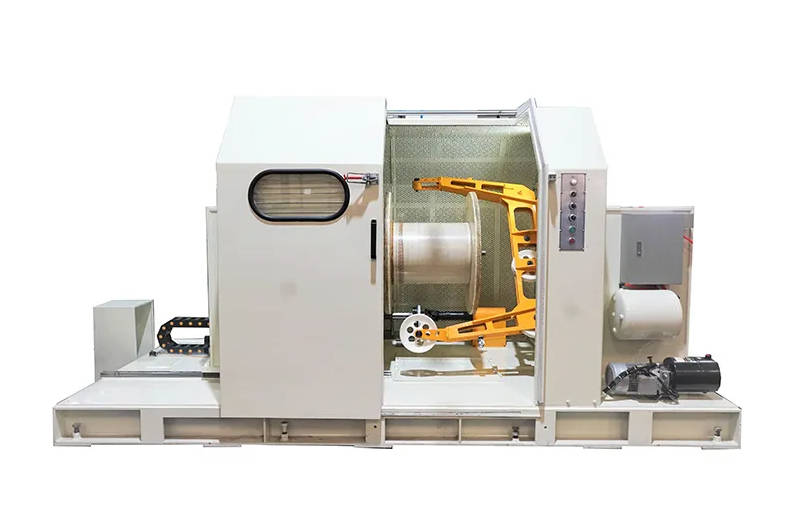
QingFeng SFS () has re-engineered the bunching process specifically for the 448G and 1.6T markets. Our High-Precision Bunching Machine is designed to handle fragile SPC conductors with “medical-grade” care.
1. Active Servo Tension Control
We have replaced legacy friction brakes with an Active Servo Tension Control System. This system utilizes ultra-sensitive load cells to monitor the tension of every strand in real-time.
QingFeng SFS’s active tensioning system maintains a stable force within ±0.5g, ensuring that silver-plated conductors are never stretched or compromised during the high-speed twisting process.
2. Low-Friction Wire Path Design
To eliminate mechanical abrasion, QingFeng SFS uses Aerospace-grade Carbon Fiber Bows and diamond-coated or specialized ceramic exit guides. These materials provide the lowest possible coefficient of friction, ensuring that the silver layer remains perfectly smooth and intact from the payoff to the take-up reel.
3. Automatic Lay Length Synchronization
Our machines utilize a high-speed PLC (Power Line Communication) link to synchronize the bunching rotation speed with the take-up speed. This ensures a Pitch Accuracy of 0.1%, providing the mechanical and electrical consistency required for the most demanding AI server interconnects.
Technical Comparison: Traditional vs. QingFeng SFS High-Precision Bunching
| Performance Metric | Traditional Bunching Machine | QingFeng SFS 448G Precision Buncher |
| Tension Control | Passive Friction / Magnetic | Active Servo Closed-Loop |
| Tension Accuracy | ±10g to ±15g | ±0.5g to ±1g |
| Surface Protection | Hardened Steel / Standard Ceramic | Carbon Fiber & Diamond Coating |
| Pitch (Lay Length) Accuracy | ±3% to ±5% | ±0.1% |
| Max Rotation Speed | 1,500 – 2,000 RPM | 3,000 – 4,000 RPM |
| Silver Dust Generation | High (Visible) | Near-Zero (Clean Process) |
V. Addressing Manufacturer FAQs: Common Pain Points in Bunching
FAQ 1: How do we eliminate “Silver Dust” accumulation in the bunching bow?
Silver dust is a symptom of mechanical scraping. If you see dust, your conductor is already damaged. QingFeng SFS eliminates this by optimizing the “entry angle” of the wire into the bow and using polished, non-abrasive guides. A cleaner machine environment is proof of a higher-quality conductor.
FAQ 2: What is the optimal lay length for 448G Twinax conductors?
While the specific design depends on the cable diameter, a shorter, more consistent lay length generally provides better flexibility and mechanical stability. However, it must be perfectly uniform. Any variation in lay length translates directly into impedance fluctuations during the high-frequency test.
FAQ 3: How can we ensure tension remains constant from an empty bobbin to a full one?
This is a common challenge due to the change in the bobbin’s weight and radius. QingFeng SFS’s High-Precision Bunching Machine uses a “Diameter-Compensated” algorithm that automatically adjusts the torque and braking force in real-time as the bobbin fills, maintaining identical tension from the first meter to the last.
VI. The Production Synergy: From Buncher to Extruder
The conductor is the “skeleton” of the cable. If the skeleton is deformed, the “flesh” (insulation) cannot be applied correctly.
- Perfect Roundness: A high-precision bunched conductor is perfectly round. This allows for a Concentricity of >95% during the Teflon Physical Foaming stage.
- Surface Adhesion: A clean, un-scratched silver surface ensures better adhesion between the conductor and the Teflon insulation, preventing “shrink-back” and maintaining the dielectric constant over time.
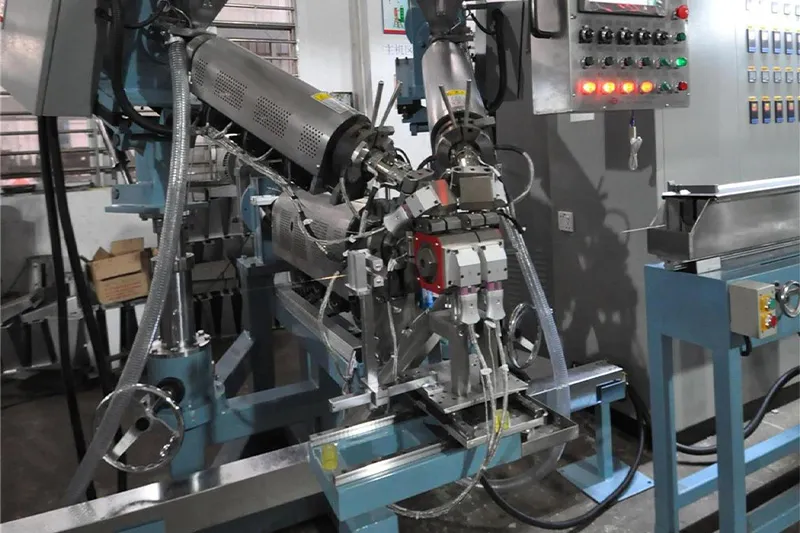
- Total Quality Management: Using the QingFeng SFS Full Range of Network Cable Equipment ensures that the tension settings and precision standards are consistent across every stage of production, from the buncher to the Taping Machine.
VII. Conclusion: Protecting Your Most Expensive Raw Material
In the manufacturing of 448G internal cables, the Silver-Plated Copper (SPC) conductor is often the most expensive raw material. Scrapping a finished cable because of a defect introduced at the very first stage is a massive financial loss.
Investing in a QingFeng SFS High-Precision Bunching Machine is the most effective way to protect your raw material investment and ensure that your 1.6T cabling products pass the most rigorous signal integrity tests in the industry. By treating the silver layer as a precious component rather than just a wire, you position your factory as a Tier-1 supplier for the AI and HPC markets.
Ready to upgrade your conductor quality for 448G? Contact QingFeng SFS today to learn more about our high-precision bunching and twisting solutions.