The rapid expansion of AI infrastructure in 2026 has pushed high-speed data transmission to its physical limits. As data centers transition from 400G to 800G and early-stage 1.6T Ethernet, the Direct Attach Copper (DAC) cable has become a centerpiece of engineering focus. At these frequencies, specifically using 112G PAM4 signaling, the most persistent enemy of signal integrity is not just attenuation, but Intra-pair Skew.
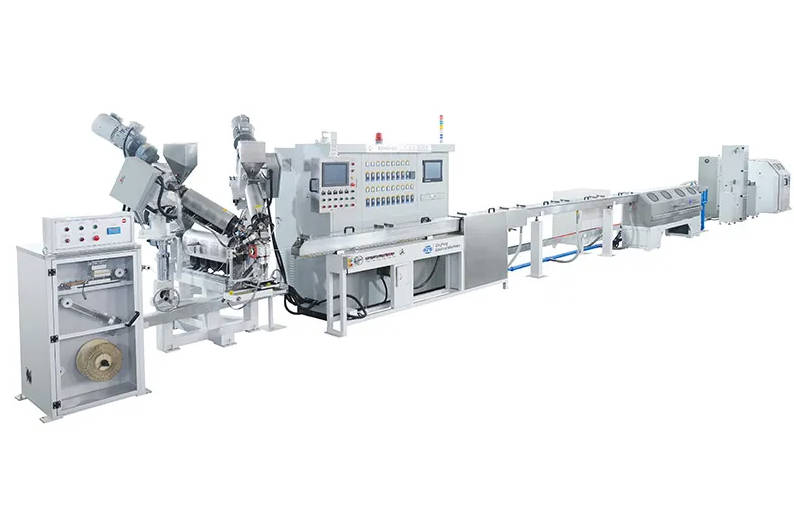
For manufacturers, the challenge of Skew is often misunderstood. While many believe Skew is solely a result of the extrusion process, the truth is that the cabling and assembly stage is where high-performance Twinax is either perfected or destroyed. At QingFeng SFS, we advocate for a sincere, technically grounded approach to assembly. This article explores why the Planetary Cable Machine is the only viable solution for protecting the delicate physics of 800G DACs.
1. The “Invisible” Enemy: Why Skew Ruins 800G Performance
Intra-pair Skew is the timing difference between the two signals traveling down the two cores of a Twinax pair. In an ideal world, the “A” wire and “B” wire are identical in length and electrical properties. However, at 112G PAM4, a timing difference of just a few picoseconds can cause the receiver to misinterpret the signal levels, leading to a high Bit Error Rate (BER).
To achieve the signal integrity required for 800G DACs, manufacturers must eliminate residual torsion during the cabling process, as any physical twist in the Twinax core alters the internal geometry and directly causes Intra-pair Skew.
Many factories find that their extruded cores pass all individual tests, yet the finished cable fails. This “invisible” defect is almost always introduced by using the wrong type of cabling equipment that subjects the wire to mechanical stress.
2. Standard Bunching vs. Planetary Cabling: The Physics of Torsion
In traditional cable manufacturing, a “Bunching” or “Twisting” machine rotates the take-up or the pay-off to twist the wires together. While this is efficient for power cables or low-speed data lines, it is catastrophic for high-speed Twinax.
The Torsion Trap
When a standard machine twists a Twinax pair, it introduces internal torsion. This torsion compresses the delicate Skin-Foam-Skin (SFS) insulation. Because the two wires in the pair are twisted together, one wire inevitably experiences slightly more tension or compression than the other. This results in a physical length difference and a dielectric constant shift, both of which contribute to Skew.
The Planetary Advantage (100% Back-twist)
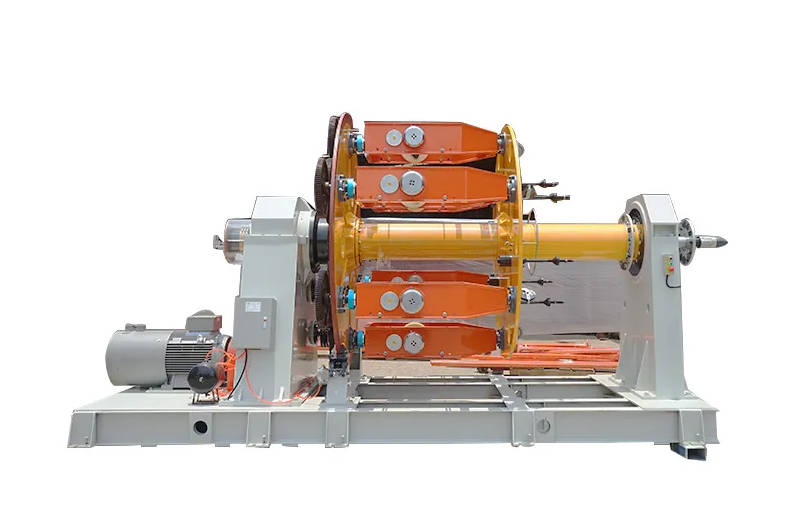
A Planetary Cable Machine operates differently. The bobbins containing the Twinax cores are mounted in a “Planetary” cage that rotates around a central axis. Crucially, as the cage rotates, the bobbins remain in a constant orientation relative to the ground. This is known as Back-twist (退扭).
By utilizing a Planetary Cable Machine with a 100% back-twist ratio, the Twinax cores are bundled without any internal twisting, ensuring that the foamed insulation remains uncrushed and the electrical symmetry of the pair is perfectly preserved.
3. Solving the “7 Hard Questions” of Planetary Cable Machine Users
Working with 800G and 1.6T customers, we have encountered several recurring technical doubts. Here is our sincere guide to solving the most critical assembly challenges.
Q1: Why do I still have Skew if my extrusion is perfect?
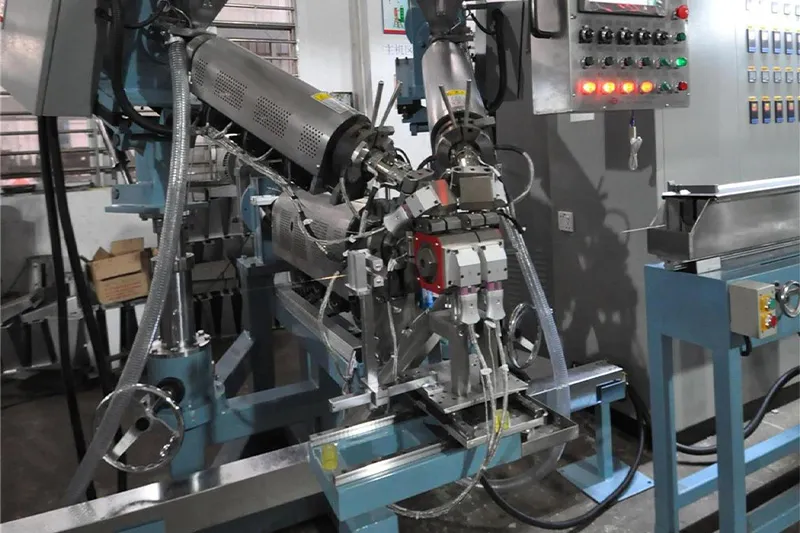
Even if your Extrusion Line produces identical cores, a standard cabling machine will introduce residual stress. If “Wire A” is twisted more tightly than “Wire B,” their electrical lengths will differ.
- The Solution: Switch to planetary cabling to ensure zero-torsion assembly.
Q2: Is 100% back-twist really necessary for PCIe 6.0?
For PCIe 6.0 (64 GT/s) and 800G, anything less than 100% back-twist introduces “Impedance Ripple.” Even a 20% residual twist can cause periodic defects that lead to signal reflections.
- The Solution: Ensure your machine is mechanically or electronically geared to provide a true 1:1 back-twist ratio.
Q3: How do I prevent core elongation during assembly?
30AWG to 34AWG conductors are extremely fragile. If the payout tension on the planetary bobbin is inconsistent, one core will stretch more than the other.
- The Solution: High-speed planetary machines must utilize ultra-lightweight mechanical dancers on every individual bobbin to maintain a constant, low-tension payout that prevents conductor elongation.
Q4: How do I ensure all bobbins are synchronized?
In old mechanical machines, vibration and gear wear could cause synchronization drift.
- The Solution: Modern Planetary Cable Machines should use dedicated high-speed motion controllers. Each bobbin and the main cage are synchronized via electronic gearing, ensuring microsecond-level alignment.
Q5: Can a planetary machine handle ultra-fine 34AWG cores?
A common fear is that the sheer size of a planetary cage will snap fine wires.
- The Solution: At QingFeng SFS, we optimize the inertia of the rotating cage and use ceramic-coated guides to ensure that 34AWG cores can be handled at high RPMs without abrasion or breakage.
Q6: Why do defects increase at higher RPMs?
Centrifugal force can cause the core wire to “swing” within the cage, leading to uneven tension.
- The Solution: Stability is key. A balanced mechanical design and precisely positioned guide rollers are required to counteract centrifugal forces during high-speed operation.
Q7: How do I maintain such a complex machine?
Planetary machines have many moving parts.
- The Solution: Focus on a design with simplified lubrication paths and high-visibility monitoring. A sincere partner provides a machine that is easy for daily operators to inspect and maintain.
4. Technical Specifications for 800G Assembly
When evaluating a Planetary Cable Machine for your facility, use these benchmarks to ensure compatibility with 2026 standards.
| Feature | Requirement for 400G | Requirement for 800G/1.6T | QingFeng SFS Benchmark |
| Back-twist Ratio | 80% – 100% | Strict 100% | Mechanical/Electronic Gearing |
| Tension Range | 200g – 500g | 50g – 150g | Ultra-fine mechanical dancer |
| Control System | Standard PLC | Motion Controller | Microsecond Synchronization |
| Bobbbin Diameter | 400mm – 500mm | 250mm – 400mm | Low-Inertia Design |
| RPM Stability | ±5 RPM | ±1 RPM | High-resolution Encoder Feedback |
5. The Motion Control Revolution in Cabling
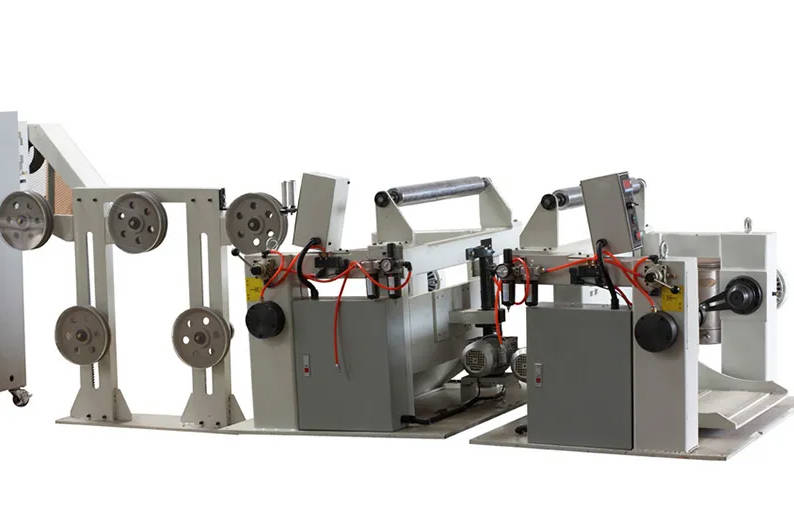
In the past, cabling was considered a “mechanical” process. Today, it is a “software and motion” process. For 800G DAC production, the complexity of planetary rotation requires a system that treats every motor as part of a single unified gear.
Utilizing high-speed motion controllers in the planetary cabling process allows for the dynamic balancing of tension across multiple bobbins, ensuring that the payout of ‘Wire A’ and ‘Wire B’ is identical to within a fraction of a millimeter.
This technology eliminates the human error associated with manual tension adjustments and ensures that your yield remains high, even during long production runs of 8-pair or 16-pair high-density cables.
6. R&D Insights: The Path to 1.6T (224G per Lane)
As we look toward 1.6T Ethernet, the requirements for Skew will become even more punishing. At QingFeng SFS, we view the Planetary Cable Machine not just as a production tool, but as a dynamic R&D platform.
We must be sincere: 1.6T DAC mass production is currently in the verification and R&D phase. We are working with customers to test how different shielding materials—such as ultra-thin silver foil—react to the planetary assembly process. By maintaining a torsion-free environment, we allow engineers to isolate variables and find the perfect balance between shielding effectiveness and mechanical flexibility.
Conclusion: Precision as a Partnership
The transition to 800G and 1.6T is a journey that requires every machine in your factory to speak the same language of precision. While the Extrusion Line sets the potential of the cable, the Planetary Cable Machine realizes that potential by assembling the cores without damage.
At QingFeng SFS, we don’t just sell equipment; we provide the technical transparency and support needed to solve the most difficult problems in cable assembly. Intra-pair Skew is a solvable problem, provided you respect the physics of the wire and choose a partner committed to sincere engineering excellence.
FAQ: Quick Review for Technical Teams
Q1: What is the maximum allowable Skew for an 800G DAC?
A: While it varies by customer spec, the goal for 800G (112G PAM4) is typically less than 5ps/m. Achieving this requires a near-perfect torsion-free cabling process.
Q2: Why is “Back-twist” the most important feature for Twinax?
A: Back-twist ensures that the internal structure of the Twinax pair is not rotated. Without it, the foamed insulation is compressed unevenly, causing impedance drift and Skew.
Q3: Can I use a standard twisting machine for PCIe 6.0 cables?
A: We sincerely advise against it. Standard twisting creates residual mechanical stress that is almost impossible to compensate for at frequencies above 30GHz.
Q4: How does QingFeng SFS ensure identical tension for all core wires?
A: We use ultra-lightweight mechanical dancers on each bobbin. These dancers provide immediate physical feedback to the payout motor, keeping tension constant regardless of line speed.
Q5: What is the specific advantage of a Planetary Machine for multi-pair DACs?
A: When bundling 8 or 16 pairs, a planetary machine ensures that every pair is treated with the same zero-torsion precision, leading to uniform performance across all channels.
Q6: Does a Planetary Machine run slower than a Bunching Machine?
A: Yes, planetary machines are generally slower due to the mechanical complexity of the rotating cage. However, the significantly higher Yield Rate makes them far more profitable for high-end 800G production.
Q7: How do we verify the “torsion-free” state of a cable?
A: Beyond electrical Skew testing, manufacturers often use cross-sectional analysis (microscope) to ensure that the “A” and “B” wires have maintained their parallel orientation without any visible twisting.