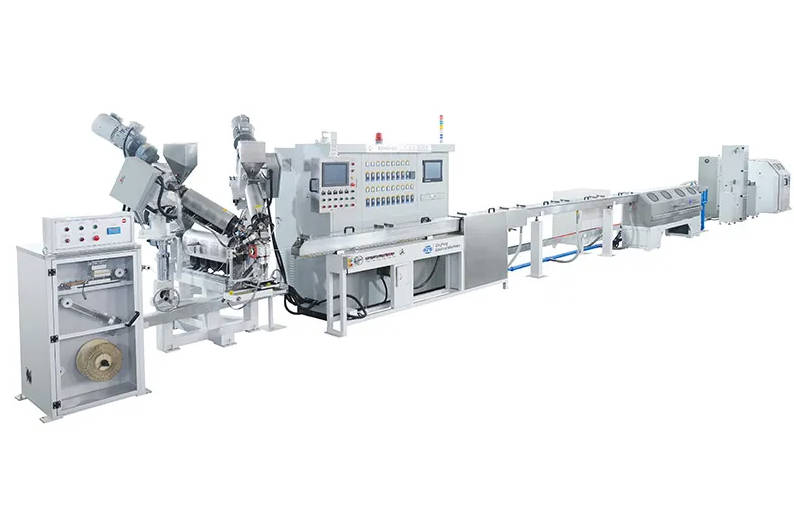
For high-frequency twinax cable production, solid insulation offers stronger mechanical stability and easier process control, while foam insulation can help reduce dielectric constant, lower signal loss, and support better high-speed transmission performance in many applications. The right choice depends on cable design, impedance requirements, attenuation targets, material selection, production capability, and the precision of the extrusion line.
In twinax cable manufacturing, insulation is not only a protective layer around the conductor. It is a key part of the cable’s electrical structure. The insulation material, wall thickness, concentricity, foaming uniformity, and outer diameter stability can directly influence impedance consistency, attenuation, signal integrity, and long-term cable reliability.
For manufacturers producing high-frequency data cables, communication cables, or precision twinax cables, choosing between solid insulation and foam insulation is both a technical decision and a production investment decision. A suitable extrusion line must be able to control temperature, pressure, line speed, conductor preheating, cooling, diameter measurement, and take-up tension with high stability.
This article compares solid insulation and foam insulation for twinax cable production and explains how the extrusion process affects high-frequency cable performance.
What Is Insulation in Twinax Cable Production?
Twinax cable usually contains two conductors arranged for balanced signal transmission. Each conductor may be insulated individually, and the pair may also be wrapped, shielded, or jacketed depending on the cable design.
Insulation has several important functions:
| Function | Importance in Twinax Cable |
| Electrical separation | Prevents conductor contact and supports stable signal transmission |
| Dielectric control | Influences impedance, capacitance, attenuation, and propagation behavior |
| Mechanical protection | Protects conductors from damage during downstream processing |
| Geometry control | Helps maintain conductor spacing and cable symmetry |
| Process compatibility | Supports taping, shielding, cabling, and jacket extrusion steps |
In ordinary low-frequency cables, insulation is often viewed mainly as a protective layer. In high-frequency twinax cables, however, insulation is part of the signal path. Its properties and manufacturing consistency matter more.
High frequency cable insulation must maintain stable material properties, uniform thickness, good concentricity, and consistent outer diameter during production.
What Is Solid Insulation Cable?
Solid insulation cable uses a continuous, non-foamed polymer layer around the conductor. The insulation material may vary depending on cable design, electrical requirements, temperature requirements, and cost considerations. In many cable applications, solid insulation is selected because it is mechanically stable and relatively easier to control during extrusion.
Solid insulation is commonly used when the cable requires:
Stronger mechanical suppor
Better crush resistance
Easier extrusion setup
Stable wall thickness
Smooth surface quality
Lower process complexity
Good handling during downstream productio
For twinax cable production, solid insulation can provide a stable conductor covering and predictable mechanical structure. It is often suitable for applications where mechanical robustness, production repeatability, and process simplicity are important.
However, solid insulation usually has a higher effective dielectric constant than foam insulation made from the same base polymer. This may influence capacitance, signal velocity, and attenuation in high-speed cable designs. Therefore, solid insulation is not always the preferred option for very high-frequency transmission.
What Is Foam Insulation Twinax Cable?
Foam insulation twinax cable uses an insulation layer that contains controlled microscopic air cells within the polymer. Because air has a low dielectric constant, introducing a controlled foam structure can reduce the effective dielectric constant of the insulation layer.
Foam insulation is often used in high-frequency twinax cable because it can reduce dielectric constant and help improve signal transmission performance when the foam structure is stable and uniform.
Foam insulation may be produced through physical foaming, chemical foaming, or other process designs depending on the material and equipment configuration. In high-frequency cable production, physical foaming is often preferred in many precision applications because it can offer better control over cell structure when properly engineered.
Foam insulation is commonly considered when the cable requires
Lower dielectric constan
Reduced capacitance
Improved signal velocity
Lower attenuation in many high-frequency application
Lighter insulation structure
Better electrical performance potentia
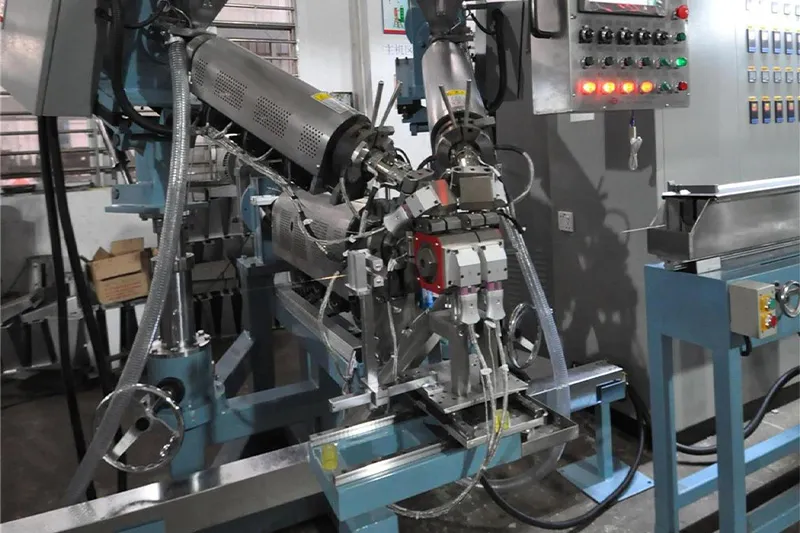
However, foam insulation is more demanding to produce than solid insulation. The extrusion line must control material melting, gas injection or foaming conditions, pressure stability, cooling, diameter control, and foam uniformity. Poorly controlled foam insulation can cause inconsistent cell size, unstable outer diameter, weak mechanical strength, or impedance variation.
Solid vs Foam Insulation: Key Comparison
The following table summarizes the main differences between solid insulation and foam insulation for high-frequency twinax cable production.
| Comparison Item | Solid Insulation | Foam Insulation |
| Structure | Dense polymer layer | Polymer layer with controlled air cells |
| Process complexity | Generally easier to control | More complex and process-sensitive |
| Mechanical strength | Usually stronger | Usually lower than solid insulation, depending on foam ratio |
| Dielectric constant | Typically higher than foam version of the same material | Lower due to air content |
| Attenuation performance | Suitable for many applications but may have higher dielectric loss | Often preferred for high-frequency signal performance |
| Diameter control | Easier to stabilize | Requires precise foaming and cooling control |
| Concentricity control | Important but generally easier | More challenging because foam expansion must be stable |
| Surface quality | Usually smoother and easier to manage | Requires careful cooling and process adjustment |
| Equipment requirement | Standard precision extrusion line may be sufficient | Requires more advanced extrusion control and foaming capability |
| Typical use case | Robust cable, simpler production, stable mechanical requirements | High-speed data cable, low-loss cable, advanced communication cable |
Neither structure is universally better. The correct choice depends on the cable’s electrical requirements, mechanical requirements, cost target, and production capability.
Why Insulation Choice Matters for High-Frequency Twinax Cable
Twinax cable performance depends heavily on structural consistency. Even small changes in insulation thickness, density, conductor position, or outer diameter may affect the electrical behavior of the cable.
For high-frequency twinax cables, insulation choice can influence:
1. Impedance Stability
Impedance is affected by conductor geometry, insulation material, dielectric properties, and spacing between conductors. If insulation thickness or dielectric properties vary along the cable length, impedance may become unstable.
Solid insulation can be easier to control mechanically. Foam insulation can offer better dielectric performance, but only when the foam structure is consistent.
2. Attenuation
Attenuation refers to signal loss over distance. In high-frequency cables, dielectric loss can become an important factor. Foam insulation may help reduce dielectric-related loss because of its lower effective dielectric constant.
However, if foam cells are uneven or the insulation structure is unstable, the expected performance benefit may not be achieved.
3. Signal Velocity
A lower effective dielectric constant can increase signal propagation velocity. Foam insulation may therefore be useful for applications where signal timing and high-speed transmission are important.
4. Cable Geometry
Twinax cable geometry must remain stable through extrusion, cooling, taping, shielding, and jacketing. Insulation that deforms easily may create downstream problems. This is why extrusion stability and material selection are critical.
5. Production Yield
A theoretically advanced insulation structure is not useful if it cannot be produced consistently. Foam insulation may offer strong performance potential, but it requires better equipment, process control, and operator experience.
Solid Insulation Extrusion: Keeping Wall Thickness and Concentricity Stable
For solid insulation cable, extrusion control is mainly focused on geometry stability and material consistency. Since the insulation layer is a dense polymer structure, the key production target is to keep the conductor centered, maintain uniform wall thickness, avoid surface defects, and control outer diameter variation throughout continuous production.
Although solid insulation is usually easier to process than foam insulation, high-frequency twinax cable still requires a stable extrusion line. Small changes in melt flow, conductor position, cooling condition, or traction speed may affect insulation roundness, concentricity, and impedance consistency.
Key control priorities for solid insulation extrusion include:
| Control Area | What Needs to Be Controlled | Why It Matters for Solid Insulation |
| Melt temperature stability | The extruder should maintain a stable and suitable temperature profile from feeding to die output. | Unstable temperature may cause poor plasticization, rough surface, material degradation, or inconsistent insulation density. |
| Screw design and plasticization | The screw should match the insulation material and provide uniform melting and mixing. | Poor plasticization may lead to gels, lumps, uneven flow, or weak surface quality, which can affect downstream taping and shielding. |
| Conductor preheating | The conductor temperature should be controlled before entering the extrusion die. | Proper preheating helps reduce thermal shock, improve adhesion, and support a more stable interface between conductor and insulation. |
| Die and tooling alignment | The die, tip, guide, and conductor path should be accurately aligned. | Tooling alignment directly affects concentricity, wall thickness distribution, and conductor centering inside the insulation layer. |
| Cooling path control | Cooling should be gradual and stable, especially for small-diameter or precision cable structures. | Improper cooling may cause shrinkage, internal stress, ovality, or dimensional instability after extrusion. |
| Online diameter monitoring | The outer diameter should be measured continuously during production. | Real-time measurement helps detect diameter drift early and supports quick adjustment before long lengths of cable are affected. |
| Capstan and traction stability | Pulling speed should remain synchronized with extrusion output. | Speed fluctuation may cause diameter variation, stretching, or unstable wall thickness along the cable length. |
| Take-up tension | Winding tension should be controlled after extrusion and cooling. | Excessive or unstable take-up tension may deform the insulation, affect cable geometry, or create handling problems in later processes. |
For solid insulation cable, the extrusion line should not only produce a smooth insulation surface, but also maintain repeatable geometry over long production runs. The main quality indicators are stable outer diameter, good concentricity, uniform wall thickness, smooth surface finish, and reliable cable handling after take-up.
A well-configured extrusion line helps manufacturers reduce adjustment frequency, improve production repeatability, and maintain consistent insulation quality for high-frequency twinax cable manufacturing.
Foam Insulation Extrusion: Controlling Cell Formation, Expansion, and Density
Foam insulation extrusion is more sensitive than solid insulation because the final insulation structure depends on controlled cell formation and expansion. The extrusion line must not only shape the polymer around the conductor, but also control foam ratio, cell size, cell distribution, density, cooling behavior, and dimensional stability at the same time.
If the foaming process is unstable, the insulation may show uneven density, irregular cell size, weak mechanical strength, poor roundness, unstable outer diameter, or impedance variation. Therefore, foam insulation production requires stronger process discipline and more precise equipment configuration.
Important control points for foam insulation extrusion include:
| Foaming Control Point | Production Risk If Unstable | Engineering Control Focus |
| Melt temperature control | Overheating or underheating may change foaming behavior, cell size, and melt strength. | Keep the temperature profile stable and suitable for the selected material and foaming method. |
| Pressure stability | Pressure fluctuation may cause sudden foam expansion, unstable density, or irregular outer diameter. | Maintain stable melt pressure before the die and avoid abrupt process changes during continuous production. |
| Gas or foaming agent control | Inaccurate dosing may create uneven foam ratio, inconsistent dielectric properties, or weak insulation structure. | Control gas injection or foaming agent distribution precisely according to the required foam level. |
| Screw and barrel configuration | Poor mixing may cause uneven cell distribution or unstable material flow. | Use a screw and barrel design suitable for stable melting, mixing, and foaming preparation. |
| Die pressure and flow design | Improper die design may disturb expansion behavior and affect roundness. | Match die structure with material flow, pressure release, insulation diameter, and required foam expansion. |
| Cooling and foam setting | Too fast or uneven cooling may lock in unstable foam structure or create surface defects. | Control the cooling method so that the foam structure sets evenly while maintaining outer diameter stability. |
| Line speed synchronization | Speed changes may affect wall thickness, foam expansion, and density consistency. | Keep extrusion output, line speed, cooling, and take-up synchronized during production. |
| Online measurement and feedback | Diameter fluctuation may not be detected until a long defective section has already been produced. | Use online diameter monitoring and process records to identify early signs of unstable foaming. |
For foam insulation twinax cable, the production target is not only dimensional accuracy, but also internal structure consistency. A stable foam layer should have controlled cell size, uniform density, reliable mechanical strength, and consistent outer diameter. These factors are especially important for high-frequency cable applications because dielectric variation may directly affect impedance, attenuation, and signal transmission stability.
Compared with solid insulation, foam insulation places higher demands on extrusion temperature control, pressure control, foaming system accuracy, cooling stability, and operator experience. A small process change may affect both the physical structure and electrical performance of the cable.
For manufacturers developing foam insulation twinax cable, QingFeng SFS provides extrusion line solutions for cable production environments where process stability, equipment configuration, and production repeatability are critical.
Material Considerations for Solid and Foam Insulation
Different insulation materials may be used depending on electrical, thermal, mechanical, and cost requirements. Common cable insulation materials may include polyethylene-based materials, fluoropolymers, polypropylene-based materials, or other engineering polymers depending on the cable specification.
When selecting insulation material, engineers should evaluate:
| Material Factor | Why It Matters |
| Dielectric constant | Influences impedance and signal velocity |
| Dissipation factor | Affects dielectric loss at high frequency |
| Thermal resistance | Important for processing and operating conditions |
| Mechanical strength | Affects cable handling and durability |
| Processability | Determines extrusion stability and productivity |
| Adhesion behavior | Influences conductor interface quality |
| Foamability | Critical for foam insulation designs |
| Cost and availability | Affects commercial feasibility |
The same base material may behave differently in solid and foam structures. Foam insulation can lower the effective dielectric constant by adding air cells, but it may reduce mechanical strength if the foam ratio is too high or poorly controlled.
Manufacturing Challenges in Foam Insulation Twinax Cable
Foam insulation offers performance advantages, but it also introduces manufacturing challenges.
Foam Uniformity
Foam cell size and distribution should be consistent. Uneven foam may cause local variation in dielectric properties and cable dimensions.
Diameter Stability
Foam expansion must be controlled to maintain the required insulation diameter. If the diameter fluctuates, impedance and downstream processing may be affected.
Mechanical Strength
Higher foam content may reduce mechanical strength. Engineers need to balance electrical performance with cable robustness.
Conductor Centering
The conductor must remain centered in the insulation. Poor concentricity may cause electrical imbalance and inconsistent cable performance.
Cooling Control
Cooling must set the foam structure without creating excessive shrinkage or surface defects. Improper cooling may affect roundness and outer diameter.
Production Repeatability
Foam insulation requires stable recipes and disciplined process control. Operators should record temperature, pressure, line speed, gas settings, diameter readings, and inspection results.
Manufacturing Challenges in Solid Insulation Cable
Solid insulation is generally easier to produce, but it still has challenges in high-frequency cable manufacturing.
Wall Thickness Variation
Uneven wall thickness can change conductor spacing and dielectric distribution.
Concentricity Error
Poor centering may affect impedance balance and cable symmetry.
Surface Defects
Rough surface, lumps, gels, or scratches may affect downstream taping and shielding.
Material Degradation
Overheating or poor plasticization may damage material properties.
Cooling Shrinkage
Improper cooling may cause dimensional instability or internal stress.
Traction Instability
Unstable pulling speed can create diameter fluctuation or elongation.
For high-frequency twinax cable, solid insulation still requires high-precision extrusion control. It should not be treated as a simple low-end process.
Selection Guide: Solid or Foam Insulation?
The following table can help cable manufacturers compare which insulation structure may be more suitable for different production goals.
| Production Goal | More Suitable Option | Reason |
| Easier process setup | Solid insulation | Lower process complexity |
| Strong mechanical robustness | Solid insulation | Dense polymer structure provides better support |
| Lower dielectric constant | Foam insulation | Air cells reduce effective dielectric constant |
| Lower high-frequency attenuation | Foam insulation in many designs | Lower dielectric contribution can support signal performance |
| Higher production simplicity | Solid insulation | Easier to stabilize in many factories |
| Advanced high-speed cable design | Foam insulation | Often used when electrical performance is prioritized |
| Lower equipment complexity | Solid insulation | Does not require foaming control system |
| Lightweight cable structure | Foam insulation | Air content reduces material density |
| Tight dimensional tolerance | Both, depending on equipment | Requires precision extrusion line and process control |
| Flexible product portfolio | Depends on market needs | Some factories may need both processes |
A practical decision should be based on cable testing, production capability, customer requirements, and equipment investment.
What to Consider Before Buying an Extrusion Line
When selecting an extrusion line for high-frequency twinax cable insulation, buyers should evaluate the complete process instead of only the extruder model.
Key questions include:
| Question | Why It Matters |
| Will the line produce solid insulation, foam insulation, or both? | Determines equipment configuration |
| What materials will be processed? | Affects screw design, temperature control, and tooling |
| What conductor size range is required? | Determines pay-off, guiding, and tooling design |
| What insulation outer diameter tolerance is needed? | Determines online measurement and control needs |
| Is physical foaming required? | Requires additional foaming system and process control |
| What line speed is realistic for stable quality? | Prevents overestimating output |
| How will diameter and concentricity be monitored? | Supports quality control |
| What downstream processes follow extrusion? | Taping, shielding, cabling, or jacketing may affect requirements |
| What technical support is available? | Important for commissioning and production optimization |
Buyers can visit the QingFeng SFS official website to learn more about cable equipment capabilities and available product categories.
Downstream Taping Quality: Common Problems and Process Adjustments
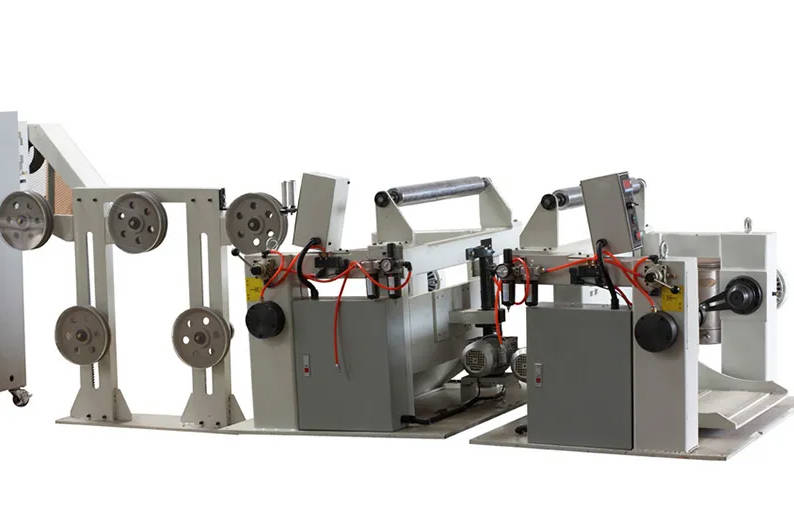
After insulation extrusion, many twinax cable structures require taping, shielding, cabling, or jacket extrusion. If the insulation layer is stable but the downstream taping process is poorly controlled, the final cable may still show uneven coverage, loose tape, unstable shielding, or handling problems in later production steps.
During cable taping, small changes in tape tension, line speed, bobbin braking, capstan synchronization, or take-up control may cause visible defects. These problems can affect cable appearance, shielding coverage, dimensional stability, and downstream processing quality. Therefore, operators should check both machine settings and material handling conditions when defects appear.
| Problem | Possible Causes | Recommended Adjustment |
| Uneven overlap | Uneven overlap is usually related to speed fluctuation, unstable capstan movement, incorrect pitch setting, or poor synchronization between the taping head and line speed. It may also occur when the tape bobbin tension changes during unwinding, when the cable path is not stable before entering the taping zone, or when the selected recipe does not match the actual cable diameter and required overlap ratio. | Check whether the taping pitch, line speed, and capstan speed are synchronized. Confirm that the recipe settings match the cable diameter, tape width, taping angle, and required overlap ratio. Inspect the tape path, guide position, bobbin rotation, and tension stability. If the overlap changes gradually during production, operators should also check whether the bobbin braking force changes as the tape roll diameter becomes smaller. |
| Loose tape | Loose tape is often caused by low tape tension, unstable bobbin braking, poor tape unwinding, take-up fluctuation, or insufficient control of the cable path. If the tape is not applied tightly enough, it may shift, wrinkle, open at the edge, or fail to maintain stable coverage during later shielding, cabling, or jacketing processes. Loose tape may also lead to inconsistent cable diameter or poor appearance after downstream processing. | Increase tape tension within a controlled range instead of making a sudden large adjustment. Inspect the bobbin brake system, tension controller, tape guide, and take-up condition. Make sure the tape is pulled smoothly without jerking or slipping. Operators should also check whether the selected tape width, tape material, wrapping angle, and overlap ratio are suitable for the cable diameter and required cable structure. |
A stable taping process depends on the coordination of tape tension, taping pitch, line speed, capstan control, bobbin braking, and take-up stability. When troubleshooting, operators should avoid adjusting only one parameter without checking the full process. For precision cable production, successful settings should be recorded as process recipes so that the same cable structure can be reproduced with fewer defects in future batches.
Common Mistakes When Choosing Insulation Structure
Mistake 1: Assuming Foam Insulation Is Always Better
Foam insulation can support high-frequency performance, but it must be produced consistently. Poor foam uniformity may create more problems than benefits.
Mistake 2: Choosing Solid Insulation Only Because It Is Easier
Solid insulation is easier to control in many cases, but it may not meet the performance targets of some advanced high-speed cables.
Mistake 3: Ignoring Extrusion Line Precision
Material selection alone cannot solve process instability. Diameter control, concentricity, temperature stability, and cooling are all critical.
Mistake 4: Overlooking Downstream Processing
Insulation must survive taping, shielding, cabling, and jacket extrusion. A fragile insulation structure may create problems later.
Mistake 5: Comparing Equipment Only by Price
A lower-cost extrusion line may become expensive if it causes poor yield, unstable quality, frequent adjustment, or difficulty meeting customer specifications.
Practical Engineering Tips for Better Insulation Extrusion
For both solid and foam insulation, manufacturers can improve production stability through better process management.
Useful practices include
Define insulation specifications before selecting equipment.
Match material selection with electrical and mechanical requirements.
Use suitable conductor preheating when required.
Keep extrusion temperature stable across production.
Monitor outer diameter during the process
Check concentricity regularly.
Record successful process recipes
Avoid sudden line speed changes during precision production
Control cooling conditions carefully.
Train operators to identify early signs of instability
Maintain tooling, guides, extruder screw, and traction system regularly.
Check downstream taping, shielding, and take-up stability when cable geometry or surface quality becomes inconsistent
Consistent extrusion process control is often more important than simply choosing a high-performance insulation material.
How QingFeng SFS Supports High-Frequency Cable Extrusion Needs
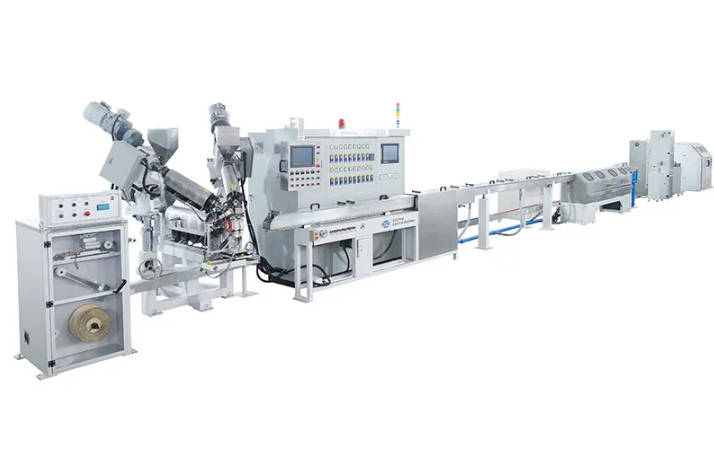
High-frequency cable manufacturers need equipment that supports repeatable production, stable insulation quality, and practical operation. For twinax cable production, the extrusion line should be configured according to material type, conductor size, insulation structure, line speed, and downstream cable process.
QingFeng SFS provides high-frequency cable extrusion line solutions for manufacturers working with cable insulation and related production applications. By discussing cable structure, material selection, dimensional requirements, and production goals before equipment selection, manufacturers can choose a line configuration that better matches real production needs.
FAQ
What is foam insulation twinax cable?
Foam insulation twinax cable uses an insulation layer with controlled air cells inside the polymer. This structure can reduce the effective dielectric constant and may help improve high-frequency signal performance when produced consistently.
Is solid insulation or foam insulation better for high-frequency cable?
Foam insulation is often preferred for high-frequency cable designs that require lower dielectric constant and lower signal loss. Solid insulation may be better when mechanical strength, simpler production, and process stability are more important.
How does insulation affect twinax cable impedance?
Insulation affects twinax cable impedance through its dielectric properties, wall thickness, concentricity, and consistency. Changes in insulation diameter or dielectric constant can cause impedance variation along the cable.
What extrusion line is needed for foam insulation cable production?
Foam insulation cable production usually requires an extrusion line with stable temperature control, pressure control, precise line speed, suitable tooling, controlled foaming capability, cooling stability, and online diameter monitoring.
Why is foam insulation more difficult to produce than solid insulation?
Foam insulation is more difficult because foam cell size, density, expansion, outer diameter, and mechanical strength must be controlled at the same time. Small process changes can affect insulation consistency.
What are the advantages of solid insulation cable?
Solid insulation cable usually offers stronger mechanical stability, easier extrusion setup, better crush resistance, and simpler process control. It is suitable for many cable applications where robust structure is important.
Can one extrusion line produce both solid and foam insulation?
In some cases, an extrusion line can be configured to support both solid and foam insulation, but this depends on the extruder design, foaming system, tooling, control system, and material requirements. Buyers should confirm this before purchasing.
Conclusion
Solid and foam insulation each have advantages in high-frequency twinax cable production. Solid insulation provides mechanical stability, easier process control, and strong production repeatability. Foam insulation can reduce effective dielectric constant and support better high-frequency performance in many applications, but it requires more precise extrusion control and stronger process management.
For cable manufacturers, the right choice depends on product design, performance targets, customer specifications, production experience, and equipment capability. A suitable extrusion line should support stable temperature control, accurate diameter management, reliable conductor centering, smooth cooling, consistent take-up, and stable downstream taping or shielding performance.
QingFeng SFS offers extrusion line solutions for cable manufacturers looking to improve insulation extrusion stability for twinax cables, high-frequency cables, and related communication cable production.