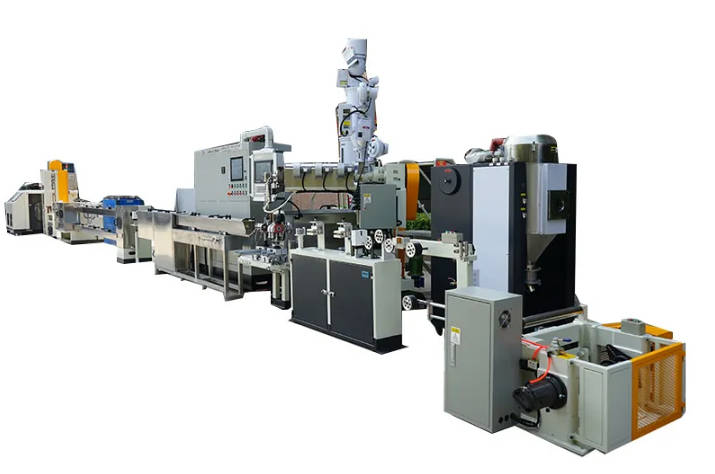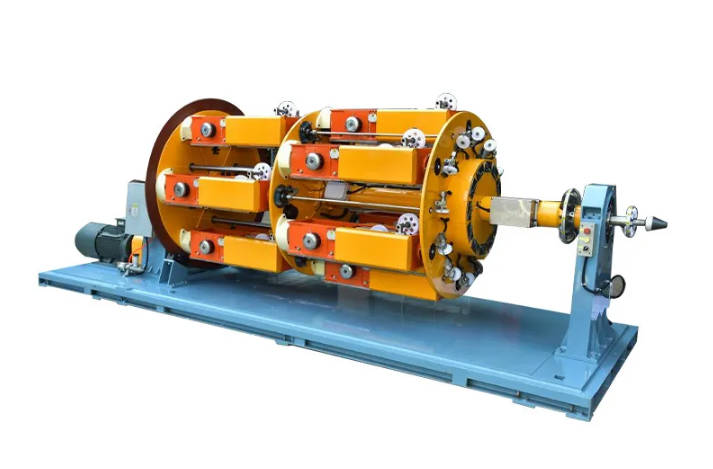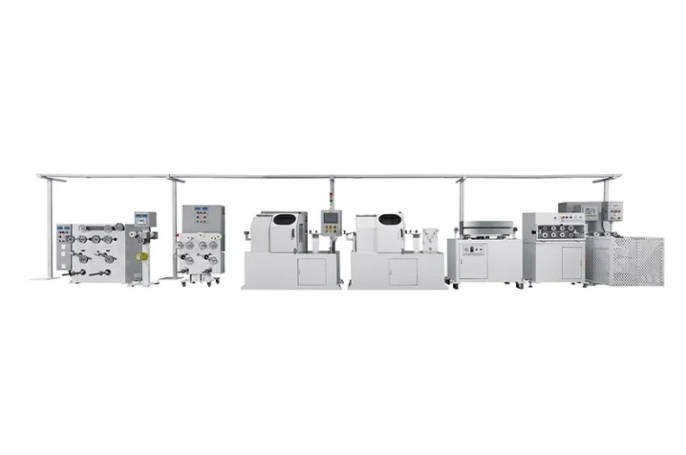
The cable extrusion process is a manufacturing method used to apply insulation, coating, sheathing, or jacketing materials around conductors, wire cores, or cable cores through a heated extrusion system. It is one of the most important processes in wire and cable manufacturing because it directly affects cable diameter, insulation thickness, concentricity, surface quality, mechanical protection, electrical performance, and production efficiency.
In a typical wire and cable extrusion process, polymer material is fed into an extruder, heated and plasticized, pushed through a screw and barrel, shaped by a crosshead and tooling, applied around the conductor or cable core, cooled, inspected, pulled by a capstan, and finally wound onto a take-up spool. The process may look simple from the outside, but stable cable extrusion depends on material behavior, screw design, tooling alignment, temperature control, cooling stability, traction synchronization, and online quality inspection.
For wire and cable manufacturers, understanding the extrusion process helps improve production quality and also helps buyers choose a suitable cable extrusion line for insulation, sheathing, jacketing, coating, foaming, or special cable applications.
What Is Cable Extrusion?
Cable extrusion is the process of applying a continuous polymer layer onto a conductor, wire, or cable core. The extruded layer can serve different functions depending on the cable design.
Common extrusion purposes include:
| Extrusion Purpose | Main Function | Common Application |
| Primary insulation | Electrically insulates the conductor | Building wire, data cable, automotive wire |
| Core wire insulation | Produces insulated cores for later cabling | Power cable, control cable, communication cable |
| Jacket extrusion | Adds outer mechanical protection | Power cable, LAN cable, industrial cable |
| Sheathing extrusion | Protects cable cores and improves durability | Power cable and multi-core cables |
| Coating extrusion | Adds a thin protective or functional layer | Special wire and flat conductor applications |
| Foaming extrusion | Creates a foamed dielectric layer | Communication and high-frequency cable applications |
| Multi-layer extrusion | Combines different material functions | Advanced cable structures |
Cable extrusion is not only about covering a conductor with plastic; it is a controlled process for building the cable’s electrical, mechanical, and dimensional performance.
Different cable products require different extrusion line configurations. A medical cable extrusion process may focus on fine wire handling and clean production, while a power cable jacket extrusion process may require higher output capacity and stronger cooling performance.
Basic Steps in the Cable Extrusion Process
Although different products use different materials and equipment configurations, the basic wire and cable extrusion process usually includes the following steps.
| Step | Process Description | Key Quality Focus |
| 1. Material preparation | Resin, compound, or masterbatch is prepared before extrusion | Dryness, cleanliness, material consistency |
| 2. Conductor or cable pay-off | Wire or cable core is fed into the line | Stable tension and smooth feeding |
| 3. Preheating | Conductor may be heated before extrusion | Adhesion, moisture removal, temperature stability |
| 4. Plasticizing | Material is melted in the extruder barrel | Stable melting and mixing |
| 5. Extrusion through crosshead | Molten material is applied around the conductor or core | Centering, wall thickness, surface quality |
| 6. Cooling | Extruded layer is cooled and shaped | Diameter stability and shrinkage control |
| 7. Online inspection | Diameter, insulation defects, or surface issues are checked | Process monitoring and defect detection |
| 8. Traction | Capstan pulls the cable at controlled speed | Line speed stability |
| 9. Take-up | Finished cable is wound onto a spool or reel | Winding quality and tension control |
Each step affects the next one. For example, unstable conductor pay-off may cause eccentric insulation. Poor cooling may create shrinkage or ovality. Unstable traction may cause diameter fluctuation. For this reason, cable extrusion quality should be controlled across the full line.
Common Materials Used in Cable Extrusion
Material selection is one of the most important decisions in cable extrusion. Different materials have different processing temperatures, flexibility, dielectric behavior, flame resistance, abrasion resistance, and environmental performance.
| Material | Common Use | Process Consideration |
| PVC | General insulation and jacket | Easy to process, widely used, cost-sensitive applications |
| PE | Communication cable insulation and jackets | Good dielectric properties, requires stable diameter control |
| XLPE compound | Crosslinkable power cable insulation | Needs compatibility with crosslinking process |
| TPE | Flexible cable jackets and special cables | Requires careful temperature and tension control |
| TPU | Flexible and abrasion-resistant cable jackets | Sensitive to processing conditions in many applications |
| Nylon | Protective coating and special wire structures | Often requires drying and stable material handling |
| LSZH compound | Low-smoke halogen-free cable jacket | Processing window and surface quality should be controlled |
| FEP | High-temperature wire and special cable insulation | Requires higher temperature control and suitable tooling |
| PFA / ETFE | High-performance cable applications | Requires specialized extrusion experience |
| Foaming compounds | Communication and high-frequency cable insulation | Requires stable foaming and precise diameter control |
The same cable extrusion line may not be suitable for every material; screw design, barrel temperature, tooling, cooling, and traction should match the material system.
Before selecting equipment, manufacturers should confirm the exact cable material, processing temperature range, target cable size, and quality requirement.
Main Equipment in a Cable Extrusion Line
A cable extrusion line is a complete production system. The extruder is only one part of the line. Stable cable quality depends on the coordination of each section.
Pay-Off System
The pay-off system feeds conductor, wire, or cable core into the extrusion line. It should provide stable tension and smooth feeding. If pay-off tension fluctuates, the conductor may move inside the tooling, causing eccentric insulation or unstable wall thickness.
Preheating Unit
Preheating may be used to improve conductor surface condition, remove moisture, or stabilize temperature before extrusion. It is especially useful in some insulation extrusion processes where conductor temperature affects adhesion or surface quality.
Extruder
The extruder melts, mixes, and pushes polymer material forward. Important extruder factors include screw diameter, L/D ratio, screw design, motor power, heating zones, barrel material, and output stability.
Crosshead and Tooling
The crosshead and tooling shape the molten material around the conductor or cable core. Tooling alignment is critical for concentricity, wall thickness, and surface quality.
Cooling Trough
The cooling system stabilizes the extruded layer. Cooling length, water temperature, cable path, and cooling method can affect outer diameter, shrinkage, surface finish, and roundness.
Diameter Measuring System
Online diameter measurement helps operators monitor dimensional stability during production. It can help detect process drift before large quantities of cable are produced.
Spark Tester
In many cable insulation processes, a spark tester is used to detect pinholes or insulation defects. It is often used after cooling and before take-up.
Capstan or Traction Unit
The capstan controls line speed and pulling force. Speed fluctuation can cause diameter changes. Excessive pulling force may stretch or deform the cable.
Take-Up System
The take-up system winds the finished cable. Stable winding tension is important because improper take-up may damage the cable after extrusion.
Key Process Parameters in Cable Extrusion
Cable extrusion quality depends on several process parameters. Operators should monitor these parameters instead of relying only on final inspection.
| Parameter | Why It Matters | Possible Problem if Unstable |
| Material temperature | Controls melting and flow behavior | Rough surface, poor plasticization, burning |
| Screw speed | Affects output and pressure | Diameter fluctuation or unstable flow |
| Line speed | Controls layer thickness with output | Thin or thick insulation |
| Crosshead pressure | Indicates flow stability | Surging, surface defects, dimensional variation |
| Tooling alignment | Controls concentricity | Eccentric insulation |
| Cooling temperature | Affects shrinkage and surface finish | Ovality, shrinkage, stress |
| Traction stability | Controls continuous cable movement | Diameter variation |
| Take-up tension | Affects finished cable condition | Stretching, deformation, winding marks |
| Material dryness | Affects surface and internal quality | Bubbles, voids, roughness |
| Online inspection | Detects process abnormalities | Late discovery of defects |
Stable cable extrusion quality comes from controlling temperature, pressure, speed, tooling, cooling, and tension as one integrated process.
If one parameter is changed, other parameters may need adjustment. For example, increasing line speed may require changes in extruder output, cooling capacity, and take-up settings.
Quality Control in the Cable Extrusion Process
Quality control should happen during production, not only after the cable is finished. In cable extrusion, many defects become expensive if they are discovered too late.
Common quality control items include:
| Quality Item | What to Check | Related Process Area |
| Outer diameter | Whether cable OD is within tolerance | Extruder output, line speed, cooling |
| Wall thickness | Whether insulation or jacket thickness is consistent | Tooling and centering |
| Concentricity | Whether conductor is centered | Crosshead, tooling, pay-off tension |
| Surface finish | Smoothness, scratches, lumps, roughness | Material, temperature, tooling |
| Spark test | Pinholes or insulation defects | Material quality and extrusion stability |
| Adhesion | Bonding between conductor and insulation when required | Preheating and material condition |
| Ovality | Cable roundness | Cooling and take-up |
| Shrinkage | Final dimension after cooling | Material and cooling process |
| Color consistency | Appearance and identification | Masterbatch and mixing |
| Winding quality | Reel appearance and cable stress | Take-up tension and traversing |
For manufacturers producing higher-value cables, online inspection and process data recording can help improve repeatability. A suitable wire and cable extrusion line should support the quality checks required by the target cable product.
Common Cable Extrusion Defects and Causes
Cable extrusion defects are often caused by process instability, material issues, tooling problems, or equipment mismatch. The following table summarizes common defects and possible causes.
| Defect | Possible Cause | Suggested Check |
| Diameter fluctuation | Unstable extruder output or line speed | Screw speed, capstan, pressure |
| Eccentric insulation | Poor tooling alignment or unstable conductor tension | Crosshead, guide, pay-off |
| Surface roughness | Poor plasticization, contamination, wrong temperature | Material, screw, heating zones |
| Bubbles or voids | Moisture, material contamination, trapped air | Drying, material handling |
| Lumps | Contamination or unstable material flow | Filter, compound quality, screw |
| Shrinkage | Improper cooling or material behavior | Cooling water, line speed |
| Ovality | Uneven cooling or take-up pressure | Cooling trough, take-up tension |
| Poor adhesion | Low conductor temperature or unsuitable material | Preheating and material selection |
| Jacket cracks | Wrong material, excessive stress, poor cooling | Material and process settings |
| Color variation | Poor mixing or unstable masterbatch feeding | Material feeding and mixing |
Problem solving should follow a logical process. Identify the defect, check when it appears, review recent parameter changes, inspect material condition, and verify mechanical alignment. Random adjustment may create new defects.
How Material Choice Affects Equipment Selection
When selecting a cable extrusion line, material choice should be discussed before machine configuration. Different materials require different screw design, heating capacity, crosshead design, and cooling setup.
| Material Requirement | Equipment Impact |
| High-temperature material | Requires suitable barrel, screw, heater, and tooling design |
| Soft flexible compound | Needs gentle traction and stable take-up |
| Foaming material | Requires precise pressure, temperature, and diameter control |
| LSZH compound | Requires stable processing window and surface control |
| Nylon coating | May require material drying and smooth coating control |
| XLPE compound | Should match downstream crosslinking process |
| Fine wire insulation | Requires accurate centering and low-tension handling |
| Thick jacket extrusion | Requires output capacity and cooling length |
For example, an extrusion line used for general PVC jacket production may not be suitable for FEP or PFA high-temperature cable production. A line used for large power cable sheathing may not be ideal for fine medical cable extrusion.
Equipment Selection Tips for Wire and Cable Manufacturers
When choosing extrusion equipment, buyers should match the machine to the actual product range and factory plan.
| Buying Factor | What to Confirm |
| Cable product type | Insulation, jacket, sheath, coating, foaming, or multi-layer |
| Material range | PVC, PE, XLPE, TPE, TPU, Nylon, LSZH, FEP, PFA, ETFE |
| Cable diameter range | Minimum and maximum product size |
| Output requirement | Stable working speed and material throughput |
| Quality tolerance | OD, wall thickness, concentricity, surface quality |
| Online inspection | Diameter gauge, spark tester, defect detection |
| Automation level | PLC, HMI, recipe storage, alarms, data recording |
| Factory layout | Line length, cooling space, reel handling |
| Future expansion | Product upgrade and material flexibility |
| Supplier support | Installation, commissioning, training, spare parts |
A cable extrusion machine should be selected based on product structure, material behavior, quality tolerance, and real production speed, not only by machine price.
Buyers should prepare cable drawings, material information, production targets, and required quality standards before requesting a quotation.
How to Improve Cable Extrusion Quality
Improving extrusion quality requires consistent process discipline. The following practices are useful in many cable production environments:
- Use clean and consistent raw materials.
- Dry moisture-sensitive materials when required.
- Set temperature zones according to material behavior.
- Check tooling alignment before production.
- Keep conductor pay-off tension stable.
- Use appropriate preheating when needed.
- Avoid sudden changes in line speed.
- Monitor outer diameter during production.
- Check cooling water temperature and cleanliness.
- Inspect cable surface regularly.
- Record stable parameters for repeat orders.
- Maintain screw, barrel, guides, capstan, and take-up system.
- Train operators to identify early signs of defects.
Cable extrusion is a continuous process. Small changes in temperature, tension, pressure, or speed can affect the final product. Consistent monitoring helps reduce scrap and improve repeatability.
Choosing a Supplier for Cable Extrusion Equipment
A reliable supplier should understand both equipment design and cable production requirements. Buyers should not only compare quotation price; they should compare technical communication, customization capability, manufacturing quality, service support, and experience with similar cable products.
Useful supplier questions include:
| Question | Why It Matters |
| Have you supplied extrusion lines for similar cable products? | Confirms application experience |
| Can the line process our required material? | Verifies material compatibility |
| What diameter and concentricity control options are available? | Supports quality requirements |
| Can the line integrate online inspection? | Improves process monitoring |
| Can the layout be customized for our factory? | Supports installation and workflow |
| What tooling support is provided? | Helps production startup |
| What training and commissioning are included? | Reduces startup risk |
| How are spare parts and after-sales handled? | Supports long-term operation |
QingFeng SFS provides extrusion line solutions for cable insulation, jacketing, sheathing, foaming, and special wire applications. Buyers can also visit the QingFeng SFS official website to learn more about cable manufacturing equipment categories and company capabilities.
FAQ
What is the cable extrusion process?
The cable extrusion process is a manufacturing method that applies insulation, coating, sheathing, or jacketing material around conductors, wire cores, or cable cores using an extruder, crosshead, cooling system, traction unit, and take-up system.
What materials are used in wire and cable extrusion?
Common materials include PVC, PE, XLPE compounds, TPE, TPU, Nylon, LSZH compounds, FEP, PFA, ETFE, and foaming materials. The suitable material depends on cable application and performance requirements.
What equipment is needed for cable extrusion?
A typical cable extrusion line includes pay-off, preheating unit, extruder, crosshead and tooling, cooling trough, diameter measuring system, spark tester, capstan or traction unit, take-up system, and control system.
How do you control cable diameter in the extrusion process?
Cable diameter is controlled by stabilizing extruder output, line speed, crosshead pressure, tooling alignment, cooling conditions, and traction. Online diameter measurement can help detect variation during production.
What causes defects in cable extrusion?
Common causes include unstable temperature, poor material drying, contamination, incorrect tooling alignment, unstable line speed, poor cooling, excessive take-up tension, or unsuitable machine configuration.
What is extrusion coating wire?
Extrusion coating wire means applying a polymer coating or insulation layer around a wire through an extrusion process. It is used for electrical insulation, mechanical protection, or functional surface protection.
How do I choose a cable extrusion line for my factory?
To choose a cable extrusion line, confirm your cable type, material, diameter range, layer structure, output requirement, tolerance, inspection needs, factory layout, automation level, and supplier technical support.
Conclusion
The cable extrusion process is a core step in wire and cable manufacturing. It affects insulation quality, jacket performance, outer diameter, wall thickness, concentricity, surface finish, production efficiency, and long-term product consistency. To achieve stable results, manufacturers need to control materials, equipment configuration, temperature, pressure, tooling, cooling, traction, and online inspection as one complete process.
For cable manufacturers, understanding the extrusion process also helps with equipment selection. The right extrusion line should match the cable product, material system, production speed, quality tolerance, and factory layout.
QingFeng SFS offers cable extrusion line solutions for manufacturers looking to improve insulation extrusion, jacket extrusion, sheathing, foaming, and special cable production.