Cable extrusion line price is mainly determined by what cable the line must produce—not simply by the screw diameter or extruder motor power. Material type, conductor range, number of extrusion layers, production speed, dimensional accuracy, online inspection and upstream/downstream equipment can all change the final cost.
This explains why two cable extrusion line quotations can look similar at first but have very different prices.
Both suppliers may write:
- Extruder
- Crosshead
- Cooling trough
- Capstan
- Take-up
- PLC control
Yet one line may be designed for ordinary PVC insulation, while another needs to process FEP or PFA. One may use a single extrusion layer, while another needs three-layer co-extrusion. One may rely on offline inspection, while another integrates diameter, wall-thickness and concentricity monitoring.
These are not minor accessories. They change the engineering requirements of the complete production line.
For buyers, the more useful question is therefore not:
“How much is one cable extrusion machine?”
It is:
“What does the quoted line need to achieve for my cable?”
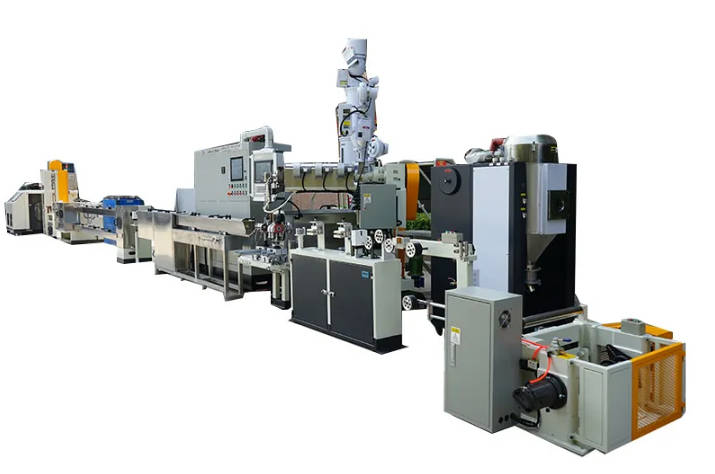
QingFeng SFS provides cable extrusion line solutions for insulation, jacketing, foaming, multi-layer extrusion and different cable applications. Its extrusion equipment can be configured around different materials and production requirements.
Why There Is No Useful Universal Cable Extrusion Line Price
Imagine three buyers requesting “one cable extrusion line.”
Buyer A manufactures standard PVC-insulated wire.
Buyer B produces thin TPU-insulated automotive cable.
Buyer C needs a physical foaming extrusion process for high-frequency cable.
All three need extrusion equipment, but the actual machines may differ substantially in:
- Screw design
- Temperature range
- Extrusion crosshead
- Tension requirements
- Cooling
- Online measurement
- Control architecture
- Production speed
- Material handling
- Number of extruders
Giving all three buyers the same machine would either over-specify one project or under-specify another.
The cable extrusion line price becomes meaningful only after the product, material and quality requirements have been defined.
Instead of asking for a generic machine price first, buyers should break the quotation into several cost layers.
Cost Layer 1: The Extruder Is the Core—but Size Alone Does Not Define Cost
The first major cost component is the extruder itself.
The required extruder depends on:
- Cable diameter
- Insulation or jacket thickness
- Required material output
- Material type
- Production speed
- Product range
A larger screw and motor generally mean a larger machine structure, gearbox, heating system and electrical load.
But bigger is not always better.
Why Oversizing Can Be a Mistake
Suppose a factory mainly produces thin electronic wire.
Buying a much larger extruder simply because it has more output capacity can create disadvantages:
- More material remains inside the barrel
- Residence time may increase at low output
- Small products may become harder to control
- Energy consumption can increase
- Initial investment becomes unnecessarily high
The correct extruder should operate comfortably within the normal production window of the target cable.
What Buyers Should Provide
Instead of requesting a certain screw diameter immediately, provide:
- Conductor diameter range
- Finished cable diameter
- Insulation or jacket thickness
- Material
- Required line speed
- Expected product range
The equipment manufacturer can then size the extruder around the actual output requirement.
Cost Layer 2: Material Choice Can Change the Machine Behind the Same Cable Diameter
Two cables with the same finished outside diameter can require very different extrusion equipment because they use different polymers.
QingFeng SFS lists extrusion solutions for materials and processes including FEP, PFA, ETFE, nylon, PVC, PE, TPU, LSZH, XLPE, TPV, Foam-PE, HDPE, PU and PP.
Different materials change requirements for:
- Screw geometry
- Barrel design
- Heating
- Cooling
- Drying
- Crosshead construction
- Material-contact parts
- Process control
Standard Thermoplastic vs More Specialized Material Processing
| Requirement | Standard Thermoplastic Application | More Specialized Application |
| Temperature control | Conventional extrusion range | May require higher or more tightly controlled temperatures |
| Screw design | General material-specific design | More specialized geometry may be required |
| Material preparation | Relatively simple in some applications | Drying or additional material control may be required |
| Crosshead | Standard cable geometry | High precision or special flow path may be needed |
| Inspection | Basic dimensional control may be sufficient | More precise online monitoring may be required |
| Engineering effort | Lower | Higher |
The material name alone is still not enough.
For example, two TPU grades or two fluoropolymer grades can have different processing behavior. Buyers should provide the exact resin grade or material data during technical discussions.
A low-priced extrusion line becomes expensive if its screw, temperature control or crosshead cannot process the intended material consistently.
Cost Layer 3: One Layer, Two Layers or Three Layers?
The number of extrusion layers can change the line architecture significantly.
A simple insulation line may require one extruder.
A multi-layer cable structure may require:
- Two extruders
- Three extruders
- A co-extrusion crosshead
- Additional material feeding systems
- More temperature-control zones
- More drive control
- More complex recipe management
QingFeng SFS’s extrusion equipment portfolio includes single- and multi-layer extrusion configurations, with support for one- to three-layer production depending on the cable process.
Why Multi-Layer Extrusion Costs More
The buyer is not simply buying “another screw.”
Each additional extrusion layer may add:
- Extruder
- Motor
- Gearbox
- Heating
- Feeding system
- Electrical cabinet components
- Crosshead complexity
- Control channels
- Installation space
- Commissioning work
Simple Cost Logic
| Cable Structure | Typical Equipment Complexity | Relative Investment Direction |
| Single insulation layer | One main extruder | Lower |
| Single outer jacket | One main extruder | Lower |
| Two-layer extrusion | Multiple melt streams | Higher |
| Three-layer co-extrusion | Multiple extruders + complex crosshead | Higher still |
| Skin-foam-skin structure | Multiple layers + foaming control | Specialized |
This is why buyers should compare quotations based on cable structure, not simply machine length or motor power.
Cost Layer 4: Precision Has a Price
A cable extrusion line can produce cable without necessarily producing it within the tolerances required by the target market.
A factory producing ordinary power cable may have different control priorities from a factory producing:
- Fine electronic wire
- High-frequency cable
- Medical cable
- Automotive cable
- Precision sensor cable
Higher dimensional accuracy can require more sophisticated:
- Crossheads
- Tension control
- Pulling systems
- Diameter measurement
- Wall-thickness measurement
- Concentricity monitoring
- Closed-loop adjustment
What Are You Actually Paying to Control?
A higher-specification extrusion line may control several variables continuously:
| Quality Variable | Why It Matters |
| Finished outside diameter | Maintains cable dimensions |
| Wall thickness | Prevents excessively thin insulation |
| Concentricity | Keeps conductor centered inside insulation |
| Melt pressure | Indicates extrusion stability |
| Temperature | Keeps material inside the correct processing window |
| Conductor tension | Prevents stretching or unstable centering |
| Line speed | Maintains the relationship between output and diameter |
| Surface defects | Reduces downstream rejects |
QingFeng SFS offers optional PLC/HMI control and online inspection functions for extrusion-line configurations, including dimensional and concentricity-related monitoring. (dgqfmachine.com)
When comparing cable extruder machine prices, buyers should distinguish between a machine that can extrude material and a production system that can continuously verify cable quality.
Cost Layer 5: The Extruder May Be Only One Part of the Quotation
This is one of the main reasons extrusion line quotations can be difficult to compare.
One supplier may quote only:
- Extruder
- Crosshead
- Basic cooling
Another supplier may quote a complete line.
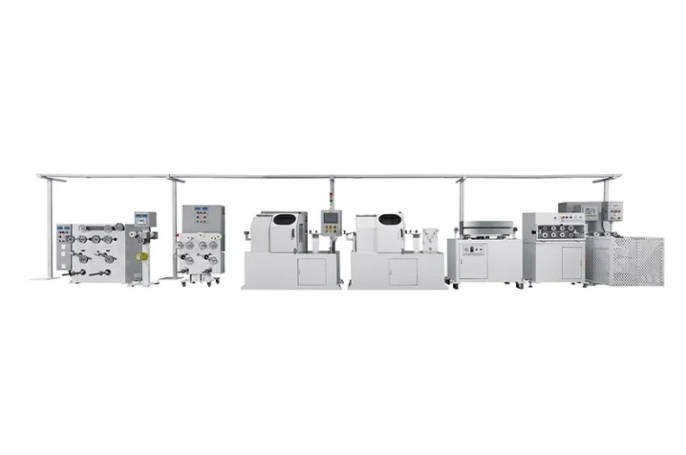
A complete cable extrusion process can include:
- Payoff
- Accumulator
- Straightener
- Preheater
- Dryer or material feeder
- Extruder
- Crosshead
- Cooling trough
- Diameter measurement
- Wall-thickness inspection
- Spark tester
- Capstan or caterpillar
- Accumulator
- Printer
- Take-up
- PLC and HMI system
Naturally, the second quotation costs more.
It is also delivering more equipment.
Payoff Configuration Can Change Cost
A basic small-reel payoff and a heavy motorized payoff are not equivalent.
Cost can change according to:
- Reel diameter
- Reel weight
- Conductor size
- Required tension
- Motorized or passive control
- Automatic reel change
- Accumulator requirement
Thin conductors may require especially sensitive tension control.
Large power conductors may instead require stronger reel handling and higher mechanical load capacity.
Take-Up Is Also Product-Specific
Take-up cost depends on:
- Finished cable diameter
- Reel dimensions
- Full reel weight
- Production speed
- Traverse requirements
- Cable tension
- Loading method
A small electronic-wire take-up and a heavy power-cable take-up should not be expected to cost the same.
Cost Layer 6: Production Speed Changes More Than Motor Power
Higher production speed sounds like a simple specification.
It is not.
Increasing line speed can require improvements throughout the line:
- Faster material output
- More stable screw control
- Higher-performance cooling
- More responsive tension control
- Faster measurement systems
- Stronger capstan
- More capable take-up
- Better drive synchronization
The complete line must operate at the same production speed.
There is little value in buying an extruder capable of higher output if:
- The cooling trough is too short
- The diameter gauge cannot measure reliably
- The capstan slips
- The take-up cannot maintain winding quality
The cost of higher production speed is distributed across the complete extrusion line, not concentrated in the extruder motor.
When requesting quotations, specify the target stable production speed for an actual product rather than asking only for the maximum mechanical speed.
Cost Layer 7: Standard Extrusion and Physical Foaming Are Different Investments
A physical foaming extrusion line adds another level of process complexity.
Depending on the cable, the system may require:
- Foaming-compatible extruder
- Gas injection
- Specialized screw
- Pressure control
- Specialized crosshead
- More precise material control
- Tighter cooling management
- Electrical-property monitoring
These systems are particularly relevant to selected high-frequency cable structures where dielectric properties are critical.
QingFeng SFS includes physical foaming and Teflon foaming extrusion equipment within its extrusion line range. (dgqfmachine.com)
A buyer should therefore not compare a standard solid-insulation line directly with a physical foaming line and conclude that one supplier is simply “more expensive.”
They are different production systems.
Cost Layer 8: Automation Can Reduce Labor but Increase Initial Investment
Modern extrusion lines can incorporate increasing levels of automation.
Possible functions include:
- Product recipes
- Automatic speed synchronization
- Temperature monitoring
- Alarm recording
- Parameter trends
- Online measurement
- Automatic correction
- Production-data storage
- Operator-access control
Each function can increase equipment and engineering cost.
The right question is not:
“How much automation can we add?”
It is:
“Which automation removes a real production risk?”
Automation That Solves a Real Problem
For example:
- Frequent diameter variation → consider online diameter feedback
- Operator setup inconsistency → use stored product recipes
- Thin conductor stretching → improve tension control
- Frequent unknown stoppages → use alarm history and trend recording
Automation should reduce variability or labor.
Adding controls that operators never use simply increases purchase and maintenance complexity.
Cost Layer 9: Customization Is Engineering Work
A standard line is normally easier to quote.
A customized project may require engineering for:
- Unusual cable diameter
- Special conductor
- Very low tension
- High-temperature polymer
- Multiple extrusion layers
- Special reel dimensions
- Limited factory floor space
- Integration with existing machines
- Unique inspection equipment
QingFeng SFS provides customized extrusion-line configurations and modular layouts for different factory and cable requirements. (dgqfmachine.com)
Customization may influence:
- Mechanical design
- Electrical drawings
- Software
- Crosshead tooling
- Machine layout
- Trial production
- Commissioning
This is why two machines with similar visible components may still have different engineering costs.
A Cheap Quotation Can Be Expensive After Installation
The machine purchase price is only the first cost.
Cable manufacturers should also consider:
- Startup scrap
- Material waste
- Production downtime
- Energy consumption
- Operator labor
- Changeover time
- Maintenance
- Spare parts
- Product rejection
- Future upgrade cost
Consider two hypothetical lines.
Line A
Lower purchase price, but:
- More manual adjustment
- Higher startup scrap
- Limited product range
- No online wall-thickness measurement
- Frequent product changes require long setup
Line B
Higher initial price, but:
- Better process control
- Faster recipe changes
- More suitable product range
- Online inspection
- Lower operator intervention
Line A is still the correct choice if the factory produces simple, stable products.
Line B may be economically stronger if the factory produces high-value cables where scrap is expensive.
There is no universal answer.
The most useful cost metric is not purchase price alone, but the cost of producing an acceptable meter of cable over the expected life of the line.
How to Compare Two Cable Extrusion Line Quotations
Put both quotations into the same comparison table.
Do not compare only the final total.
| Quotation Item | Supplier A | Supplier B |
| Cable range | ||
| Material grades | ||
| Extruder size | ||
| Number of extrusion layers | ||
| Target product speed | ||
| Payoff | ||
| Tension control | ||
| Crosshead | ||
| Cooling system | ||
| Diameter measurement | ||
| Wall-thickness measurement | ||
| Spark testing | ||
| Capstan | ||
| Take-up | ||
| PLC/HMI | ||
| Product recipes | ||
| Included tooling | ||
| Installation | ||
| Training | ||
| FAT | ||
| Spare parts |
Once the scope is normalized, the real price difference becomes much easier to understand.
What Information Is Needed for an Accurate Price?
If you want a useful quotation rather than a broad estimate, prepare the following information.
Product
- Cable application
- Product drawing
- Minimum and maximum conductor diameter
- Finished outside diameter
- Insulation or jacket thickness
- Number of layers
Material
- Exact material
- Material grade where available
- Solid or foamed extrusion
- Drying requirements
- Color or additive requirements
Production
- Target line speed
- Required output
- Annual production volume
- Number of product sizes
- Expected changeover frequency
Reels
- Payoff reel size
- Payoff reel weight
- Take-up reel size
- Full finished reel weight
Quality Control
- Diameter measurement
- Wall-thickness measurement
- Concentricity
- Spark testing
- Surface inspection
- Data recording
Factory
- Voltage
- Available floor space
- Existing equipment to integrate
- Factory layout restrictions
The more complete this information is, the more meaningful the extrusion line quotation becomes.
Manufacturers can review QingFeng SFS wire and cable extrusion equipment before preparing a project specification.
What Should Be Included in FAT Before Final Payment?
Machine price should also be connected to acceptance criteria.
A factory acceptance test can verify:
- Actual material feeding
- Temperature stability
- Melt-pressure stability
- Conductor tension
- Target production speed
- Finished diameter
- Wall thickness
- Concentricity where required
- Surface quality
- Spark testing
- Acceleration and deceleration
- Reel winding
- Alarm functions
- Product recipe storage
- Continuous running
Where possible, use the intended material and conductor.
An empty-machine demonstration does not prove cable quality.
If a project includes a higher-priced precision configuration, the FAT is where the buyer should verify that the added functions create measurable production value.
Frequently Asked Questions
How much does a cable extrusion line cost?
There is no useful universal price because cable extrusion lines are configured according to material, conductor range, finished diameter, number of layers, production speed, inspection equipment and auxiliary machines.
Why do cable extrusion line quotations vary so much?
Two quotations may include very different scopes. One may contain only basic extrusion equipment, while another includes precision tension control, online inspection, multiple extruders, larger reel systems and automation.
Does a larger cable extruder machine always cost more?
Generally, larger extruders require larger mechanical and drive systems, but size is only one cost factor. Material compatibility, precision and complete-line configuration can have an equally important effect.
Is a high-speed cable extrusion line more expensive?
Often yes, because higher line speed may require stronger drives, better synchronization, faster cooling, more responsive tension control and higher-speed downstream equipment.
Does multi-layer extrusion increase cable extrusion line price?
Yes. Two- or three-layer extrusion generally requires multiple extruders, a more complex crosshead, additional feeding and heating systems, and more control channels.
Why does fluoropolymer extrusion equipment cost more?
FEP, PFA, ETFE and other specialized polymers can require different screws, higher-temperature processing systems, specialized material-contact components and tighter process control than simpler conventional cable compounds.
Is online diameter measurement worth adding to an extrusion line?
It can be valuable when dimensional consistency is important or material waste is costly. The decision should depend on product tolerances and production economics.
What equipment is normally included in a complete cable extrusion line?
A complete line may include payoff, preheating or straightening, material feeding, extruder, crosshead, cooling, online measurement, spark testing, pulling, accumulation and take-up.
What information should I send to get an accurate wire extrusion line cost?
Provide the cable drawing, material, conductor range, finished dimensions, extrusion layers, target speed, reel specifications, inspection requirements and factory conditions.
Should I choose the lowest cable extrusion machine price?
Not automatically. Compare whether each machine can produce the required cable at the required quality and stable production speed. A lower purchase price may not provide the lowest long-term manufacturing cost.
Conclusion
Cable extrusion line price is not determined by one specification.
It is built layer by layer:
- Extruder size
- Material processing requirements
- Number of extrusion layers
- Precision and inspection
- Payoff and take-up equipment
- Production speed
- Foaming or specialized processes
- Automation
- Custom engineering
- Testing and commissioning
A fair quotation comparison therefore begins with the same cable specification and the same equipment scope.
The right cable extrusion line is not necessarily the cheapest or the most highly equipped—it is the configuration that meets the required cable quality and output without paying for unnecessary capability.
For a project-specific quotation, manufacturers can review QingFeng SFS custom cable extrusion line solutions or learn more about QingFeng SFS cable manufacturing equipment.