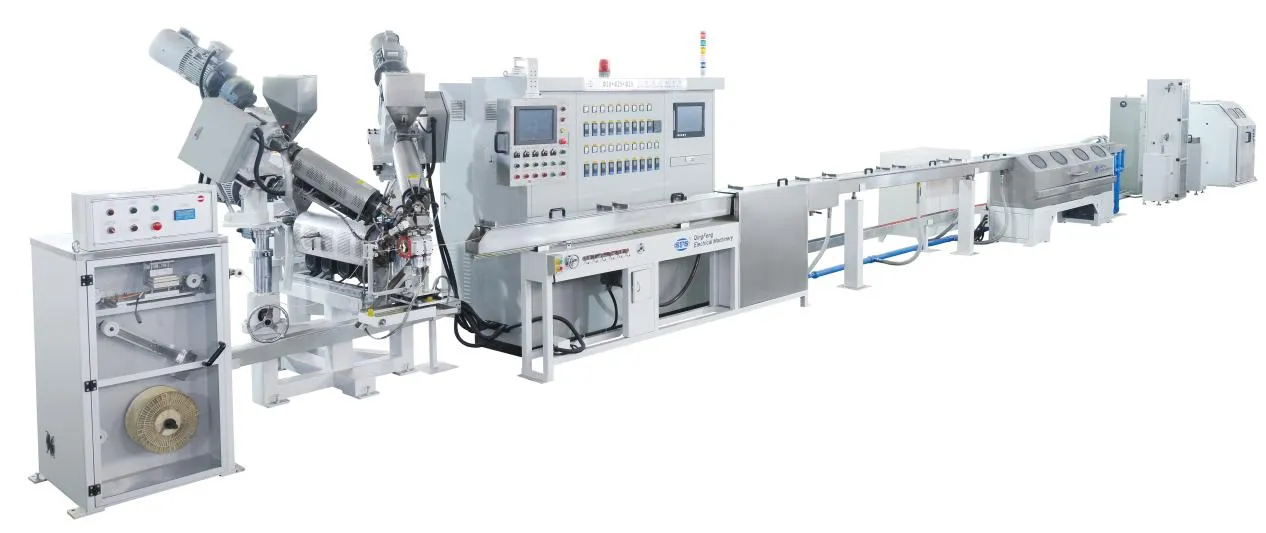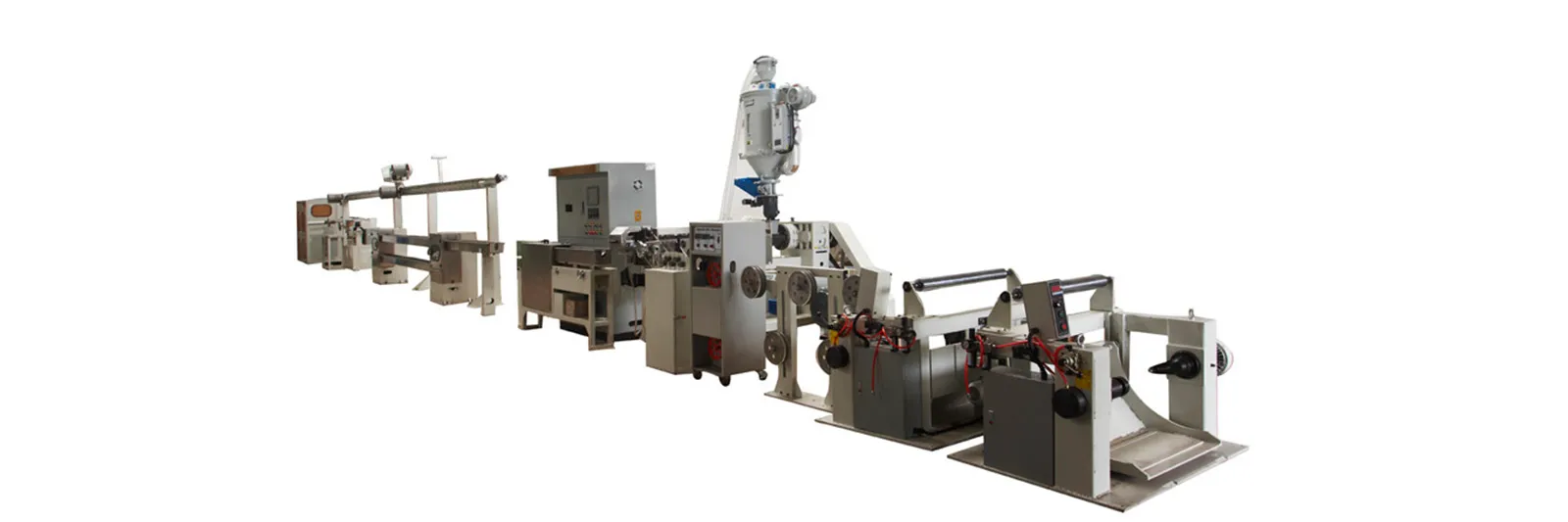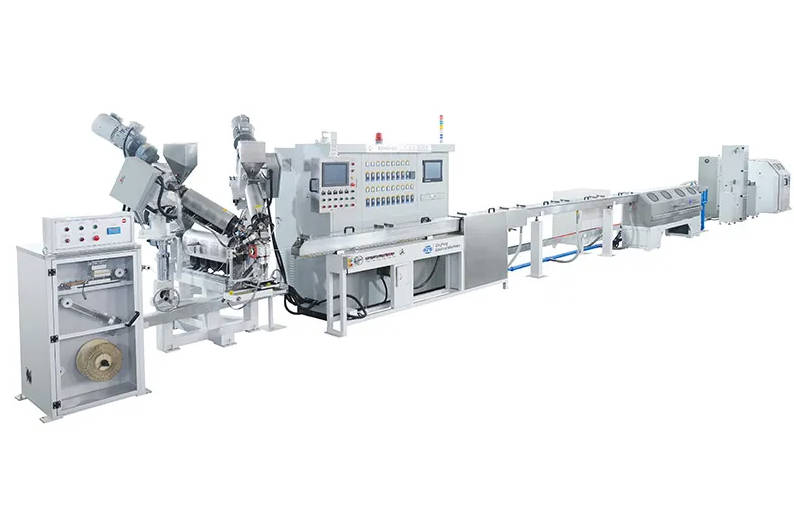
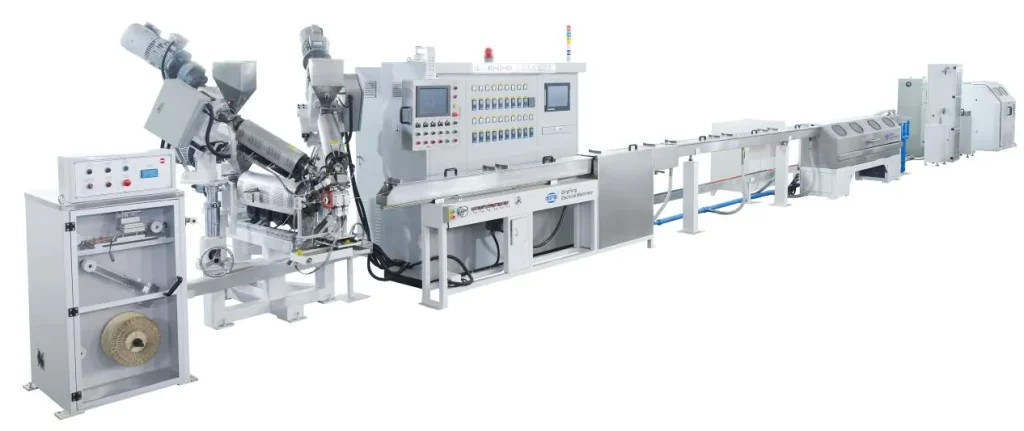
A double wire extrusion line lets a single extruder produce two insulated conductors simultaneously through a specially designed crosshead. The obvious appeal is higher output without doubling floor space or operator count. Yet the decision is not as simple as “two lines are better than one.” The right configuration depends on your cable type, conductor size range, order batch size, and how much flexibility your factory needs. This article explains how dual extrusion works, when it genuinely improves economics, and when a single wire extrusion line remains the more practical choice.
How Double Wire Extrusion Works Compared to Single Line
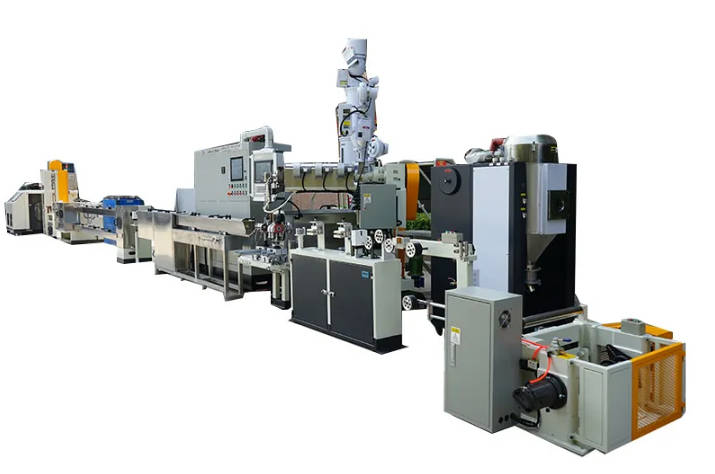
In a standard single wire extrusion line, polymer pellets are melted in a barrel, forced through a crosshead die, and applied as insulation around one conductor. The line then carries the product through a cooling trough, a diameter gauge, and a spark tester before reaching the take-up.
A double wire extrusion line uses the same extruder barrel and screw but feeds melt into a twin-cavity crosshead. Inside the crosshead, the flow splits into two independent channels, each with its own tip and die set. Two conductors enter from separate pay-offs, receive insulation simultaneously, and exit toward separate cooling and collection paths. The extruder motor, heater bands, and main gearbox serve both lines, while downstream components such as capstans, water troughs, and take-ups are duplicated.
This shared-upstream, duplicated-downstream architecture is what distinguishes a true dual extrusion system from merely placing two standalone cable extrusion line units side by side. The capital cost is lower than two complete lines, but the process coupling introduces interdependence: melt temperature and pressure at the crosshead affect both conductors, and a disturbance upstream influences both outputs.
For manufacturers producing small-diameter building wire, automotive cables, or similar products in large volumes, this arrangement can reduce per-meter equipment cost and labor. For those running thick power cables, specialty sheathing, or frequent changeovers, the shared upstream can become a limitation rather than an advantage.
When a Double Wire Line Delivers Real Value
The economic case for dual extrusion strengthens under specific conditions and weakens under others. Rather than treating it as a universal upgrade, evaluate your product mix against three factors.
Conductor size and cable type. Double wire extrusion is most common for small to medium conductor sizes, typically in the range used for household wiring, appliance cord, and automotive primary wire. The physical space inside the crosshead limits how large each die assembly can be. Very fine conductors or very large power cables tend to push the crosshead design toward single-cavity solutions. If your portfolio is concentrated in building wire or standard flexible cords, dual extrusion deserves serious consideration.
Order volume and batch size. A double wire line shines when you can run the same specification for extended periods. The setup time for a twin-cavity crosshead involves adjusting two die sets, two conductor guides, and dual downstream alignment. If your order book consists of many short runs with frequent color, size, or material changes, the accumulated changeover time can erase the throughput advantage. In that environment, a single wire extrusion line with quick-change tooling may keep overall factory output higher.
Product consistency requirements. Some applications demand extremely tight tolerances on insulation wall thickness, concentricity, or surface finish. While modern dual crossheads can deliver excellent results, the shared melt source means that temperature or pressure drift affects both lines. If your end customer requires individual conductor traceability with tight process validation, separate single lines may offer cleaner process isolation.
Manufacturers whose cable making machine portfolio spans multiple product families often run a mix: dual lines for high-volume standard products and single lines for specialty or validation-critical work.
Factory Layout and Utility Requirements
Before adding a double wire extrusion line to a quotation, factory planners should verify that space and utilities can accommodate it. The upstream extruder section is roughly comparable to a single line of the same screw diameter, but the downstream footprint expands.
Cooling trough length. Two parallel insulated conductors need adequate cooling time before reaching the capstan. Depending on line speed and insulation compound, the water trough may need to be longer than a single-line equivalent, or a dual-lane trough with independent temperature zones may be required. Verify that your existing cooling water capacity and filtration can support the additional heat load.
Electrical supply. The extruder motor and heaters are shared, so upstream power demand is not doubled. However, the additional capstan motors, dual take-ups, and auxiliary equipment increase total connected load. Review your substation capacity and whether the line will require a dedicated feeder.
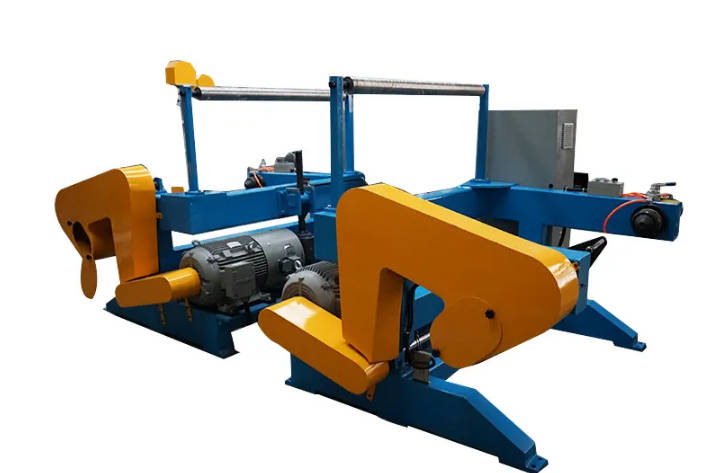
Pay-off and take-up arrangement. Two conductor reels need synchronized tension control. If the pay-offs are floor-mounted shaft-less units, ensure aisle space allows safe reel loading on both sides. Similarly, dual take-ups need adequate clearance for finished reel removal without interfering with the neighboring line.
Air and vacuum services. Some extrusion setups use vacuum sizing tanks or compressed-air wipe units. A dual-line configuration doubles these service points. Confirm that your compressor and vacuum pump sizing can handle the peak simultaneous demand.
If any of these checks raises a concern, consult your equipment supplier early in the project. Most suppliers offering services and support for layout planning can review floor drawings and utility schematics before the purchase decision is finalized.
Process Control Considerations for Dual Extrusion
Running two conductors through one extruder demands tighter process discipline than operating two independent lines. The following control points deserve attention during both equipment selection and daily production.
Melt temperature uniformity. The crosshead must split a single melt stream into two balanced flows. Any temperature gradient across the crosshead body can produce viscosity differences, leading to unequal output between the two cavities. Look for crosshead designs with independent zone temperature control and sufficient thermal mass to maintain stability across the full operating range.
Pressure monitoring. Install pressure transducers at each cavity exit if the machine design allows. A pressure drop on one side can signal partial blockage, die wear, or conductor feed issues before dimensional drift appears on the finished product.
Diameter and eccentricity measurement. Each conductor should have its own non-contact diameter gauge and, if the budget permits, an eccentricity or wall-thickness measurement unit. Relying on a single downstream gauge for both lines makes it impossible to tell which cavity is drifting when an out-of-spec condition appears.
Conductor pre-straightening and tension. Two conductors entering the crosshead must remain parallel and stable. Excessive whip or vibration from poorly tensioned pay-offs can cause intermittent contact between the conductor and die tip, damaging both insulation and tooling. Invest in precision tension control on the pay-off stands.
Spark testing placement. Each line should pass through its own spark tester. A combined dual-line spark tester may save space, but a single fault indication does not reveal which conductor triggered it. Separate testing stations support clearer quality records and faster troubleshooting.
Suppliers with strong in-house engineering capabilities can advise on sensor integration and control architecture. When evaluating vendors, ask how their control system isolates alarms by cavity and whether historical trending is available per line.
Investment and Flexibility Trade-offs
The purchase decision ultimately balances capital outlay, operating economics, and strategic flexibility. A double wire extrusion line typically costs more than a single line of the same extruder size but substantially less than two complete single lines. The savings come from the shared extruder, main drive, and control cabinet.
Where the savings matter most. If you are expanding capacity to serve a growing contract with predictable, high-volume specifications, the lower per-meter capital cost of dual extrusion improves project returns. The labor savings are also real: one operator can monitor both lines from a single control station, rather than staffing two separate machines.
Where flexibility wins. If your business model depends on responding to sporadic orders across many specifications, the ability to run one line while performing maintenance or changeover on the other can be more valuable than simultaneous dual output. Two independent single lines give you operational redundancy; a shared-extruder dual line does not.
Future product migration. Consider whether your product roadmap might shift toward larger conductors, multi-layer insulation, or sheathing operations that are poorly suited to twin-cavity crossheads. A single wire extrusion line with a modular crosshead design may adapt more easily to future process changes.
For factories that already run single lines and are considering a dual line as the next addition, the question is not “which is better?” but “which fits the next three to five years of known demand?”
FAQ
Is double wire extrusion suitable for all cable types?
No. Dual extrusion works best for small to medium conductors with single-layer insulation, such as building wire, appliance cord, and automotive primary wire. Large power cables, very fine data cables, and products requiring multi-layer or foam insulation are typically produced on single-cavity lines designed for those specific processes.
Will installing a double wire line require building expansion?
Not necessarily for the extruder itself, but the downstream footprint is larger. Dual cooling troughs, separate capstans, and dual take-ups extend the line length. Pay-off and reel-handling clearances also increase. Review your floor plan against the supplier’s layout drawing before committing.
How much more complex is process control on a dual line?
The core extrusion parameters remain the same, but you must monitor and balance two outputs from one melt source. Temperature uniformity across the crosshead, independent diameter monitoring, and per-cavity pressure tracking add control points. Modern systems handle this well, but the operator needs training to interpret dual-channel alarms and trends.
Should I choose a single or double line if my orders are small and varied?
A single wire extrusion line is usually the better fit for small-batch, high-mix production. Changeovers on a twin-cavity crosshead involve two die sets and dual alignment, which takes longer than a single-cavity change. The throughput advantage of dual extrusion is most valuable when you can run long batches.
Conclusion
A double wire extrusion line can improve capital efficiency and labor productivity when your product mix consists of high-volume, small-to-medium conductor cables with relatively stable specifications. The shared extruder and crosshead reduce per-meter equipment cost compared with two standalone lines, while simultaneous output increases effective capacity within a given floor area.
However, dual extrusion is not universally superior. Factories running large conductors, complex multi-layer products, or frequent specification changes often find that single wire extrusion lines offer simpler process control, faster changeovers, and greater operational flexibility. The shared upstream design that creates the cost advantage also introduces coupling: a temperature disturbance or material transition affects both outputs.
The right choice depends on matching the equipment configuration to your cable types, conductor range, batch sizes, and factory layout. Before making a capital commitment, confirm that your utilities, floor space, and cooling capacity can support the dual downstream arrangement, and verify that the control system provides independent monitoring for each cavity.
If you are evaluating a capacity expansion and would like a configuration review, share your cable type, conductor range, target daily output, and existing line layout. We can assess whether a single or double wire extrusion line aligns with your production goals.