Blog

We share information, tips and knowledge we have learned over the years in twisting machines and networking equipment.

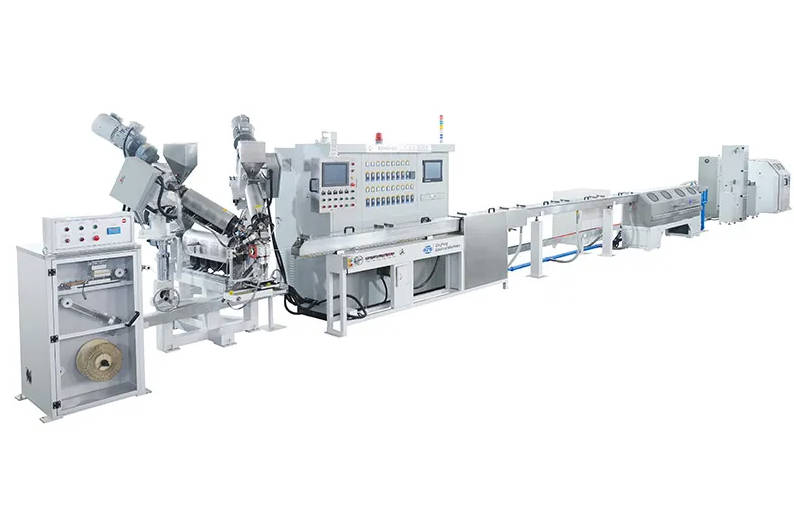
PE Wire Extrusion Line
Blog

PE Wire Extrusion Lines Explained: From Low-Voltage to High-Speed Cables

Polyethylene (PE) is arguably the most versatile polymer in the wire and cable industry. Its applications range from the rugged, weather-resistant outer jacketing of high-voltage underground cables to the delicate, microscopic insulation of high-frequency LAN cables (Cat 6/7) and 5G coaxial lines. However, for factory managers and process engineers, PE presents a unique set of manufacturing challenges. Unlike PVC, which is relatively forgiving, Polyethylene is a crystalline polymer. It shrinks significantly upon cooling, requires precise temperature management to prevent “melt

Read More
Wire Extrusion Lines
Blog

How Wire Extrusion Lines Support High- and Low-Voltage Power Cables

The global demand for electricity is undergoing a transformation. From the rapid urbanization requiring massive amounts of low-voltage building wires to the modernization of national grids demanding ultra-reliable high-voltage transmission lines, the pressure on cable manufacturers is immense. At the heart of this supply chain sits a critical piece of machinery: the Wire Extrusion Line. For manufacturers, investing in an extrusion line is a significant capital expenditure. However, the term “Wire Extrusion Line” is a broad umbrella. The technology required

Read More
Planetary Cable Machines
Blog

Why Planetary Cable Machines are Essential for OPGW and Fiber Optic Cables

In the rapidly evolving sectors of telecommunications and power transmission, the demand for high-performance cables—specifically Optical Ground Wire (OPGW) and hybrid fiber optic cables—has reached unprecedented levels. These cables represent the lifeline of modern infrastructure, carrying both high-voltage electricity and high-speed data. However, manufacturing them presents a unique engineering challenge: the materials involved are incredibly fragile, expensive, and sensitive to mechanical stress. For cable manufacturers, selecting the right stranding equipment is not merely a matter of production speed; it is a

Read More
Nylon Extrusion Line
Blog

Teflon (FEP) Extrusion Lines: The Standard for High-End Consumer Electronics Wiring

In the rapidly advancing world of consumer electronics, the hardware landscape has shifted dramatically. Devices are becoming thinner, faster, and more powerful. From the AI-driven processors in data centers to the 5G antennas in the latest smartphones, the demand for high-frequency data transmission has never been higher. At the heart of this ecosystem lies a critical, often overlooked component: the high-speed wire connecting these systems. To match the performance of advanced PCBs and processors, manufacturers are moving away from traditional

Read More
Wire Extrusion Lines
Blog

The Essential Role of Wire Extrusion Lines in the Telecommunications Industry

1. Introduction The modern world runs on data, and the intricate network of cables that transports this information is the backbone of global telecommunications. From high-speed fiber optic connections to essential copper telephone lines, every communication cable relies on a precise manufacturing process. Central to this process is the wire extrusion line, a sophisticated system that ensures the conductors are perfectly insulated and protected. Wire extrusion, in the context of telecom, is the process of applying a continuous, uniform layer

Read More
Blog

What is the difference between cage stranding machine and frame stranding machine?

What is the difference between cage-type stranding machines and frame-type stranding machines? We have previously compared cage-type and frame-type stranding machines; today we shall examine their distinctions. 1. Production Processing SpeedFrame-type stranding machine: Utilising a frame structure, the central shaft bears no load from the winding reel’s net weight. This design ensures high mechanical rigidity and hardness, delivering superior overall performance with a small turning radius and high processing speed.Cage-type stranding machine: The small turning radius necessitates a bulky untwisting

Read More
Blog

Cage winch machine maintenance and care

After the cage winch machine is installed and solidified, start installing the power wiring. After all installations are completed, please lubricate the rotating parts and start the motor. After running at low speed for 1 hour, please check whether the fasteners are loose, and tighten them if they are loose. After all inspections are completed, check the high-speed operation and no-load operation. Then, let’s understand the maintenance and care of the cage winch machine. The cage winch machine can twist

Read More
Blog

Introduction to the operating principle of the wire twisting machine

Introduction to the operating principle of the wire twisting machine The application range of the wire twisting machine is very wide. In addition to the wire twisting machine, or the automatic wire twisting machine, the fully automatic wire twisting machine, the general automatic wire twisting machine can wind coils of different sizes, such as ring coils and square coils. These two are common. Their winding methods are mainly different in settings. Each type of coil must be set with appropriate

Read More

Looking For Wire and Cable Machine Manufacturer ?

Contact us for design assistance, free quote, and expert advice today. 

Your inquiry will be replied within 24 working hours, and we respect your privacy.

Get a Free Quote