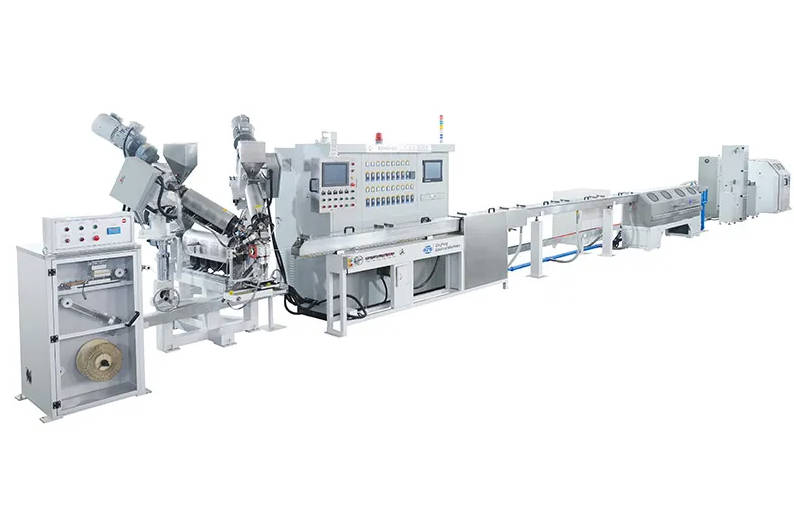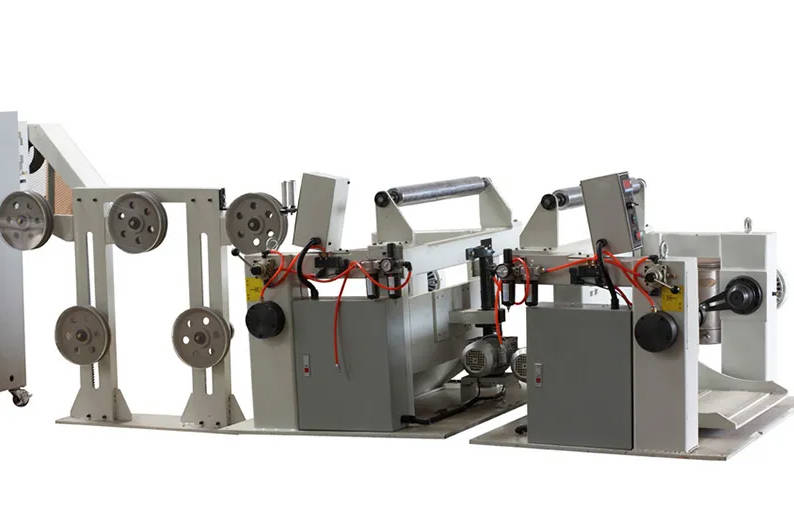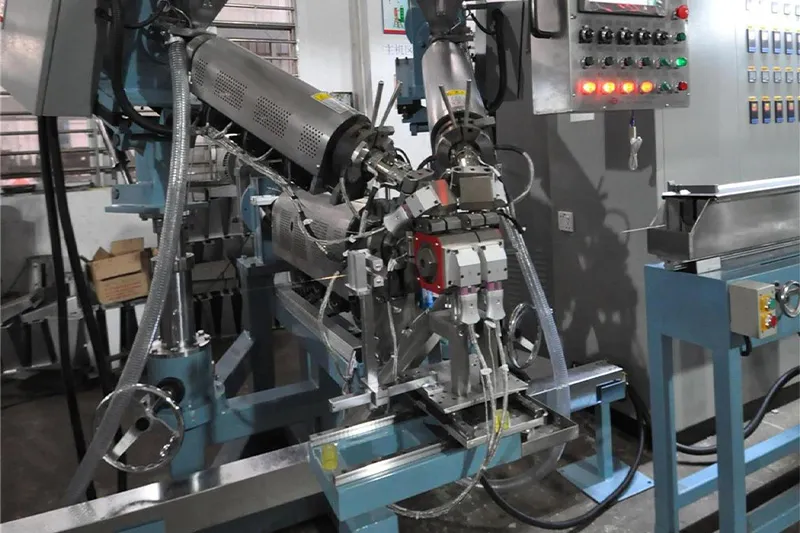
A medical cable extrusion line must do more than apply insulation or a protective jacket. It must control material identity, contamination, dimensions, surface quality and production records throughout the entire manufacturing process.
Medical cables may be used in patient monitoring systems, diagnostic equipment, imaging systems, surgical instruments, medical sensors and other electrically connected devices. Although these products can differ considerably in structure and intended use, they commonly require flexible construction, reliable electrical performance and consistent manufacturing quality.
The correct equipment configuration therefore cannot be selected only by extruder diameter or maximum line speed. A medical cable manufacturer must first define the cable application, conductor structure, insulation material, dimensional tolerance, cleanliness requirements and inspection plan.
This article organizes the equipment-selection process around seven quality gates. Each gate controls a different source of risk in medical cable manufacturing.
Manufacturers evaluating new production capacity can review QingFeng SFS medical and precision cable extrusion line solutions for configurable insulation, jacketing and online inspection systems.
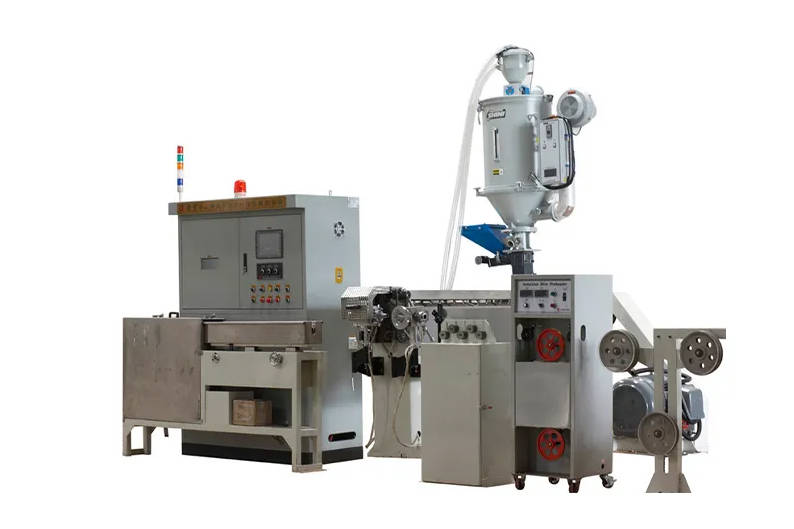
Quality Gate 1: Define What “Medical Cable” Means for the Project
“Medical cable” is an application category rather than one standardized cable design.
A cable used inside a stationary diagnostic machine may have very different requirements from a flexible patient lead cable or a small cable used in a reusable surgical instrument.
Before discussing equipment, the project team should define four basic conditions:
- Where the cable will be used
- Whether it contacts the patient directly, indirectly or not at all
- Whether the finished cable will be disposable or reusable
- Which mechanical, electrical and cleaning conditions it must withstand
Common Medical Cable Applications
| Application | Typical Manufacturing Priorities | Possible Extrusion Requirements |
| Patient monitoring cable | Flexibility, stable electrical performance and repeated bending resistance | Precise jacket extrusion, stable tension and smooth surface |
| Diagnostic equipment cable | Signal integrity, dimensional consistency and shielding compatibility | Controlled insulation thickness and concentricity |
| Medical sensor wire | Small dimensions and low conductor tension | Fine-wire payoff, micro-extrusion crosshead and laser diameter measurement |
| Surgical instrument cable | Flexibility, abrasion resistance and cleaning durability | Material-specific screw design and controlled jacket bonding |
| Imaging equipment cable | Electrical stability and complex multi-core construction | Consistent insulation geometry and coordinated downstream handling |
| Medical equipment power cable | Mechanical protection and electrical safety | Jacket thickness control, spark testing and stable take-up |
| Wearable medical device cable | Low weight, flexibility and compact dimensions | Thin-wall extrusion and accurate low-tension production |
This classification affects material selection and equipment design.
For example, a cable that never contacts a patient should not automatically be treated like a long-term skin-contact component. Conversely, describing a polymer as “medical grade” does not by itself prove that the final cable is suitable for a specific medical application.
Material suitability must be evaluated at the grade, cable and finished-device levels—not only by the general polymer family.
Biological evaluation depends on the nature and duration of body contact and forms part of a wider risk-management process. It is therefore incorrect to assume that purchasing a particular polymer or extrusion line automatically establishes the biocompatibility of the finished product.
Quality Gate 2: Match the Extrusion Material to the Cable Function
Medical wire extrusion may involve PVC, TPU, TPE, PE, PP, fluoropolymers and other engineered compounds. Silicone materials may also be used in some medical cable constructions, although silicone extrusion commonly requires a curing process that differs from conventional thermoplastic extrusion.
The equipment should be configured around the exact compound grade supplied for production.
Material Selection Matrix
| Material Family | Relevant Characteristics | Common Manufacturing Concerns | Equipment Considerations |
| PVC | Flexible, widely processed and available in multiple formulations | Plasticizer selection, thermal history, surface cleanliness and formulation control | Stable low-speed output, controlled temperature profile and effective material changeover |
| TPU or PU | Flexibility, abrasion resistance and good mechanical durability | Moisture sensitivity, pressure fluctuation and surface defects | Resin drying, stable feeding, suitable screw geometry and controlled cooling |
| TPE | Flexibility and relatively easy thermoplastic processing | Grade-to-grade variation, adhesion and dimensional recovery | Material-specific temperature recipes and precise haul-off control |
| PE or PP | Electrical insulation and relatively low density | Adhesion, shrinkage and surface finish | Stable cooling, accurate tooling and conductor preheating where appropriate |
| FEP, PFA or ETFE | Temperature resistance, chemical resistance and electrical performance | High processing temperature, material residence time and equipment compatibility | High-temperature extruder, suitable material-contact parts and controlled ventilation |
| Silicone elastomer | Flexibility and temperature resistance | Curing, contamination and surface consistency | Specialized extrusion and curing configuration rather than a standard thermoplastic-only line |
| Custom medical compound | Properties tailored to a defined application | Lot variation, documentation and process-window sensitivity | Trial production using the actual resin grade and documented operating recipes |
Do Not Select the Extruder Before Confirming the Compound
Two TPU materials can require different drying conditions, processing temperatures and screw designs. Two PVC compounds can differ in hardness, additives and thermal stability.
For this reason, the equipment supplier should receive:
- Material family and exact grade
- Material data sheet
- Recommended processing conditions
- Moisture-control requirements
- Color or additive information
- Expected material-change frequency
- Required production output
- Finished cable dimensions
A generic statement such as “the line can process TPU” is not enough. The supplier should confirm that the screw, barrel, feeding system, heating zones and crosshead are suitable for the specific compound and output range.
For medical cable extrusion, a stable and repeatable material window is more important than a high theoretical output that cannot be maintained consistently.
Quality Gate 3: Design Clean Production Around Contamination Risk
Clean production does not always mean that the complete extrusion line must operate inside a classified cleanroom.
The required environment should be determined by the cable application, customer specification, device risk analysis and downstream production process.
ISO 14644-1 classifies cleanroom air according to airborne particle concentration. However, airborne particle classification alone does not establish chemical, microbiological or overall product cleanliness.
This distinction is important when specifying a medical cable extrusion line.
Three Possible Production Approaches
| Production Approach | Suitable Situation | Main Controls |
| Standard controlled production area | Non-patient-contact equipment cable with defined cleanliness procedures | Material segregation, housekeeping, covered storage and controlled handling |
| Local clean production zone | Small or sensitive cable requiring improved contamination control around extrusion and collection | Enclosed feeding, local filtration, protected cooling and covered take-up |
| Classified cleanroom production | Required by the product specification, customer quality system or validated manufacturing process | Cleanroom-compatible equipment, documented cleaning and environmental monitoring |
A machine should not be advertised as “cleanroom suitable” only because it has stainless-steel covers.
The equipment design should be reviewed for:
- Particle-generating components
- Exposed lubricants
- Horizontal surfaces that collect dust
- Difficult-to-clean corners
- Open material conveying
- Water splashing or uncontrolled cooling tanks
- Belt or brake wear near the cable path
- Cable contact with floors or unclean surfaces
- Unprotected collection and take-up areas
What Cleanable Equipment Design Looks Like
A clean-production-oriented line may include:
- Smooth machine surfaces
- Accessible cable-contact areas
- Removable crosshead components
- Covered material feeding
- Clearly separated electrical and processing zones
- Controlled cooling-water circulation
- Easy-drain water troughs
- Protected cable paths
- Dedicated material-contact tools
- Enclosed or covered finished-cable collection
- Documented cleaning access points
The objective is not to make every component stainless steel. It is to reduce contamination sources and make cleaning procedures repeatable.
Material Segregation Is as Important as Room Cleanliness
Cross-contamination can occur even in a clean room when material handling is poorly controlled.
Potential sources include:
- Residual resin inside the hopper or screw
- Incorrect color masterbatch
- Mixed production scrap
- Shared tools
- Unidentified resin bags
- Residue inside vacuum-loading pipes
- Contaminated cooling water
- Oil, grease or cleaning-agent residue
- Incorrect regrind use
A well-designed clean production plan should therefore define material identity, storage, loading, purging, cleaning, line clearance and batch changeover.
Quality Gate 4: Build the Line as a Controlled Material Path
A medical cable extrusion line should be evaluated as one continuous material and product path from conductor payoff to finished reel.
Typical Line Architecture
- Conductor payoff
- Accumulator or tension controller
- Conductor straightener
- Conductor preheater, where required
- Material dryer or feeding system
- Precision extruder
- Extrusion crosshead
- Cooling or curing section
- Diameter measurement
- Wall-thickness or concentricity measurement
- Surface inspection
- Spark testing
- Capstan or haul-off
- Accumulator
- Take-up system
- PLC and HMI control
- Production-data recording
QingFeng SFS lists medical treatment cable extrusion, material-specific configurations, PLC and HMI control, online inspection and wall-thickness or concentricity monitoring within its cable extrusion equipment portfolio.
Payoff and Conductor Tension
Medical cables frequently use fine conductors, stranded conductors or delicate plated wire. Excessive or fluctuating tension may stretch the conductor, disturb the strand structure or shift the conductor away from the insulation center.
The payoff system should therefore be selected according to:
- Conductor diameter
- Conductor construction
- Reel dimensions
- Reel weight
- Acceptable tension range
- Required line speed
- Acceleration and deceleration behavior
For fine medical wire, smooth tension control may contribute more to yield than a higher maximum extrusion speed.
Crosshead and Tooling
The crosshead controls how the molten material flows around the conductor or cable core.
Tooling geometry affects:
- Insulation thickness
- Jacket thickness
- Concentricity
- Surface quality
- Draw-down ratio
- Melt pressure
- Material residence time
- Cable stripping behavior
- Bonding between material layers
Where frequent size changes are expected, the supplier should provide a clear tooling schedule rather than one general-purpose tip and die.
Cooling and Cable Handling
Cooling conditions influence material shrinkage, surface finish and final diameter.
The cooling system should be evaluated for:
- Water temperature stability
- Trough length
- Cable support
- Water cleanliness
- Drainage and cleaning
- Gradual or direct cooling
- Cable deformation before complete solidification
A very soft or thin-wall medical cable may be marked by guide wheels or deformed by excessive capstan pressure. Downstream contact points should therefore be reviewed as carefully as the extruder.
Quality Gate 5: Control the Parameters That Create the Cable
A medical cable cannot be inspected into quality after production. Critical variables must be controlled while the cable is being made.
Process Parameter and Risk Map
| Process Variable | Possible Effect When Unstable | Recommended Control |
| Resin moisture | Bubbles, surface defects and unstable mechanical properties | Drying procedure and moisture-controlled feeding |
| Barrel temperature | Poor melting, degradation or unstable output | Independent heating zones and recipe control |
| Crosshead temperature | Die lines, unstable flow or surface defects | Dedicated crosshead temperature monitoring |
| Screw speed | Output fluctuation and inconsistent melt history | Closed-loop or recipe-based speed control |
| Melt pressure | Diameter variation and process instability | Continuous pressure monitoring and alarm limits |
| Conductor tension | Stretching, breakage or eccentric insulation | Active tension control |
| Conductor temperature | Adhesion and dimensional variation | Controlled preheating where required |
| Haul-off speed | Finished-diameter variation | Synchronized line-speed control |
| Cooling temperature | Shrinkage, surface or geometry variation | Controlled cooling-water conditions |
| Take-up tension | Cable deformation and inconsistent reel quality | Feedback-controlled take-up |
The essential control principle is simple: measure the variables that affect quality, define acceptable limits and record deviations when they occur.
Recipe Management
PLC and HMI control should support production recipes for different:
- Materials
- Conductor sizes
- Cable structures
- Tooling combinations
- Finished diameters
- Production speeds
- Cooling settings
- Inspection limits
Recipe management reduces dependence on operator memory and makes repeated batches easier to compare.
However, recipe storage alone does not establish process control. Access permissions, parameter-change records and backup procedures should also be considered.
Quality Gate 6: Turn Inspection Into a Release System
Quality control in medical cable manufacturing should not be limited to measuring a few samples after the reel is complete.
A stronger system combines incoming verification, online inspection, final testing and production traceability.
Quality-Control Stages
| Stage | Typical Checks | Purpose |
| Incoming material | Resin identity, batch number, conductor specification and documentation | Prevent incorrect material from entering production |
| Line clearance | Previous material, tooling, labels and production records | Prevent mix-ups between jobs |
| Startup approval | Diameter, wall thickness, surface, color and electrical checks | Confirm the process before continuous production |
| Online monitoring | Diameter, concentricity, spark test, surface defects and process alarms | Detect defects before an entire reel is produced |
| Periodic sampling | Mechanical, dimensional and electrical tests | Verify ongoing process stability |
| Final reel inspection | Reel appearance, length, labeling and test results | Confirm the reel meets release criteria |
| Batch documentation | Material lot, machine recipe, operator, time and inspection data | Provide production traceability |
Diameter Measurement
Laser diameter gauges can monitor cable outside diameter continuously. Where feedback control is configured, measured variation may be corrected through adjustments to extruder or haul-off speed.
The control strategy should avoid excessive automatic correction. A poorly tuned feedback loop can cause repeated overcorrection and introduce additional diameter fluctuation.
Wall Thickness and Concentricity
Outside diameter alone does not confirm that the conductor is centered.
A cable may have the correct total diameter while one side of the insulation is too thin. For products with strict minimum-wall requirements, concentricity or wall-thickness measurement should be considered.
Spark Testing
Spark testing can identify insulation faults such as pinholes or exposed conductor. The correct test settings depend on the cable structure, applicable specification and customer requirements.
The spark tester should be integrated with:
- Line-speed measurement
- Fault counting
- Alarm or marking function
- Production records
- Reel identification
Surface Inspection
Visual inspection remains useful, but small defects may be difficult to detect consistently at production speed.
Depending on the product, an online surface inspection system may be used to identify:
- Lumps
- Depressions
- Contamination
- Diameter bulges
- Surface scratches
- Exposed conductor
- Color variation
Traceability
For high-value medical cable manufacturing, the line should make it possible to associate the finished reel with:
- Resin lot
- Conductor lot
- Tooling set
- Production recipe
- Operator
- Date and time
- Inspection settings
- Alarm history
- Test results
- Reel or batch number
ISO 13485 is a quality-management-system standard for organizations involved in medical-device production and related supply activities. It emphasizes consistent processes, risk management and effective process validation rather than certifying an individual extrusion machine as a “medical device line.”
For manufacturers serving the United States, the FDA Quality Management System Regulation became effective on February 2, 2026 and incorporates ISO 13485:2016 as the foundational quality-system framework for finished device manufacturers. The precise obligations of a cable or component supplier depend on its role, contractual responsibilities and whether the product is considered a finished device or accessory.
An extrusion line can support regulatory manufacturing controls, but the machine itself does not certify the finished cable as medically compliant.
Quality Gate 7: Validate the Line Before Production Approval
Equipment acceptance should reproduce the intended manufacturing challenge, not only demonstrate that the machine can rotate and heat.
A useful factory acceptance test should use the actual or technically representative conductor, compound, tooling and reel configuration.
Recommended FAT Checklist
| Test Area | What to Verify |
| Material feeding | Stable feeding without bridging, contamination or uncontrolled moisture exposure |
| Startup process | Reasonable startup procedure and controlled transition to acceptable product |
| Temperature stability | Stable barrel, adapter and crosshead temperature |
| Melt-pressure stability | No abnormal pressure fluctuation during continuous production |
| Conductor tension | Stable tension during startup, acceleration and normal operation |
| Diameter control | Finished diameter remains within the agreed trial tolerance |
| Wall thickness | Minimum wall and concentricity meet the agreed criteria |
| Surface quality | No unacceptable bubbles, black spots, die lines or contamination |
| Online inspection | Gauges, spark tester and alarms operate at the intended speed |
| Data recording | Recipe, alarms, measurements and batch information can be retrieved |
| Speed transitions | Cable remains controlled during acceleration and deceleration |
| Take-up quality | Stable winding tension and uniform reel appearance |
| Cleaning | Crosshead, hopper, screw area and cooling section can be accessed |
| Changeover | Material, tooling or cable-size change can be performed using a documented procedure |
| Safety | Guards, emergency stops, heater protection and electrical interlocks function correctly |
Test the Difficult Product, Not the Easiest Product
When a line will manufacture several medical cables, the acceptance trial should include the product that creates the greatest process challenge.
This may be:
- The smallest conductor
- The thinnest insulation wall
- The softest jacket
- The highest processing-temperature material
- The lowest production output
- The highest line speed
- The strictest concentricity requirement
A machine that performs well only with a large, easy-to-process cable may still fail on the product that justified the investment.
Defect-to-Cause Guide for Medical Cable Extrusion
| Defect | Possible Process Causes | Equipment Areas to Check |
| Bubbles | Wet resin, contamination, trapped air or overheating | Dryer, feeding system, temperature profile and crosshead |
| Black spots | Degraded resin, dead zones, dirty tooling or previous-material residue | Screw, barrel, adapter, crosshead and cleaning procedure |
| Unstable diameter | Output fluctuation, changing tension or unstable haul-off | Feeding, screw speed, melt pressure, capstan and gauge feedback |
| Uneven wall thickness | Poor centering, conductor movement or incorrect tooling | Payoff tension, crosshead alignment, tip and die |
| Rough surface | Incorrect melt temperature, moisture or excessive shear | Dryer, screw design, temperature settings and tooling |
| Die lines | Damaged or contaminated die surface | Die condition and cleaning method |
| Cable flattening | Insufficient cooling or excessive capstan pressure | Cooling trough and haul-off |
| Conductor stretching | Excessive payoff or take-up tension | Payoff, accumulator, capstan and take-up |
| Repeated spark faults | Thin wall, contamination or exposed conductor | Crosshead alignment, material cleanliness and conductor handling |
| Reel deformation | Excessive winding tension or poor traverse control | Take-up and traverse mechanism |
This type of defect map should be incorporated into operator training and process troubleshooting.
How to Specify a Medical Cable Extrusion Line
A useful request for quotation should include more than the phrase “medical cable extrusion machine.”
Provide the supplier with:
- Cable application
- Material grade
- Conductor material
- Conductor construction
- Minimum and maximum conductor size
- Insulation or jacket thickness
- Finished outside diameter
- Dimensional tolerance
- Number of extrusion layers
- Required production speed
- Payoff and take-up reel dimensions
- Online inspection requirements
- Cleaning or controlled-environment requirements
- Production-data requirements
- Factory voltage
- Floor-space limitations
- Required test material
- Acceptance criteria
QingFeng SFS can configure cable extrusion equipment for insulation, jacketing and precision applications according to material, cable structure, production speed and inspection requirements. The company’s broader cable machinery capabilities also support coordinated production-line planning.
Conclusion
Medical cable production requires the connection of three disciplines: material engineering, contamination control and process measurement.
The extrusion material determines the screw, temperature profile, drying and cooling requirements. The cleanliness plan determines equipment access, material handling and line-clearance procedures. The quality plan determines which variables must be inspected, recorded and reviewed.
A suitable medical cable extrusion line is not defined by one special component. It is defined by how consistently the complete system controls material, dimensions, cleanliness and traceability.
Before selecting a machine, define the finished cable and its risk profile. Then convert those requirements into equipment functions, online measurements, cleaning procedures and acceptance tests.
Manufacturers planning new medical wire extrusion capacity can review QingFeng SFS customized medical cable extrusion line configurations or discuss a cable production project based on actual material and product specifications.
Frequently Asked Questions
What materials can a medical cable extrusion line process?
Depending on its screw, barrel, heating, feeding and cooling configuration, a medical cable extrusion line may process PVC, TPU, TPE, PE, PP, fluoropolymers and other specialized compounds. The exact resin grade should be confirmed before equipment selection.
Does medical cable manufacturing require a cleanroom?
Not every medical cable must be extruded in a classified cleanroom. The required environment depends on the cable application, patient contact, customer specification, manufacturing risk assessment and downstream process.
What is the difference between clean production and cleanroom production?
Clean production uses controlled material handling, cleaning, segregation and contamination-prevention procedures. Cleanroom production additionally operates within an environment classified and monitored according to defined airborne-particle limits.
Which online inspections are needed for medical wire extrusion?
Common options include laser diameter measurement, wall-thickness or concentricity measurement, spark testing and surface-defect inspection. The final configuration depends on the cable design and customer acceptance criteria.
How can cross-contamination be prevented during medical cable extrusion?
Cross-contamination can be reduced through material identification, enclosed feeding, dedicated containers, documented purging, accessible tooling, line-clearance checks and controlled handling of production scrap.
Is medical-grade resin enough to make a cable medically compliant?
No. Material documentation supports the evaluation, but the finished cable must still be assessed according to its intended use, manufacturing process, patient-contact conditions and applicable device requirements.
What information is needed to quote a medical wire extrusion line?
The supplier typically needs the material grade, conductor range, cable structure, wall thickness, finished diameter, production speed, reel sizes, inspection requirements, cleanliness requirements and factory conditions.
How should a medical cable extrusion line be tested before shipment?
The line should be tested with the intended or representative material and conductor. The trial should verify temperature, pressure, tension, diameter, wall thickness, surface quality, online inspection, production records and cleaning access.