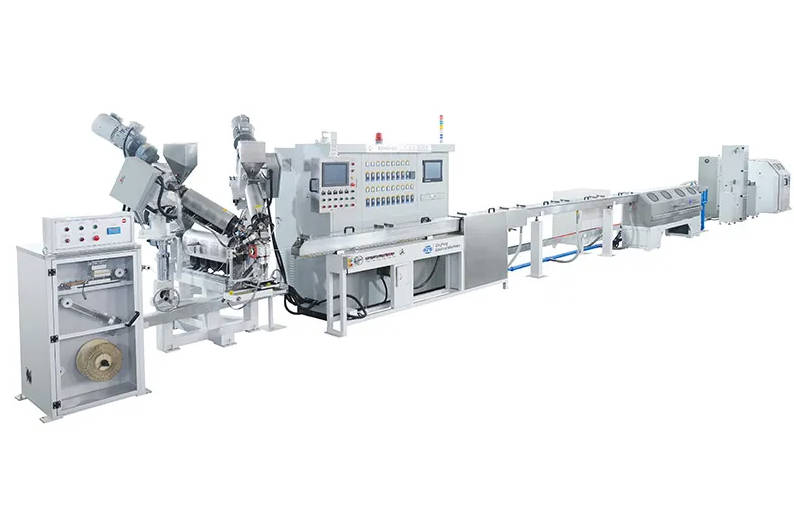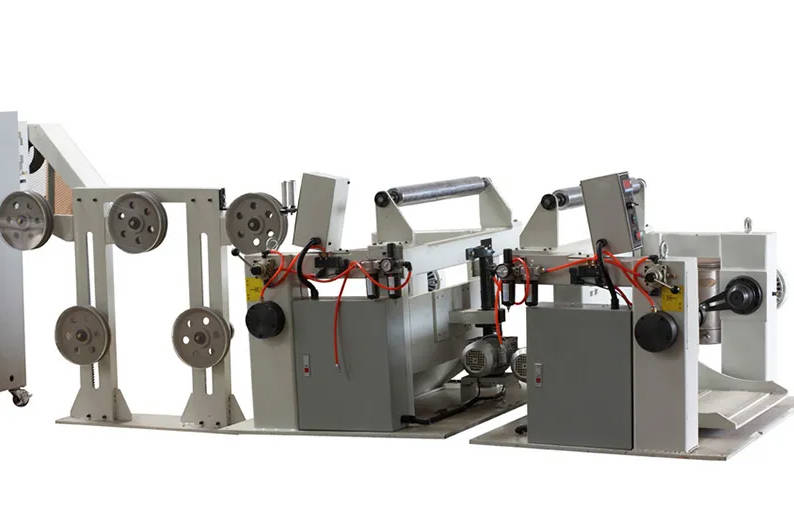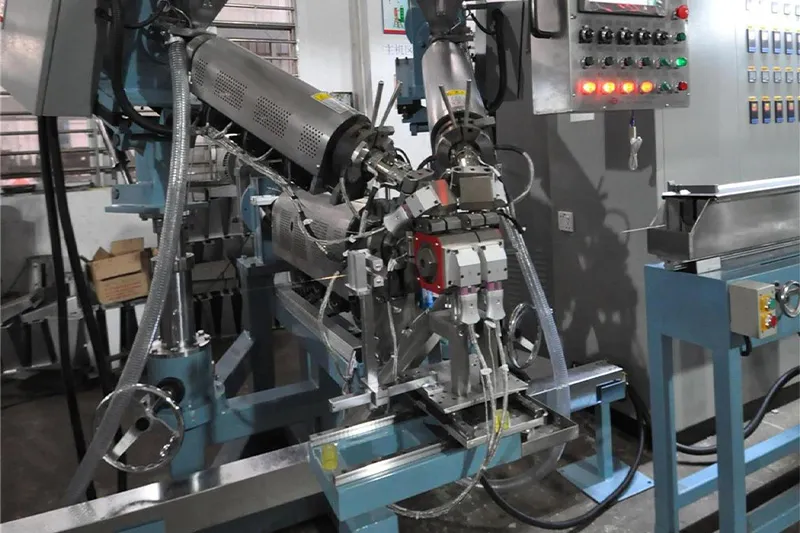
For manufacturers producing foamed dielectric twinax cable, the choice between physical foaming extrusion and solid extrusion directly affects cable loss, impedance stability, capacitance, outer diameter, production efficiency, and final product positioning.
High-speed twinax cables are widely used in data centers, servers, telecom equipment, AI computing systems, high-speed interconnects, and DAC cable assemblies. As transmission speeds continue to increase, cable manufacturers need more than a standard insulation process. They need a stable, precise, and controllable twinax cable extrusion line that can support low-loss cable production.
Physical foaming extrusion is usually the better choice for high-speed twinax cables when low loss, low capacitance, smaller cable size, and better signal transmission are required. Solid extrusion is simpler and mechanically stronger, but it usually has a higher dielectric constant and higher cable loss than foamed dielectric insulation.
This article compares physical foaming extrusion and solid extrusion from a manufacturing perspective and explains how cable manufacturers should choose the right extrusion line for high-speed twinax cable production.

What Is a Foamed Dielectric Twinax Cable?
A foamed dielectric twinax cable is a high-speed twinaxial cable that uses a foamed insulation layer around the conductors. Unlike solid insulation, foamed dielectric insulation introduces controlled air cells into the polymer material during extrusion.
Because air has a much lower dielectric constant than most solid polymers, a properly foamed dielectric layer can help reduce the effective dielectric constant, capacitance, and attenuation of the cable. Foamed dielectric materials are commonly used to achieve lower capacitance, smaller cable builds, and improved attenuation compared with solid insulation.
A typical high-speed twinax cable may include the following structure:
| Cable Component | Function in Twinax Cable |
| Copper conductor | Carries high-speed differential signals |
| Dielectric insulation | Controls impedance, capacitance, and signal speed |
| Foamed dielectric layer | Helps reduce cable loss and capacitance |
| Shielding layer | Reduces EMI and crosstalk |
| Drain wire | Supports grounding and shielding performance |
| Outer jacket | Provides mechanical protection |
For high-speed applications, the dielectric layer is not just an insulation layer. It is one of the most important parts affecting signal integrity.
Why Dielectric Material Matters in High-Speed Twinax Cable Manufacturing
In high-speed twinax cable production, the dielectric material affects several key electrical properties:
| Electrical Factor | Why It Matters |
| Impedance stability | Helps maintain consistent signal transmission |
| Capacitance | Lower capacitance supports better high-frequency performance |
| Insertion loss | Lower loss improves signal quality over distance |
| Return loss | Affects signal reflection and transmission stability |
| Signal propagation speed | Important for high-speed differential pairs |
| Cable diameter | Affects routing flexibility and high-density installation |
| Skew control | Important for maintaining timing between differential conductors |
The dielectric layer in a twinax cable affects signal integrity because it controls capacitance, impedance, and signal propagation speed. A lower dielectric constant usually helps reduce capacitance and cable loss, which is why foamed dielectric insulation is widely used in low loss cable designs.
For manufacturers targeting low loss cable, foam extrusion cable, DAC cable, or high-speed data cable, the extrusion process must keep the dielectric layer stable, uniform, and repeatable.
What Is Solid Extrusion for Twinax Cable?
Solid extrusion is a conventional cable insulation process. In this process, the polymer material is melted in the extruder and extruded directly around the conductor to form a dense, non-foamed insulation layer.
Common materials used in solid extrusion may include PE, FEP, PFA, or other insulation materials, depending on the cable application.
Advantages of Solid Extrusion
Solid extrusion is still widely used because it has several practical advantages:
| Advantage | Explanation |
| Easier process control | No gas injection or foam structure control is required |
| Good mechanical strength | Dense insulation provides stronger physical support |
| Stable insulation wall | Suitable for products requiring durability |
| Lower equipment complexity | The extrusion line configuration is simpler |
| Lower initial investment | Usually more cost-effective than physical foaming extrusion |
| Easier operation | Operators can manage the process more easily |
For standard cable products, solid extrusion may be enough. It is especially suitable when the cable does not require extremely low insertion loss or very small outer diameter.
Limitations of Solid Extrusion for High-Speed Twinax Cable
However, for high-speed twinax cable manufacturing, solid extrusion has some limitations:
- Higher dielectric constant than foamed dielectric insulation
- Higher capacitance under the same cable structure
- Higher attenuation at high frequencies
- Larger insulation diameter may be needed to meet impedance targets
- Less competitive for premium low-loss cable applications
Solid extrusion is simpler and mechanically strong, but it is usually not the best choice for high-speed low-loss twinax cable because solid insulation has a higher dielectric constant and can increase cable capacitance and attenuation.
What Is Physical Foaming Extrusion?
Physical foaming extrusion is a precision insulation process that injects gas, usually nitrogen or carbon dioxide, into the polymer melt during extrusion. The gas forms a controlled cellular structure inside the insulation layer.
The purpose of physical foaming is to introduce air into the dielectric material while maintaining stable insulation geometry and mechanical strength.
Physical foaming extrusion creates a controlled cellular insulation structure by injecting gas into the polymer melt. In twinax cable manufacturing, this process helps produce a lower dielectric constant, lower capacitance, and lower-loss insulation layer.
For a foamed dielectric twinax cable, physical foaming extrusion is often used when the cable must meet higher requirements for:
- Low insertion loss
- Stable impedance
- Low capacitance
- Small cable diameter
- High-speed data transmission
- Better signal integrity
- Long-distance transmission performance
Physical Foaming vs Solid Extrusion: Key Differences
The following table summarizes the major differences between physical foaming extrusion and solid extrusion for high-speed twinax cables.
| Comparison Factor | Physical Foaming Extrusion | Solid Extrusion |
| Dielectric constant | Lower because air is introduced into the insulation | Higher depending on polymer material |
| Cable loss | Better for low-loss cable designs | Higher loss at high frequencies |
| Capacitance | Lower | Higher |
| Cable diameter | Can be smaller under the same impedance requirement | May require larger diameter |
| Process difficulty | More complex | Easier to control |
| Equipment requirement | Needs gas injection, foam control, and monitoring systems | Standard extrusion configuration |
| Best application | High-speed, low-loss, data transmission twinax cables | Standard cables or mechanically demanding cables |
| Production risk | Foam instability, cell collapse, OD fluctuation | Fewer foam-related process risks |
| Investment cost | Higher | Lower |
| Technical value | Higher for premium cable production | Suitable for general cable production |
For high-speed twinax cable manufacturers, physical foaming extrusion provides better electrical performance, while solid extrusion provides simpler production and stronger mechanical insulation. The right choice depends on the cable’s speed, loss requirement, impedance target, and production budget.
Why Physical Foaming Is Preferred for Low Loss Twinax Cable
Physical foaming is widely used in low loss cable production because it improves the dielectric structure of the cable.
Lower Dielectric Constant
Air has a much lower dielectric constant than solid plastic materials. When controlled air cells are introduced into the insulation layer, the effective dielectric constant of the insulation is reduced.
This is important because lower dielectric constant helps improve signal propagation speed and reduce capacitance.
Lower Capacitance and Attenuation
A lower dielectric constant usually means lower capacitance. Lower capacitance helps reduce high-frequency signal loss and supports better signal quality.
For high-speed twinax cables used in data centers, servers, and high-speed interconnects, this can make a significant difference in cable performance.
Smaller Cable Size Under the Same Impedance Requirement
Foamed dielectric insulation can help manufacturers achieve the required impedance with a smaller insulation diameter.
This is especially important for compact cable designs used in:
- Data center equipment
- AI servers
- High-density server cabinets
- Internal high-speed cable assemblies
- DAC cable applications
Molex describes low-loss twinax cables as balanced transmission lines used in data center and telecommunication applications, with multiple impedance options such as 85 ohms, 90 ohms, and 100 ohms.
When Should Cable Manufacturers Choose Physical Foaming Extrusion?
Cable manufacturers should consider physical foaming extrusion when producing high-speed, low-loss, and compact cable products.
Choose Physical Foaming Extrusion If You Need:
| Requirement | Why Physical Foaming Helps |
| Low insertion loss | Foamed dielectric helps reduce dielectric loss |
| Low capacitance | Lower effective dielectric constant reduces capacitance |
| Smaller cable diameter | Foamed insulation can support compact cable design |
| Stable impedance | Precision foam extrusion helps control dielectric consistency |
| High-speed data transmission | Better electrical performance supports higher frequencies |
| Premium cable positioning | Suitable for high-end twinax cable and DAC cable products |
| Better signal integrity | Helps reduce signal degradation in high-speed applications |
Physical foaming extrusion is especially suitable for:
- High-speed twinax cable
- DAC cable
- Data center cable
- Server internal cable
- AI server interconnect cable
- Low-loss copper cable
- High-frequency differential pair cable
- Foam PE insulated cable
- Foamed fluoropolymer insulated cable
As data rates increase, low-loss twinax cable and cabled interconnect solutions are increasingly important for maintaining signal integrity in high-speed systems. Molex notes that 224G interconnect solutions use low-loss twinax cable and shielding structures to support high-speed data center applications.
When Is Solid Extrusion Still a Better Choice?
Although physical foaming extrusion has many advantages for high-speed cable production, solid extrusion is not outdated. In some cases, solid extrusion is still the better choice.
Solid Extrusion Is Suitable When:
| Situation | Reason |
| Mechanical strength is more important | Solid insulation provides stronger physical support |
| Cable speed requirement is not extremely high | Low-loss performance may not be the main concern |
| Production cost must be controlled | Solid extrusion needs simpler equipment |
| Operators have limited foam extrusion experience | Solid extrusion is easier to operate |
| Product design is standard | A physical foam extrusion line may not be necessary |
For manufacturers producing standard communication cables, control cables, or mechanically demanding cables, solid extrusion can still be a practical and cost-effective solution.
Solid extrusion is not always worse than physical foaming extrusion. It is better for applications where mechanical strength, simple operation, and lower investment cost are more important than ultra-low cable loss.
Common Problems in Foam Extrusion Cable Production
For customers looking for a foam extrusion cable line or physical foaming extrusion line, the biggest concern is not only whether the machine can produce foamed insulation. The real concern is whether the extrusion line can produce stable cable quality continuously.
Below are common problems in foam extrusion cable production and the equipment factors behind them.
| Problem | Possible Causes | Extrusion Line Solution |
| Unstable capacitance | Unstable foam ratio, temperature fluctuation, poor gas control | Use precise gas injection, temperature control, and online capacitance monitoring |
| OD fluctuation | Unstable line speed, melt pressure variation, poor cooling control | Use laser diameter gauge, stable haul-off, and closed-loop control |
| Eccentric insulation | Poor conductor centering, tooling misalignment, uneven melt flow | Use precision crosshead tooling and accurate conductor tension control |
| Foam cell collapse | Incorrect cooling, improper gas pressure, poor melt strength | Optimize temperature profile, gas pressure, and cooling system |
| Poor surface quality | Die temperature issue, material contamination, unstable extrusion pressure | Improve material filtration, die design, and screw stability |
| Impedance variation | OD fluctuation, eccentricity, unstable dielectric constant | Use online OD, capacitance, and concentricity monitoring |
| Low production repeatability | Manual adjustment and unstable process control | Use PLC control, recipe management, and closed-loop feedback |
The key to producing stable foamed dielectric twinax cable is not only the extruder itself, but the complete extrusion line system, including gas injection, conductor tension, crosshead precision, cooling, OD monitoring, capacitance testing, and closed-loop control.
Key Requirements for a High-Speed Twinax Cable Extrusion Line
A professional twinax cable extrusion line for foamed dielectric insulation should be designed for precision, stability, and repeatability.
1. Precision Pay-Off and Tension Control
Stable conductor tension is essential for small AWG high-speed twinax cable production. If conductor tension fluctuates, the insulation may become eccentric, causing impedance variation and unstable electrical performance.
2. Conductor Preheating System
Conductor preheating helps improve extrusion stability and reduces sudden temperature differences when the polymer contacts the conductor. This is especially important for high-speed cable insulation where wall thickness and concentricity must be tightly controlled.
3. Physical Foaming Extruder
The physical foaming extruder should provide stable melting, mixing, and pressure control. Screw design, temperature zones, and melt pressure stability all affect foam cell formation and final insulation quality.
4. High-Pressure Gas Injection System
The gas injection system is one of the core parts of a physical foaming extrusion line. It controls how gas enters the polymer melt and directly affects foam ratio, cell size, and dielectric consistency.
5. Precision Crosshead and Tooling
The crosshead determines how evenly the insulation is applied around the conductor. Precision tooling helps improve concentricity, wall thickness stability, OD control, and impedance consistency.
6. Online OD and Capacitance Monitoring
For high-speed twinax cable production, online monitoring is strongly recommended. Laser diameter gauges, capacitance testers, and spark testers help detect process drift early and reduce defective production.
7. Stable Cooling System
Cooling affects foam stability and final insulation geometry. If the cooling process is not controlled properly, the foam structure may collapse or the cable diameter may fluctuate.
8. Stable Haul-Off and Take-Up System
A stable haul-off system keeps line speed consistent. The take-up system should protect the finished cable from excessive tension, deformation, or winding defects.
9. PLC and Closed-Loop Control
Modern extrusion lines should support PLC control, recipe storage, real-time monitoring, and automatic adjustment. Closed-loop control reduces dependence on manual operation and improves long-run production consistency.
How to Choose Between Physical Foaming and Solid Extrusion
The best extrusion process depends on your target cable product.
Choose Physical Foaming Extrusion If Your Cable Requires:
- Low loss performance
- High-speed signal transmission
- Lower capacitance
- Smaller cable diameter
- Better signal integrity
- Stable impedance control
- Data center or server cable application
- Premium twinax cable production
- DAC cable or high-frequency cable production
Choose Solid Extrusion If Your Cable Requires:
- Simpler production
- Lower equipment investment
- Stronger mechanical insulation
- Standard cable performance
- Easier operation
- Lower technical barrier
For manufacturers targeting high-speed, low-loss, compact, and high-frequency twinax cables, physical foaming extrusion is usually the more competitive process. However, the final cable quality depends heavily on the precision, stability, and control capability of the extrusion line.
How to Evaluate a Physical Foaming Extrusion Line Supplier
Before purchasing a physical foaming extrusion line, cable manufacturers should evaluate not only the machine price, but also the supplier’s ability to provide a complete process solution.
Questions to Ask Before Buying an Extrusion Line
| Question | Why It Matters |
| Can the extrusion line support both solid extrusion and physical foaming extrusion? | Provides production flexibility |
| What insulation materials can it process? | Determines cable product range |
| What is the minimum conductor size it can handle? | Important for small AWG twinax cable |
| What OD tolerance can the line maintain? | Affects impedance and product consistency |
| Does the line support online capacitance monitoring? | Important for high-speed cable quality control |
| Does it include gas injection and foam ratio control? | Core requirement for physical foaming extrusion |
| Can it produce stable closed-cell foam structure? | Affects dielectric performance |
| Is it suitable for high-speed twinax cable or DAC cable production? | Determines whether it fits your target market |
| Can the supplier provide trial production or sample testing? | Helps reduce investment risk |
| Can the line be customized? | Different cable designs need different configurations |
Why Equipment Customization Matters
Different cable designs require different extrusion line configurations.
For example, a small AWG foamed dielectric twinax cable may require more precise conductor tension control, smaller tooling, better OD monitoring, and more sensitive capacitance control. A fluoropolymer foam extrusion cable may require a different screw design and temperature control system compared with foam PE insulation.
That is why cable manufacturers should not choose an extrusion line only based on price. They should choose a supplier that understands both equipment and cable process requirements.
Recommended Extrusion Line Configuration for Foamed Dielectric Twinax Cable
For manufacturers planning to produce foamed dielectric twinax cable, a recommended extrusion line may include:
| System | Function |
| Precision pay-off | Controls conductor feeding and tension |
| Conductor preheater | Improves extrusion stability |
| Physical foaming extruder | Melts, mixes, and extrudes insulation material |
| Gas injection system | Creates controlled foamed dielectric structure |
| Precision crosshead | Controls insulation concentricity |
| Cooling system | Stabilizes foam structure and cable OD |
| Laser diameter gauge | Monitors OD in real time |
| Capacitance tester | Monitors dielectric consistency |
| Spark tester | Checks insulation defects |
| Haul-off system | Controls line speed and cable stability |
| Take-up system | Collects finished cable smoothly |
| PLC control system | Supports process monitoring and control |
| Optional closed-loop control | Improves long-run production consistency |
If you are planning to produce foamed dielectric twinax cable, choosing a stable and customizable twinax cable extrusion line is the first step toward consistent low-loss cable production.
Physical Foaming vs Solid Extrusion: Which One Is Better for Your Cable Factory?
Physical foaming extrusion is better for manufacturers targeting high-speed, low-loss, compact, and high-frequency twinax cable products. It helps reduce dielectric constant, capacitance, and cable loss while supporting smaller cable designs.
Solid extrusion is more suitable for standard cable products where process simplicity, mechanical strength, and investment cost are more important.
For high-speed data center twinax cables, the industry trend is moving toward lower dielectric loss, tighter impedance control, better shielding, and more precise extrusion line technology.
If your target market is high-speed twinax cable, DAC cable, AI server cable, data center cable, or other low-loss copper cable products, physical foaming extrusion is usually the better long-term investment.
FAQ About Foamed Dielectric Twinax Cable Extrusion
Is foamed dielectric always better than solid dielectric?
No. Foamed dielectric is better for low-loss and high-speed cable applications, but solid dielectric may be better when mechanical strength, simple processing, and lower investment cost are more important.
What is the difference between physical foaming and chemical foaming?
Physical foaming uses injected gas to create foam cells inside the polymer insulation. Chemical foaming uses chemical agents that decompose and release gas. For high-speed cable production, physical foaming is usually preferred because it offers better process control and cleaner dielectric performance.
Why does foamed dielectric reduce cable loss?
Foamed dielectric reduces cable loss because the air cells inside the insulation lower the effective dielectric constant and capacitance. Lower capacitance helps improve high-frequency signal transmission.
Can one extrusion line produce both solid and foamed insulation?
It depends on the extrusion line configuration. Some extrusion lines can be customized to support both solid extrusion and physical foaming extrusion, but foam production requires gas injection, pressure control, foam control, and monitoring systems.
What should I check when buying a foam extrusion cable line?
You should check material compatibility, gas injection stability, OD tolerance, capacitance control, conductor tension control, cooling system, crosshead precision, PLC control, and supplier experience in high-speed cable production.
What affects impedance stability in twinax cable extrusion?
Impedance stability is affected by insulation OD, wall thickness, concentricity, dielectric constant, foam uniformity, conductor position, cooling stability, and online process control.
Is physical foaming extrusion suitable for DAC cable production?
Yes. Physical foaming extrusion is suitable for many high-speed DAC cable and twinax cable applications because it helps produce low-loss, low-capacitance, and compact insulation structures.