The main difference between a planetary cable machine and a tubular stranding machine is not simply machine shape or rotational speed. The more important question is how each machine controls the orientation, tension and movement of the cable elements while they are stranded.
A planetary machine is usually selected when manufacturers need greater control over individual bobbins, cable-core orientation and complex stranding structures. A tubular strander is often considered when the product structure is comparatively regular and production efficiency is a stronger priority.
Neither machine is universally better.
The right choice depends on:
- What is being stranded
- Whether individual elements may rotate
- How many bobbins are required
- Cable diameter and conductor size
- Required lay length
- Input reel size
- Production speed
- Product change frequency
- Future cable portfolio
This means equipment selection should begin with the finished cable drawing rather than a request for the fastest stranding machine.
QingFeng SFS provides planetary cable machine solutions for different wire and cable structures, including heavy-duty, light-type, vertical, non-back-twist and power-cable configurations.
Decision Gate 1: Can the Cable Elements Rotate Around Their Own Axes?
This is the most useful question to ask first.
Imagine several insulated cable cores entering a stranding machine.
As they are laid helically around a center, two things can happen:
- The cores follow the cable helix while maintaining controlled orientation.
- The cores rotate mechanically as part of the stranding path.
For some products, this difference has limited practical impact.
For other products, it can affect:
- Internal geometry
- Shielding position
- Insulation stress
- Pair orientation
- Cable flexibility
- Finished cable symmetry
Why Planetary Motion Matters
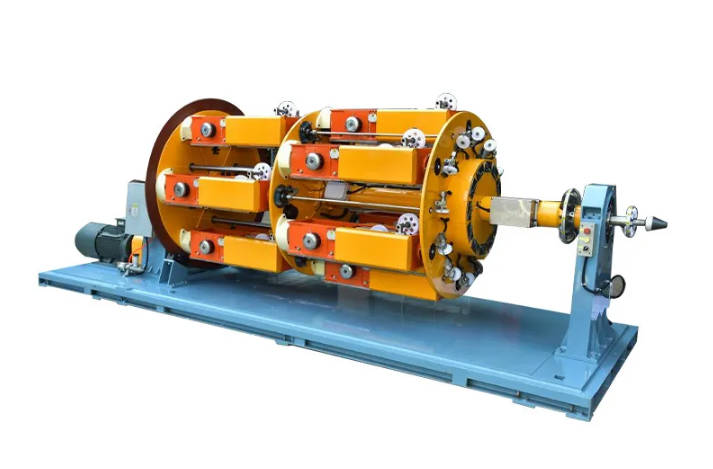
A planetary cable machine uses bobbin cradles arranged around a rotating cage. Depending on the machine configuration, the bobbin cradle can compensate for cage rotation so the pay-off element does not simply rotate uncontrolled with the cage.
This is commonly described through back-twist or non-back-twist control.
The result is greater control over how the individual cable elements enter the final stranded structure.
QingFeng SFS offers multiple planetary configurations, including heavy-duty cage machines, light planetary machines, vertical systems and high-frequency non-back-twist planetary machines.
If maintaining the orientation of individual cable elements is important to the finished cable, planetary stranding deserves stronger consideration.
When Orientation Is Less Critical
Some conductor or strand constructions do not require the same level of orientation control.
If relatively uniform wires are being stranded into a conventional structure and individual elements can tolerate the rotational path, a tubular configuration may offer a simpler production approach.
This is why equipment should not be selected only by conductor diameter.
Two cables with the same outside diameter can require completely different machines because the internal structures behave differently during twisting.
Decision Gate 2: What Exactly Is Being Stranded?
The second question is not “What is the finished cable diameter?”
It is:
What are the individual elements entering the stranding point?
They may be:
- Bare copper wires
- Aluminum wires
- Insulated power cores
- Shielded cable elements
- Communication cores
- High-frequency cable elements
- Steel wires
- Optical elements
- Flexible conductors
- Specialized composite structures
The more structurally sensitive the input element becomes, the more important its mechanical path becomes.
Product Structure Comparison
| Product Requirement | Planetary Cable Machine | Tubular Stranding Machine |
| Ordinary stranded wires | Suitable depending on configuration | Often suitable |
| Large insulated cable cores | Strong option | Product-dependent |
| Orientation-sensitive cores | Strong advantage | Requires careful evaluation |
| Complex multi-core cable | Highly configurable | More dependent on machine layout |
| Steel or reinforcement wires | Suitable with appropriate machine | Suitable in many regular constructions |
| High-frequency cable elements | Non-back-twist configurations can be valuable | Must evaluate element rotation carefully |
| Power cable stranding | Strong application area | Suitable for selected structures |
| Wide product mix | Strong flexibility potential | More specialized by configuration |
QingFeng SFS lists planetary machine applications across power transmission, automotive and telecommunications cable production, with machine variants designed around different bobbin and cable requirements.
Decision Gate 3: Is Your Main Priority Structural Control or Rotational Efficiency?
This is where many purchasing discussions become oversimplified.
Tubular machines are frequently associated with relatively compact rotating structures. Planetary machines use cages and rotating bobbin assemblies, which can involve larger rotating mass and more mechanical components.
That does not automatically mean:
Tubular = fast
Planetary = slow
Actual production speed depends on:
- Machine size
- Number of bobbins
- Bobbin weight
- Finished cable diameter
- Lay length
- Input-wire tension
- Cable construction
- Rotating balance
- Production quality limits
The correct comparison is stable meters per minute for the specified cable—not the unloaded maximum RPM of the machine.
Why Rotating Mass Matters
Consider what happens when equipment accelerates.
Every rotating component has inertia.
A machine carrying several large loaded bobbins cannot react in exactly the same way as a smaller rotor carrying lighter packages.
As rotating mass increases:
- Acceleration requires more energy
- Deceleration becomes more important
- Machine balance becomes more critical
- Bearing loads increase
- Vibration control becomes more demanding
Planetary equipment therefore needs to be sized according to the actual reel and cable range.
QingFeng SFS currently divides its planetary portfolio into several architectures rather than using one universal machine, including Φ400, Φ500, Φ630 and Φ800 heavy-type cage machines as well as 1250, light-type and vertical planetary configurations.
Do Not Compare Speed Without Lay Length
Stranding-machine speed means very little without the required lay length.
Lay length is the axial distance over which a cable element completes one full revolution around the cable.
A shorter lay requires more rotations for each meter of cable.
A longer lay requires fewer rotations.
Therefore:
- Shorter lay generally limits linear production speed.
- Longer lay can permit higher linear output.
- Larger products may impose lower practical rotational limits.
- Sensitive cable elements may impose stricter tension limits.
If Supplier A quotes a higher RPM but tests with a longer lay, while Supplier B quotes a lower RPM with the actual required lay, the first number may be misleading.
A useful quotation should therefore connect:
Cable structure + lay length + rotational speed + actual line speed
rather than presenting RPM alone.
Decision Gate 4: How Many Bobbins Does the Product Require?
The number of input elements affects machine configuration immediately.
A simple construction may require relatively few bobbins.
A more complex cable may require:
- Several insulated cores
- Multiple conductor layers
- Fillers
- Reinforcement
- Additional structural elements
Planetary machines can be designed around multiple cage sections, allowing manufacturers to build more complex structures in stages.
The equipment layout may include:
- Central payoff
- Planetary cage
- Additional cage section
- Closing die
- Taping device
- Capstan
- Take-up
Not every project requires all these components.
The purpose of the RFQ is to identify the minimum configuration capable of producing the cable correctly.
More Bobbins Create More Than a Capacity Question
Increasing bobbin quantity also changes:
- Machine length
- Rotating mass
- Number of tension systems
- Setup time
- Loading time
- Maintenance requirements
- Operator access
- Cable changeover time
This is why “more bobbins” is not automatically a better specification.
The machine should carry enough bobbins for the intended cable structure without adding rotating capacity that the factory rarely uses.
Decision Gate 5: What Size Bobbins Are Required?
Bobbin diameter affects both production length and machine dynamics.
Larger reels may provide:
- Longer continuous runs
- Fewer reel changes
- Better suitability for larger cable elements
But they can also create:
- Higher rotating mass
- Larger machine footprint
- Higher loading requirements
- More demanding braking
- Greater acceleration and deceleration loads
Smaller bobbins may be suitable where:
- Cable elements are fine
- Product batches are shorter
- Frequent changeovers are common
- The machine prioritizes low rotating inertia
The correct machine therefore cannot be selected using finished cable diameter alone.
The RFQ should specify:
- Bobbin flange diameter
- Barrel diameter
- Bobbin width
- Empty weight
- Full weight
- Loading method
- Required continuous production length
Compare the Two Machines Through a Production Day
Instead of comparing brochures, imagine both machines producing the same order.
The order requires:
- Loading input bobbins
- Threading
- Setting tension
- Setting lay
- Starting the machine
- Accelerating
- Running continuously
- Replacing bobbins
- Changing products
- Cleaning
- Maintenance
This exposes differences that maximum speed cannot show.
Production Comparison
| Production Factor | Planetary Cable Machine | Tubular Strander |
| Product-structure flexibility | Generally strong | Strong for defined structures |
| Individual bobbin control | Major design focus | Configuration-dependent |
| Back-twist capability | Important advantage | Depends on machine design |
| Orientation-sensitive cores | Well suited with correct configuration | Requires careful product assessment |
| Mechanical complexity | Higher in many configurations | Often more compact mechanically |
| Bobbin accessibility | Depends on cage design | Depends on rotor layout |
| High bobbin quantity | Multiple cage options possible | Machine-specific |
| Product changeover | Can involve more adjustment points | Can be efficient for stable product families |
| Large product capability | Strong with heavy planetary configurations | Machine-specific |
| High-speed regular structures | Depends on rotating mass and product | Often considered where simplified geometry permits |
| Future customization | High potential | Depends on rotor configuration |
The important conclusion is that “flexibility” and “speed” are not isolated advantages.
A flexible machine that takes too long to change products may still be inefficient for one factory.
A very fast machine designed around a narrow product range may be inefficient for another factory that changes cable structures every few hours.
Back-Twist Is the Real Technical Fork in the Road
For many projects, the machinery decision becomes much clearer once back-twist is defined.
What Is Back-Twist?
As the main cage rotates, the bobbin cradle can rotate in a compensating direction.
The objective is to control how much torsion is transferred into the cable element itself.
Depending on cable design, manufacturers may require:
- Full back-twist
- Partial back-twist
- No back-twist
- Fixed bobbin orientation
The correct ratio should come from the finished cable structure.
Why It Matters
Without suitable orientation control, sensitive cable elements may experience:
- Unwanted torsion
- Internal stress
- Shape changes
- Shield movement
- Unequal mechanical loading
For ordinary wires, these effects may be manageable.
For complex insulated or high-frequency elements, they may become part of the product-quality equation.
QingFeng SFS includes dedicated non-back-twisted planetary equipment within its planetary cable machine range, alongside heavy, light, vertical and power-cable planetary configurations.
Tension Control Can Decide Finished Cable Quality
Each bobbin should deliver material into the stranding point with controlled tension.
If several elements have different tension:
- One element may become effectively shorter
- Another may become loose
- Cable geometry can move away from center
- Lay can become irregular
- Insulated cores may stretch
- Finished cable diameter can fluctuate
This makes tension control especially important in planetary equipment because multiple individual payoffs must work together.
What to Ask About Tension
Do not ask only:
Does the machine have tension control?
Ask:
- How is bobbin tension generated?
- Is it manually or automatically adjustable?
- How does tension change as the bobbin empties?
- Is each bobbin controlled independently?
- What tension range is available?
- How is the system calibrated?
- Can product recipes store tension settings?
- What happens during acceleration and deceleration?
The answer should reflect the actual cable material.
A fine insulated core should not be controlled in the same way as a heavy conductor.
Product Scenario 1: Large Power Cable
Suppose the factory needs to strand several insulated power cable cores around a center.
Priorities may include:
- Large bobbins
- Stable core orientation
- High pulling force
- Larger finished diameter
- Accurate lay
- Possibility of filling or additional processing
A heavy-duty planetary machine becomes a strong candidate because the machine can be configured around larger bobbins and controlled core handling.
QingFeng SFS’s planetary category includes heavy-weight and power planetary cage configurations intended for larger conductor and cable applications.
In this scenario, maximum rotor speed may be less important than:
- Full-reel stability
- Core tension
- Lay consistency
- Cable roundness
- Changeover efficiency
Product Scenario 2: Regular Wire Stranding
Now consider a relatively regular strand built from similar wires.
The individual wires do not have a complex internal orientation that must be preserved.
The purchasing priorities may shift toward:
- Output
- Compact machine arrangement
- Stable wire tension
- Repeatable lay
- Simple production
A tubular stranding approach can become more attractive because the factory does not need to pay for process capabilities that the product does not use.
This illustrates an important procurement principle:
Do not purchase complex motion control simply because it sounds technically superior; purchase the motion control required by the cable.
Product Scenario 3: Orientation-Sensitive Cable Elements
Now consider a cable composed of specialized insulated or high-frequency elements where their orientation during assembly matters.
The priorities change again:
- Low torsional disturbance
- Independent bobbin control
- Stable tension
- Precise lay
- Protection of the incoming cable geometry
This is where planetary architecture becomes particularly relevant.
QingFeng SFS also offers planetary configurations for telecommunications and high-frequency cable production, in addition to power and automotive applications.
Product Scenario 4: A Factory With Many Cable Families
Some factories do not have one dominant product.
They may manufacture:
- Power cable
- Automotive cable
- Communication cable
- Special cable
- Conductors of several sizes
Here, the purchasing decision becomes less about maximum output on one SKU and more about usable range.
Ask:
- How many products fit the same machine?
- How often will cages or tooling change?
- Can several bobbin sizes be used?
- Can tension recipes be stored?
- Is back-twist adjustable?
- Can additional processes be added later?
A more configurable machine can reduce the need for future equipment purchases, but only if its changeover time and operating complexity remain practical.
What Buyers Commonly Compare Incorrectly
Mistake 1: Comparing Maximum RPM
RPM does not tell you actual cable output unless lay length and cable structure are also defined.
Mistake 2: Comparing Only Finished Diameter
Cable diameter says nothing about whether the internal elements require back-twist or orientation control.
Mistake 3: Assuming More Bobbins Mean Greater Capability
Unused cage positions add investment and mechanical complexity without creating output.
Mistake 4: Ignoring Full Bobbin Weight
A machine should be evaluated with production-loaded bobbins, not only empty reels.
Mistake 5: Looking Only at Continuous Speed
Startup and deceleration can expose:
- Tension fluctuation
- Cable movement
- Bobbin instability
- Lay variation
Mistake 6: Using the Easiest Product for FAT
A machine should be tested with the product most likely to expose its limitations.
A Better Selection Matrix
| Your Priority | Direction to Evaluate First |
| Preserve orientation of cable elements | Planetary |
| Need controlled back-twist | Planetary |
| Large insulated power cable cores | Planetary |
| Complex multi-core structure | Planetary |
| High-frequency or orientation-sensitive elements | Planetary |
| Wide future product range | Planetary deserves stronger evaluation |
| Regular strand with limited orientation requirements | Tubular deserves evaluation |
| Production dominated by standardized structures | Tubular may offer a simpler route |
| Maximum output is the primary requirement | Compare product-specific demonstrated speeds |
| Very large bobbins | Compare actual machine architectures rather than machine names |
| Frequent SKU changes | Compare real changeover time |
| Difficult tension-sensitive cores | Evaluate individual payoff control carefully |
Build the RFQ Around the Cable Drawing
Do not request:
“Quote one planetary strander.”
Instead provide a technical production package.
Input Elements
- Material
- Bare or insulated
- Diameter
- Number of elements
- Minimum bending radius
- Maximum permissible tension
Cable Construction
- Finished drawing
- Number of layers
- Central element
- Lay direction
- Lay length
- Back-twist requirement
- Finished diameter
Bobbins
- Number of bobbins
- Flange diameter
- Width
- Barrel diameter
- Empty weight
- Full weight
Production Requirements
- Target line speed
- Annual volume
- Product mix
- Changeover frequency
- Required continuous reel length
Additional Processes
- Taping
- Filling
- Compacting
- Measuring
- Printing
- Other inline operations
Factory Requirements
- Available floor space
- Voltage
- Lifting equipment
- Installation restrictions
- Operator requirements
QingFeng SFS can configure planetary stranding equipment according to cable structure, reel dimensions and production requirements rather than using one standard machine for every project.
FAT Should Answer One Question: Can the Machine Make Your Cable?
Factory acceptance testing should focus on finished product performance.
A practical test can include:
- Load production-representative bobbins
- Thread the actual cable elements
- Set individual tension
- Confirm back-twist setting where required
- Run at low speed
- Measure lay length
- Increase to target speed
- Observe cable-core orientation
- Check tension stability
- Measure finished diameter
- Test acceleration
- Test deceleration
- Inspect cable surface
- Check reel winding
- Verify alarms and safety functions
- Repeat measurements near the end of the production run
Test the most challenging product.
That may be:
- The largest bobbin
- The heaviest cable element
- The most tension-sensitive core
- The shortest lay
- The largest finished cable
- The most orientation-sensitive product
A successful FAT proves stable production of the specified cable; it does not merely prove that the cage can reach its maximum rotational speed.
Frequently Asked Questions
What is the difference between a planetary cable machine and a tubular stranding machine?
A planetary machine uses rotating cages with individual bobbin cradles and can provide controlled back-twist or element orientation. A tubular strander uses a different rotating arrangement and is often considered for more regular stranding structures where simplified high-output production is important.
Is a planetary cable machine better than a tubular strander?
Not universally. Planetary equipment is particularly valuable for complex or orientation-sensitive cable structures, while tubular equipment may be more suitable for certain regular strands. The cable construction should determine the choice.
What is back-twist in a planetary stranding machine?
Back-twist is compensating rotation applied to the bobbin cradle as the main cage rotates. It controls the amount of torsion transferred into the individual cable element.
When should I choose a planetary cage stranding machine?
A planetary cage machine should be strongly considered when producing larger power cables, complex multi-core cables, orientation-sensitive cable elements or structures requiring controlled back-twist.
Is a tubular stranding machine faster than a planetary machine?
It can have an advantage in certain standardized applications, but machine type alone does not determine production speed. Lay length, cable diameter, bobbin weight, tension and product quality all influence usable output.
Can a planetary cable machine produce high-frequency cables?
Yes, when configured for the required product. QingFeng SFS includes high-frequency non-back-twist equipment within its planetary cable machine category.
Why is tension important in planetary cable stranding?
Uneven tension between bobbins can change core length, cable geometry and lay consistency. Each cable element should therefore enter the stranding point under suitable controlled tension.
Does a larger planetary cage machine always provide more production capacity?
No. A larger machine can accommodate larger reels and products but also has more rotating mass. Production capacity should be evaluated using the actual cable, bobbin and lay requirements.
What information is needed to quote a planetary cable machine?
Provide the cable drawing, input materials, element dimensions, bobbin sizes, number of bobbins, lay length, back-twist requirements, finished diameter and target production speed.
How should planetary and tubular stranders be compared before purchase?
Use the same cable specification and compare actual line speed, lay stability, tension, finished geometry, changeover, reel handling and acceptable output rather than comparing maximum RPM alone.
Conclusion
The difference between planetary and tubular stranding becomes easier to understand when the decision starts with the cable instead of the machine.
A planetary cable machine deserves stronger consideration when the project requires:
- Controlled element orientation
- Back-twist
- Large or complex cable structures
- Multiple bobbin configurations
- Sensitive insulated cores
- Broad production flexibility
A tubular strander deserves consideration when:
- The strand structure is comparatively regular
- Element orientation is less critical
- The production range is relatively standardized
- Efficient repeat production is a major objective
The correct stranding machine is the one whose mechanical movement matches the cable structure—not the machine with the more impressive RPM specification.
Manufacturers planning a new stranding project can review QingFeng SFS planetary cable machine configurations or explore the company’s broader wire and cable manufacturing equipment according to the intended cable structure and production plan.