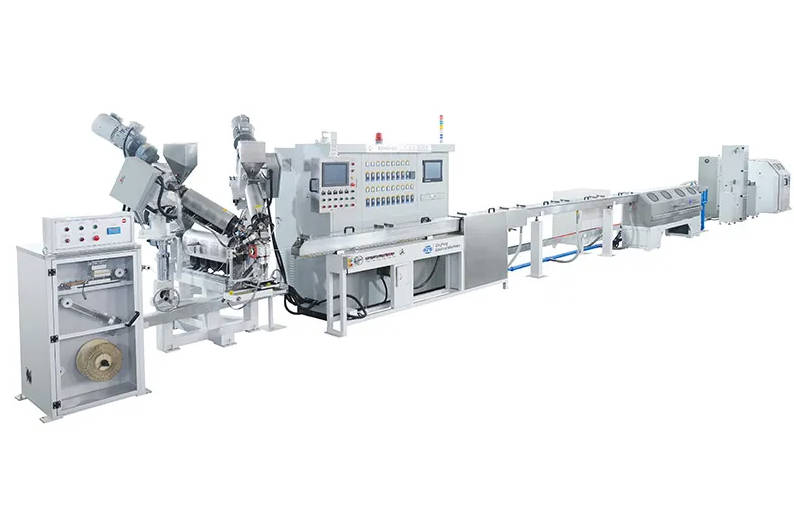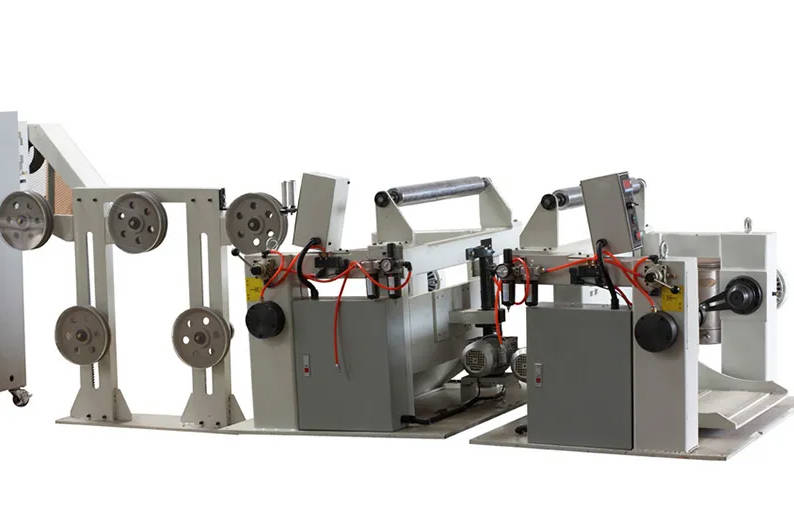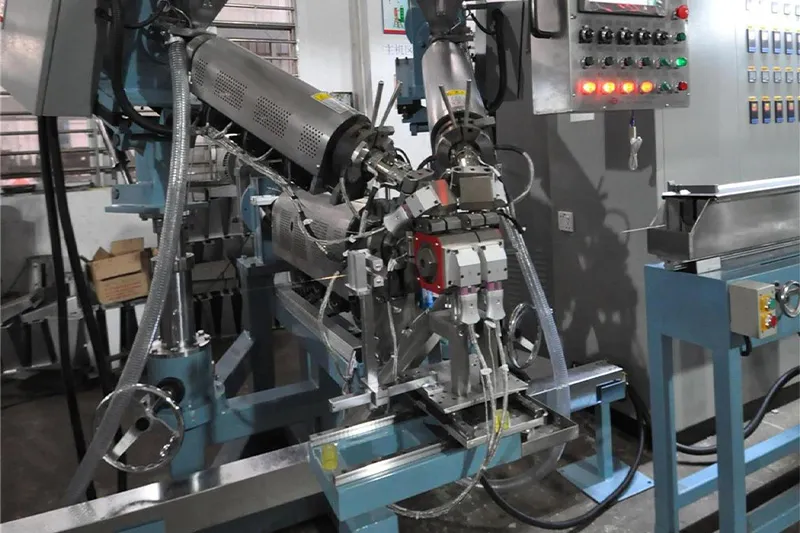
PTFE and Mylar tape wrapping is used in twinax cable production to improve insulation, shielding stability, mechanical protection, and high-frequency signal consistency. A suitable PTFE Mylar tape wrapping machine helps apply these tapes with controlled tension, stable overlap, accurate wrapping pitch, and smooth cable centering, which are critical for producing reliable twinax cables used in high-speed data transmission and communication systems.
In twinax cable manufacturing, the tape wrapping process is not a simple covering step. PTFE tape, Mylar tape, aluminum-laminated Mylar foil, and other composite tapes may be applied around the insulated pair, shielding layer, drain wire, or cable core. If the wrapping process is unstable, problems such as tape wrinkles, uneven overlap, loose shielding, cable deformation, and inconsistent electrical performance may appear.
For this reason, manufacturers producing high-frequency twinax cables should pay close attention to both tape material selection and machine performance. A professional taping machine should support stable tape feeding, precise tension control, suitable tape head design, and reliable synchronization between cable speed and wrapping rotation.
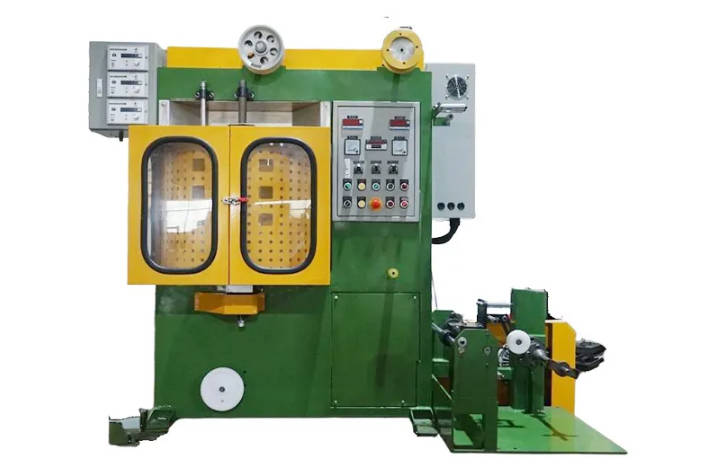
What Are PTFE and Mylar Tapes in Twinax Cable Production?
PTFE and Mylar tapes are commonly used functional wrapping materials in cable manufacturing. They serve different roles depending on cable structure, electrical requirements, shielding design, and downstream processing conditions.
PTFE, or polytetrafluoroethylene, is often used in cable applications where high-frequency performance, heat resistance, chemical resistance, and dielectric stability are important. In many high-speed cable designs, PTFE tape can be used as an insulation or separation layer because it has stable electrical properties and good thermal resistance.
Mylar is a polyester film material. In cable production, Mylar tape is commonly used for insulation, separation, wrapping support, and mechanical protection. Mylar foil tape, especially aluminum-laminated Mylar tape, is often used as part of the shielding structure in communication cables and data cables.
PTFE tape is usually selected for its dielectric and thermal properties, while Mylar tape is widely used for insulation, separation, shielding support, and mechanical protection.
The exact use depends on the cable design. Some twinax cables may use PTFE tape for insulation stability and Mylar foil tape for shielding. Others may use polyester-based tapes as a separator layer or binder layer before further processing.
Why Tape Wrapping Matters for Twinax Cables
Twinax cable is designed for balanced high-speed signal transmission. Compared with ordinary low-frequency cables, the internal structure of twinax cable is more sensitive to geometric consistency. Cable diameter, conductor spacing, insulation thickness, shielding coverage, and core roundness may all influence the final cable performance.
Tape wrapping affects several important aspects of twinax cable quality:
| Quality Factor | How Tape Wrapping Affects It |
| Shielding consistency | Controls coverage, overlap, and continuity of the shielding layer |
| Signal stability | Helps maintain cable geometry and reduce structural variation |
| Impedance consistency | Reduces irregular pressure, gaps, and deformation around the cable core |
| Mechanical protection | Protects insulation and shielding layers during later processing |
| Cable roundness | Helps maintain a stable and uniform outer profile |
| Process reliability | Reduces defects during extrusion, cabling, or jacket application |
For cable manufacturers, these quality factors directly affect production yield, customer acceptance, and batch-to-batch consistency. A high speed cable taping machine should therefore be evaluated not only by speed, but also by wrapping accuracy, tension stability, and material handling capability.
PTFE Tape vs Mylar Tape: Key Differences for Cable Manufacturers
PTFE and Mylar tapes are not interchangeable in every cable design. Each material has different advantages and processing requirements. Understanding these differences helps engineers select suitable tape materials and machine configurations.
| Item | PTFE Tape | Mylar Tape / Mylar Foil Tape |
| Material Type | Fluoropolymer film | Polyester film or laminated polyester foil |
| Common Use | Insulation, dielectric layer, heat-resistant wrapping | Insulation, separation, shielding support, binder layer |
| Electrical Role | Often used where dielectric performance is important | Often used in shielding and insulation structures |
| Thermal Performance | Generally suitable for higher temperature applications | Suitable for many standard cable wrapping applications |
| Mechanical Behavior | Can require careful tension control depending on thickness and grade | Usually easier to handle, but foil types may wrinkle if poorly controlled |
| Wrapping Challenge | Avoid stretching, deformation, or uneven pressure | Avoid wrinkles, cracks, gaps, and loose wrapping |
| Machine Requirement | Stable low-tension control and accurate tape path | Smooth feeding, overlap control, and foil-friendly guidance |
For twinax cable production, PTFE tape may be used when the cable requires stable high-frequency insulation performance. Mylar foil tape may be used when the cable requires shielding coverage. In some cable structures, both materials are used in different layers.
How a PTFE Mylar Tape Wrapping Machine Works
A PTFE Mylar tape wrapping machine applies tape around the cable core by rotating a tape head while the cable moves forward at a controlled speed. The relationship between cable line speed and tape head rotation determines the wrapping pitch and overlap.
A typical machine includes the following sections:
| Machine Section | Function |
| Cable pay-off | Feeds the cable core or conductor structure into the machine |
| Straightening or guiding unit | Helps align the cable before wrapping |
| Tape head | Holds and rotates the PTFE, Mylar, or foil tape bobbin |
| Tension control device | Controls tape feeding force during wrapping |
| Capstan or traction unit | Pulls the cable through the wrapping section |
| Take-up unit | Winds the wrapped cable onto a spool |
| Control system | Adjusts speed, pitch, direction, length, and machine parameters |
The core working principle of a tape wrapping machine is to synchronize cable movement and tape head rotation so that the tape is applied with stable overlap and controlled tension.
If the cable speed changes but the tape head rotation does not adjust correctly, overlap may become inconsistent. If tape tension fluctuates, the tape may wrinkle, break, or compress the cable core. Therefore, machine synchronization is one of the most important factors in high-speed twinax cable taping.
Key Machine Features That Matter for PTFE and Mylar Tape Wrapping
When selecting a PTFE tape wrapping machine or Mylar foil taping machine for twinax cable production, buyers should focus on the features that influence real production quality.
1. Stable Tape Tension Control
Tape tension must be stable throughout production. PTFE tape may require careful handling to avoid stretching or uneven pressure. Mylar foil tape may wrinkle or crack if tension and tape path are not properly controlled.
A suitable machine should allow operators to adjust tension according to tape material, width, thickness, cable diameter, and wrapping speed.
2. Accurate Tape Overlap Control
Tape overlap determines how much each tape turn covers the previous turn. For shielding applications, overlap consistency is especially important because gaps may reduce shielding effectiveness.
Consistent tape overlap helps improve shielding coverage and reduces the risk of exposed gaps in twinax cable production.
The machine should allow precise adjustment of wrapping pitch and rotation speed. For repeat production, parameter storage or easy setup adjustment can improve consistency.
3. Smooth Tape Feeding Path
The tape path should be smooth and suitable for the selected material. Sharp edges, poor guide design, or unstable bobbin rotation can cause tape damage. This is especially important for thin foil-laminated tapes.
4. Cable Centering and Guiding
Twinax cable cores can be sensitive to pressure and deformation. If the cable is not centered during wrapping, the tape may be applied unevenly. Poor guiding can also create surface scratches or shape distortion.
5. Support for Different Tape Materials
A manufacturer may need to process PTFE tape, Mylar tape, aluminum Mylar tape, polyester tape, copper foil tape, or other composite materials. The machine should support the required tape width, bobbin size, tension range, and wrapping direction.
6. Reliable High-Speed Operation
A high speed taping machine should maintain stable performance at the required production speed. The practical operating speed depends on cable diameter, tape width, material type, wrapping pitch, and quality requirement. Buyers should evaluate stable working speed rather than only maximum listed speed.
Manufacturers who need flexible equipment for high-frequency cable production can review QingFeng SFS high speed cable taping machine solutions for related machine configurations.
Important Process Parameters for Twinax Cable Tape Wrapping
Before production, engineers should define the tape wrapping process clearly. The following parameters are especially important.
| Parameter | Why It Matters | Practical Consideration |
| Cable diameter | Affects guide design and wrapping pitch | Confirm minimum and maximum cable size |
| Tape width | Affects coverage and overlap | Select tape width based on cable structure |
| Tape thickness | Influences flexibility and wrapping behavior | Thicker tape may require different tension |
| Tape material | Determines feeding and tension requirements | PTFE and Mylar behave differently |
| Overlap ratio | Affects shielding and layer stability | Set according to cable design |
| Wrapping direction | May affect layer balance and downstream process | Confirm left-hand or right-hand wrapping |
| Line speed | Affects productivity and process stability | Use stable production speed, not only top speed |
| Tape tension | Protects cable shape and wrapping quality | Avoid both loose and excessive tension |
| Take-up tension | Affects finished cable winding quality | Prevent stretching or uneven winding |
A well-controlled process helps reduce variation. For repeat orders, manufacturers should record successful machine parameters, tape specifications, and inspection results.
PTFE and Mylar Tape Wrapping Process for Twinax Cable
The exact production process depends on cable structure, but a typical twinax cable tape wrapping workflow may include the following steps.
| Step | Process Description | Quality Focus |
| 1. Cable core preparation | Prepare insulated conductors or twinax core before wrapping | Clean surface and stable geometry |
| 2. Tape material loading | Install PTFE, Mylar, or foil tape bobbin on the tape head | Correct bobbin direction and tape path |
| 3. Machine parameter setup | Set cable speed, tape tension, wrapping pitch, and direction | Match cable specification |
| 4. Trial wrapping | Run a short sample before full production | Check overlap, wrinkles, and centering |
| 5. Process adjustment | Adjust tension, guide position, or pitch if needed | Reduce defects before mass production |
| 6. Continuous production | Run at stable speed under controlled conditions | Maintain consistency |
| 7. Inspection | Check appearance, overlap, tape damage, and cable dimensions | Confirm process quality |
| 8. Take-up and storage | Wind finished cable properly | Avoid twisting, compression, or surface damage |
Trial wrapping is an important step because many tape defects can be detected before full production begins. Skipping this step may lead to unnecessary scrap or rework.
Common Defects in PTFE and Mylar Tape Wrapping
Tape wrapping defects may come from material quality, machine setup, operator handling, or unsuitable process parameters.
| Defect | Possible Cause | Suggested Action |
| Tape wrinkle | Excessive tension, poor guide alignment, tape stiffness | Reduce tension and check tape path |
| Tape gap | Incorrect pitch or unstable speed synchronization | Adjust pitch and verify speed ratio |
| Tape breakage | High tension, damaged tape edge, sharp guide part | Lower tension and inspect guide surfaces |
| Uneven overlap | Line speed fluctuation or unstable tape head rotation | Check control synchronization |
| Loose tape | Insufficient tension or weak bobbin braking | Increase controlled tension |
| Foil cracking | Excessive bending or poor material handling | Improve tape path and reduce stress |
| Cable deformation | Too much wrapping pressure or traction force | Reduce tension and inspect capstan setup |
| Off-center wrapping | Poor cable guiding | Adjust centering guides |
For PTFE tape, deformation and stretching should be controlled carefully. For Mylar foil tape, wrinkles and foil damage are common concerns. These issues can usually be reduced through correct machine setup, suitable tension control, and regular maintenance.
How Tape Wrapping Affects Shielding and Signal Performance
Twinax cable performance depends on the complete cable structure. Tape wrapping is one part of that structure, but it can have a meaningful impact on final quality.
In shielded twinax cable, Mylar foil tape or other shielding tape should be applied with stable coverage. If there are gaps or wrinkles, shielding performance may become inconsistent. If the tape creates uneven pressure on the cable core, it may affect the internal geometry.
For high-frequency signal transmission, geometry stability is important. Cable deformation, irregular insulation pressure, or unstable shielding layer may contribute to signal variation. While final performance must be verified through cable testing, better tape wrapping control can help manufacturers maintain more consistent production.
A suitable PTFE tape wrapping machine can help reduce process variation by controlling tape tension, cable movement, and wrapping pitch in a repeatable way.
How to Choose a PTFE Mylar Tape Wrapping Machine
Buyers should evaluate the machine based on real production needs instead of only machine appearance or price. The following points can help guide equipment selection.
Confirm the Cable Application
The first step is to define whether the machine will be used for twinax cable, DAC cable, high-frequency data cable, shielded communication cable, or another cable type. Different products may require different wrapping precision and machine configurations.
Confirm Tape Specifications
Buyers should provide tape width, tape thickness, bobbin size, material type, and required wrapping direction. PTFE tape and Mylar foil tape may need different tension settings and guide designs.
Confirm Cable Size Range
The machine should support both current cable sizes and possible future product sizes. For small-diameter twinax cable, fine cable handling and precise guiding are important.
Evaluate Tension Control
Ask the supplier how tension is controlled and adjusted. For high-speed cable taping, stable tension is more important than simple manual braking.
Check Machine Synchronization
The machine should coordinate cable line speed, tape head rotation, capstan traction, and take-up winding. Poor synchronization may cause unstable overlap and tension variation.
Consider Operation and Maintenance
A practical machine should be easy to set up, clean, adjust, and maintain. Operator-friendly controls, alarm functions, protective covers, and accessible mechanical parts can reduce production risk.
Ask About Customization
Some cable factories need special tape heads, bobbin sizes, guide structures, or pay-off and take-up arrangements. A supplier with customization capability may be more suitable for non-standard cable production.
QingFeng SFS provides tape wrapping machine options for cable manufacturers that need stable wrapping performance for industrial cable production.
Supplier Selection: What Cable Manufacturers Should Ask
Selecting a machine supplier is a technical decision. A supplier should understand cable process requirements, not only machine assembly.
| Question to Ask | Why It Matters |
| Can the machine process PTFE and Mylar foil tape? | Confirms material compatibility |
| What tape width and bobbin size are supported? | Ensures production fit |
| How is tape tension controlled? | Affects wrapping stability |
| Can the machine support single-layer or double-layer wrapping? | Matches cable structure |
| What is the recommended working speed for my cable? | Helps avoid unrealistic speed assumptions |
| Can the machine be customized for small-diameter twinax cable? | Important for fine high-speed cables |
| What training is provided after delivery? | Supports production startup |
| Are spare parts and technical support available? | Supports long-term operation |
Buyers can also visit the QingFeng SFS official website to learn more about the company’s cable equipment capabilities and product categories.
Common Mistakes When Buying a Tape Wrapping Machine
Mistake 1: Only Comparing Maximum Speed
Maximum speed does not represent stable production performance. For twinax cable production, the machine must maintain accurate overlap and tension at the required working speed.
Mistake 2: Ignoring Tape Material Behavior
PTFE, Mylar, foil tape, and composite tape behave differently. A machine suitable for one material may require adjustment or modification for another.
Mistake 3: Using Poor Tension Control for Fine Cable
Fine twinax cable can be sensitive to pressure and traction. Poor tension control may cause cable deformation or unstable wrapping.
Mistake 4: Overlooking Take-up Quality
Even if the wrapping section works well, poor take-up tension can damage the finished cable or create uneven winding.
Mistake 5: Choosing Equipment Without Process Discussion
Before buying, the supplier should understand your cable structure, tape type, cable diameter, line speed, and quality requirements. Equipment selection should be based on the complete process.
Practical Engineering Tips for Better Tape Wrapping Quality
To improve PTFE and Mylar tape wrapping quality, manufacturers should manage both equipment and production discipline.
Useful practices include:
- Store tape materials in clean and dry conditions.
- Check tape edge quality before loading.
- Confirm tape path before starting production.
- Start trial wrapping at moderate speed.
- Inspect early samples for wrinkles, gaps, and overlap consistency.
- Adjust tension gradually instead of making large changes.
- Keep guides, bearings, and rotating parts clean.
- Record stable process parameters for repeat orders.
- Train operators to identify early defects.
- Maintain pay-off and take-up systems regularly.
These steps help reduce production variation and improve long-term process stability.
FAQ
What is a PTFE Mylar tape wrapping machine used for?
A PTFE Mylar tape wrapping machine is used to apply PTFE tape, Mylar tape, Mylar foil tape, or similar materials around cable cores. In twinax cable production, it helps improve insulation, shielding coverage, and structural stability.
Why is PTFE tape used in twinax cable production?
PTFE tape is used in many twinax cable applications because it offers stable dielectric properties, heat resistance, and chemical resistance. It is often selected when high-frequency insulation performance is important.
What is Mylar foil tape used for in twinax cable shielding?
Mylar foil tape is commonly used as part of the shielding structure in twinax cables and other communication cables. It helps provide coverage around the cable core and supports EMI protection when properly applied.
How does tape overlap affect twinax cable quality?
Tape overlap affects shielding coverage, insulation stability, and cable structure. Uneven overlap may create gaps, wrinkles, or inconsistent shielding performance, especially in high-speed cable applications.
Can one machine wrap both PTFE tape and Mylar tape?
In many applications, one machine can be configured to wrap both PTFE tape and Mylar tape. However, the tape width, thickness, bobbin size, tension range, and guide design should be checked before purchase.
What causes wrinkles in Mylar foil tape wrapping?
Wrinkles may be caused by excessive tension, unstable tape feeding, poor guide alignment, unsuitable wrapping pitch, or material handling issues. Correct machine setup and smooth tape path design can reduce this problem.
How do I choose a PTFE tape wrapping machine for high-frequency cable?
To choose a PTFE tape wrapping machine for high-frequency cable, confirm cable diameter, tape specifications, required overlap, tension control method, working speed, and machine compatibility with fine cable structures.
Conclusion
PTFE and Mylar tape wrapping plays an important role in twinax cable production. PTFE tape may support insulation and high-frequency performance requirements, while Mylar and Mylar foil tape are widely used for separation, shielding support, and mechanical protection. To apply these materials consistently, manufacturers need a suitable PTFE Mylar tape wrapping machine with stable tension control, accurate overlap adjustment, smooth tape feeding, and reliable cable guiding.
For cable factories producing twinax cables, high-speed data cables, shielded communication cables, or related products, equipment selection should be based on real production requirements. Tape material, cable diameter, wrapping pitch, speed stability, supplier experience, and after-sales support should all be considered.
QingFeng SFS offers high speed taping machine solutions for cable manufacturers seeking stable tape wrapping performance in demanding cable production applications.