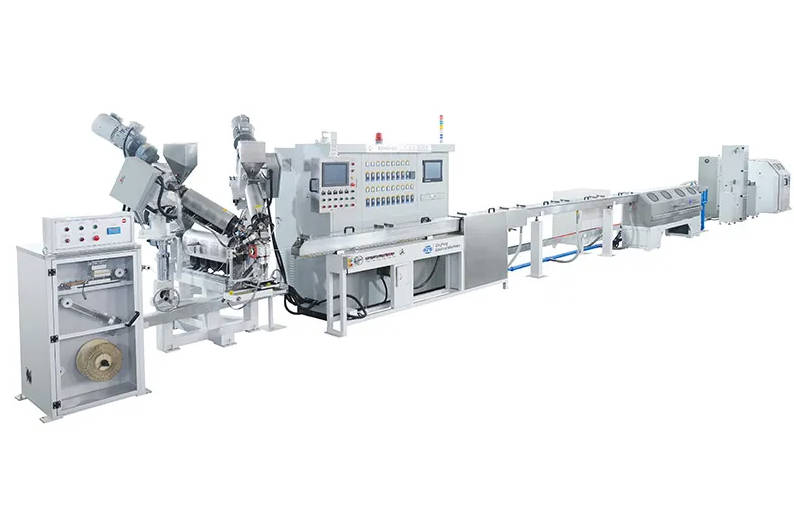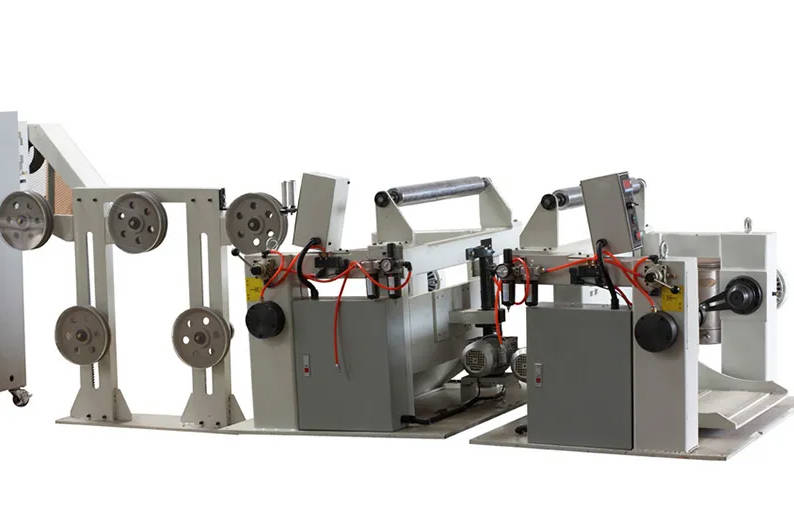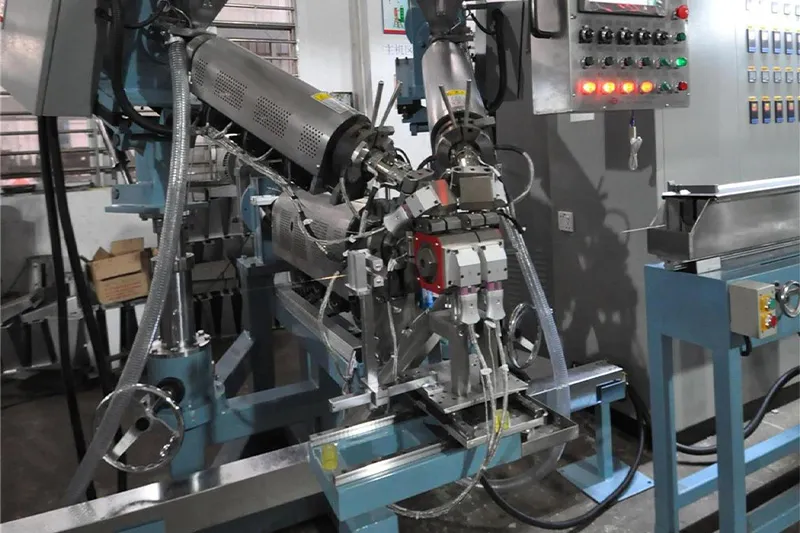
A twinax cable taping machine helps achieve accurate shielding and stable signal performance by controlling tape tension, wrapping angle, tape overlap, cable centering, and material feeding during high-speed cable production. For twinax cables used in data transmission, server interconnects, high-frequency communication systems, and precision electronic applications, the taping process is not only a mechanical wrapping step. It directly affects shielding consistency, impedance stability, attenuation control, and the long-term reliability of the finished cable.
In twinax cable manufacturing, tapes such as PTFE, Mylar, aluminum foil, polyester, or composite shielding films are commonly applied around the cable core, conductor pair, drain wire, or insulation layer. If the tape is too loose, too tight, unevenly overlapped, wrinkled, or misaligned, the cable may suffer from unstable shielding, inconsistent electrical performance, or poor mechanical protection.
That is why choosing the right twinax cable taping machine is important for manufacturers producing high-speed communication cables. A well-designed taping machine should provide stable pay-off, precise tape tension control, accurate pitch adjustment, smooth wrapping, and reliable take-up coordination.
For manufacturers looking for industrial cable wrapping equipment, QingFeng SFS provides taping machine solutions designed for cable production applications where consistency, speed, and process control are critical.
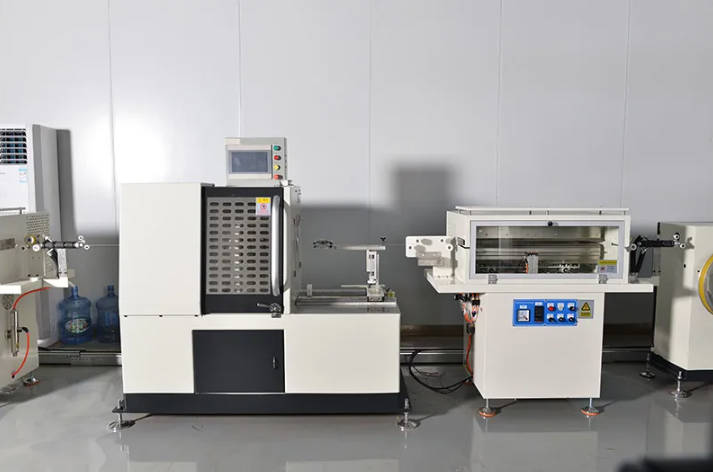
What Is a Twinax Cable Taping Machine?
A twinax cable taping machine is a cable production machine used to wrap one or more layers of tape around twinax cable structures. The machine can be used for insulation wrapping, shielding tape application, barrier layer wrapping, or protective layer taping depending on the cable design.
Twinax cables typically contain two conductors arranged in a balanced structure. In many high-frequency applications, the cable also includes insulation, shielding layers, drain wire, separator tape, and an outer jacket. The taping machine is used to apply tape materials around these cable components with controlled overlap and tension.
The main purpose of a twinax cable taping machine is to apply tape uniformly without damaging the cable core or disturbing the cable geometry. This is especially important for high-speed cables because even small process variations can influence electrical performance.
A typical high speed cable taping machine may include:
| Machine Section | Function in Twinax Cable Production |
| Pay-off system | Feeds the cable core or conductor structure into the taping section |
| Tape head | Holds and rotates the tape bobbin around the cable |
| Tension control system | Keeps tape tension stable during wrapping |
| Pitch control system | Controls tape angle and overlap |
| Centering guide | Keeps the cable core aligned during taping |
| Capstan or traction system | Pulls the cable through the machine at a controlled speed |
| Take-up system | Collects finished taped cable smoothly |
| Control panel | Adjusts speed, pitch, direction, and process parameters |
For high-frequency twinax cable applications, these sections need to work together smoothly. A good machine is not judged only by maximum speed. It should also maintain wrapping consistency during acceleration, deceleration, material changes, and long production runs.
Why Accurate Shielding Matters in Twinax Cable Production
Twinax cables are often used where signal integrity matters. These cables may be found in high-speed data links, communication equipment, industrial electronics, test systems, data center interconnects, and other applications where stable transmission is required.
Shielding is one of the key structures that helps reduce electromagnetic interference, control crosstalk, and protect the signal path. In many twinax cable designs, shielding tape or foil tape is applied around the cable core. The quality of this wrapping layer can affect the cable’s ability to maintain stable performance.
Accurate shielding depends on consistent tape overlap, stable tape tension, smooth surface contact, and correct positioning of the shielding layer.
If the taping process is unstable, several issues may occur:
| Taping Issue | Possible Effect on Cable Quality |
| Uneven tape overlap | Inconsistent shielding coverage |
| Tape wrinkles | Local impedance variation or mechanical defects |
| Excessive tape tension | Core deformation or insulation damage |
| Low tape tension | Loose shielding layer or unstable structure |
| Tape gap | Reduced shielding effectiveness |
| Tape breakage | Production downtime and quality risk |
| Off-center wrapping | Uneven cable structure and appearance defects |
For B2B cable manufacturers, these issues are not only technical problems. They can also create higher scrap rates, unstable batch quality, customer complaints, and longer inspection time. Therefore, the taping machine should be selected based on process stability rather than only equipment price.
How a Taping Machine Supports Stable Signal Performance
A taping machine does not directly create signal performance by itself. Signal performance is determined by cable design, conductor quality, insulation material, shielding structure, extrusion quality, and final testing. However, the taping process plays an important role in maintaining the designed structure.
In high-speed twinax cables, the geometry of the cable is important. If the cable core is compressed, twisted unevenly, pulled with unstable force, or wrapped with inconsistent tape pressure, the physical structure may change. These structural changes may influence impedance, skew, attenuation, and other electrical properties.
A high speed taping machine supports stable signal performance in several ways.
1. Stable Tape Tension
Tape tension must be controlled carefully throughout the entire taping process. In twinax cable production, tension is not only related to whether the tape can be wrapped tightly around the cable core. It also affects tape width stability, overlap consistency, surface contact, and the mechanical pressure applied to the cable structure. When the machine runs at high speed, even small tension fluctuations can gradually lead to uneven wrapping, unstable shielding coverage, or visible surface defects.
If the tape is pulled too tightly, several problems may occur. Soft tape materials may stretch during wrapping, causing the actual tape width and overlap ratio to change. Foil tapes may develop edge deformation, small cracks, or wrinkles if they are forced around the cable with excessive pressure. For fine twinax cable structures, too much wrapping force may also compress the insulation layer or disturb the relative position of the conductor pair. This can be especially risky for high-speed signal cables because cable geometry is closely related to impedance stability, skew control, and attenuation performance.
If the tape tension is too low, the tape may not sit firmly on the cable surface. Loose tape can shift during downstream processing, especially before extrusion, jacketing, or further shielding operations. It may also create small gaps, lifting edges, wrinkles, or inconsistent layer contact. These defects may not always be obvious at the beginning of production, but they can become more serious after take-up, storage, bending, or later cable assembly processes.
A stable tension control system helps operators maintain repeatable wrapping quality from the beginning to the end of a production run. This is important because tape bobbin diameter changes continuously during production, and the machine must still keep the feeding force stable as the bobbin becomes smaller. For high-speed twinax cable taping, buyers should pay attention to whether the machine can provide smooth low-tension control, stable braking or servo control, accurate tension adjustment, and a tape path that avoids sudden friction changes.
Modern cable taping equipment commonly uses mechanical, magnetic, pneumatic, or servo-controlled tension systems depending on the machine design and application. For fine twinax cables, stable low-tension control is often important because the cable core can be sensitive to deformation. A well-designed taping machine should make it easier to balance two requirements at the same time: the tape must be tight enough to form a stable wrapping layer, but gentle enough to avoid damaging or deforming the cable core.
2. Accurate Tape Overlap
Tape overlap refers to how much one tape turn covers the previous turn. In many applications, overlap is adjusted according to tape width, wrapping angle, cable diameter, material properties, and required shielding coverage.
A high-quality shielding taping machine should allow operators to adjust the wrapping pitch accurately. This helps keep overlap consistent throughout production.
Consistent tape overlap is one of the most important process factors for stable shielding coverage in twinax cable manufacturing.
3. Smooth Cable Centering
Cable centering keeps the cable core aligned as it passes through the taping head. Poor centering may cause uneven tape coverage or mechanical stress. For small-diameter twinax cables, the guiding system must be smooth and precise to avoid scratching, bending, or pulling the core unevenly.
4. Coordinated Speed Control
Taping speed, capstan speed, tape head rotation speed, and take-up speed should be coordinated. If one section is not synchronized with the others, tape pitch and tension may fluctuate.
For this reason, buyers should evaluate not only the mechanical frame but also the control system. A stable control system makes it easier to maintain repeatable process parameters.
5. Material Compatibility
Twinax cable production may use different tapes for different purposes. PTFE tape may be used for high-frequency insulation or heat resistance. Mylar or polyester tape may be used for insulation, separation, or wrapping stability. Aluminum foil or laminated foil tape may be used for shielding.
The machine should be compatible with the required tape width, thickness, bobbin size, material stiffness, and wrapping direction.
Common Tape Materials Used for Twinax Cables
Different twinax cable designs require different tape materials. The taping machine should be selected according to the actual material and process requirement.
| Tape Material | Common Purpose | Process Considerations |
| PTFE tape | High-frequency insulation, heat resistance, dielectric performance | Requires stable tension and careful handling |
| Mylar / polyester tape | Insulation, separation, mechanical protection | Usually easier to process but still needs overlap control |
| Aluminum foil tape | Shielding and EMI protection | Needs smooth wrapping to avoid wrinkles or cracks |
| Copper foil tape | Shielding and conductivity | May require careful tension to avoid deformation |
| Composite laminated tape | Combined shielding and insulation | Machine must handle material stiffness and bobbin stability |
| Non-woven tape | Cushioning or separation layer | Requires stable feeding and low damage handling |
For manufacturers producing multiple cable types, machine flexibility becomes important. A configurable high speed cable taping machine can help support different tape materials and cable structures within one production environment.
Key Process Parameters for Twinax Cable Taping
When selecting or operating a twinax cable taping machine, buyers should pay attention to the following parameters.
| Parameter | Why It Matters | What to Check Before Buying |
| Cable diameter range | Determines whether the machine can process your cable sizes | Minimum and maximum cable diameter |
| Tape width range | Affects overlap and wrapping coverage | Supported tape width and bobbin size |
| Tape tension range | Protects cable structure and ensures smooth wrapping | Tension control method and adjustment accuracy |
| Wrapping pitch | Controls overlap and shielding coverage | Pitch adjustment method and repeatability |
| Rotation speed | Affects production output | Stable speed under real production conditions |
| Direction control | Some cables need left-hand or right-hand wrapping | Single-direction or bi-directional capability |
| Pay-off type | Influences feeding stability | Active or passive pay-off options |
| Take-up type | Affects final cable winding quality | Tension control, traversing, and spool size |
| Control system | Determines ease of operation and repeatability | PLC, touchscreen, recipe storage, alarm function |
| Safety design | Protects operators during high-speed operation | Guards, emergency stop, fault detection |
A common mistake is selecting a taping machine only by maximum speed. In real production, stable operation at the required process speed is more important than the theoretical top speed.
Single-Layer vs Double-Layer Taping for Twinax Cables
Twinax cables may require single-layer, double-layer, or multi-layer taping depending on cable design. Each structure has different advantages and process requirements.
| Taping Structure | Typical Application | Advantages | Key Process Challenge |
| Single-layer taping | Basic insulation or separation layer | Simple structure, lower material use | Overlap must remain consistent |
| Double-layer taping | Improved shielding, insulation, or mechanical stability | Better coverage and protection | Two tape heads must be synchronized |
| Opposite-direction double taping | Shielding or structural balance | Can improve layer stability in some designs | Requires precise control of both directions |
| Multi-layer taping | Complex high-performance cable structures | Supports advanced cable design | Higher machine complexity and setup requirements |
For twinax cable manufacturers, the right choice depends on product structure, shielding requirement, cable diameter, production volume, and customer specifications. If your product line includes different cable designs, it may be useful to select equipment that supports future process expansion.
Common Problems in Twinax Cable Taping and How to Solve Them
Even with a good machine, process problems can occur if settings, materials, or production conditions are not properly managed. The following table summarizes common taping defects and possible causes.
| Problem | Possible Cause | Practical Solution |
| Tape wrinkle | Excessive tension, poor tape alignment, material stiffness | Adjust tension, check tape path, confirm guide alignment |
| Tape gap | Incorrect pitch, unstable rotation speed, poor synchronization | Recalculate pitch, inspect control system, adjust speed ratio |
| Tape breakage | Too much tension, sharp guide edge, poor tape quality | Reduce tension, polish guide path, verify tape material |
| Uneven overlap | Speed fluctuation, unstable capstan, incorrect setup | Check speed synchronization and recipe settings |
| Loose tape | Low tension, poor bobbin braking, take-up fluctuation | Increase controlled tension and inspect brake system |
| Core deformation | Excessive wrapping pressure or traction force | Reduce tension and check cable guiding system |
| Surface scratches | Rough guide parts or poor cable path | Inspect guides and replace worn components |
| Unstable take-up | Incorrect winding tension or traversing issue | Adjust take-up tension and spool traversing |
The best way to reduce taping defects is to control the complete process: material quality, machine setup, tension stability, operator training, and routine maintenance.
How to Choose a Taping Machine for Twinax Cable Manufacturing
Before purchasing a twinax cable taping machine, buyers should clearly define their production requirements. This helps avoid under-specification or unnecessary machine complexity.
1. Confirm Cable Structure
Start with the cable design. Is the machine used for wrapping around a single insulated pair, a twinax core with drain wire, a shielded cable core, or a finished cable before jacketing? Different structures may require different tape head designs and guide systems.
2. Confirm Tape Material
PTFE, Mylar, aluminum foil, copper foil, and laminated tapes behave differently during wrapping. Some materials are soft and flexible, while others are stiff or easy to wrinkle. The machine should be tested or configured according to the tape material.
3. Define Production Speed
Do not only ask for the highest possible speed. Instead, ask whether the machine can maintain stable tension, overlap, and cable centering at your required production speed.
4. Check Fine Cable Handling Capability
Twinax cables may have small diameters and delicate structures. The machine should handle the cable gently without pulling, flattening, or twisting the core.
5. Evaluate Control System
A practical machine should allow operators to set and repeat process parameters. Useful control features may include touchscreen operation, speed synchronization, fault alarms, production length counting, and recipe storage.
6. Consider Future Cable Types
If you plan to produce multiple high-speed cable products, choose a machine that can support a reasonable range of tape widths, cable sizes, wrapping directions, and process configurations.
Manufacturers evaluating equipment for high-speed communication cable production can review QingFeng SFS cable taping equipment to understand available machine options and application directions.
Supplier Evaluation: What B2B Buyers Should Ask
Choosing the right equipment supplier is just as important as choosing the machine model. A supplier should understand not only machine manufacturing but also cable production requirements.
When communicating with a taping machine supplier, buyers can ask:
| Question | Why It Matters |
| What cable diameter range can the machine support? | Ensures compatibility with current and future products |
| What tape materials have been processed on similar machines? | Helps evaluate practical experience |
| How is tape tension controlled? | Determines process stability |
| Can the machine support single or double-layer taping? | Matches cable structure requirements |
| What is the recommended production speed for my cable? | Avoids unrealistic speed expectations |
| Can the machine be customized for specific tape width or bobbin size? | Supports special production needs |
| What training and after-sales support are available? | Reduces commissioning and operation risks |
| Are spare parts and technical support available? | Supports long-term production reliability |
QingFeng SFS focuses on cable equipment for industrial production environments. Buyers can visit the QingFeng SFS official website to learn more about the company’s cable machinery capabilities and product categories.
Common Misunderstandings About Twinax Cable Taping Machines
Misunderstanding 1: Higher Speed Always Means Better Performance
Higher speed is useful only when the machine can maintain stable process quality. For twinax cable taping, tension fluctuation and overlap instability at high speed can create quality problems.
Misunderstanding 2: Any Cable Taping Machine Can Handle Twinax Cable
Twinax cable structures may require more precise guiding, lower tension, and better synchronization than ordinary cable wrapping. Buyers should check whether the machine is suitable for high-frequency cable applications.
Misunderstanding 3: Shielding Quality Depends Only on Tape Material
Tape material is important, but shielding quality also depends on overlap, tension, wrapping smoothness, drain wire position, and overall cable structure.
Misunderstanding 4: Manual Adjustment Is Enough for Stable Production
Manual adjustment may work for simple products or small batches. However, repeatable industrial production usually requires stable mechanical design and reliable control systems.
Misunderstanding 5: The Cheapest Machine Reduces Cost
A low-cost machine may increase cost if it causes more scrap, downtime, quality variation, or maintenance issues. For B2B production, total operating cost should be considered.
Practical Engineering Tips for Better Twinax Cable Taping
To improve taping quality, manufacturers should manage both machine settings and process discipline.
Useful practices include:
● Keep tape bobbins clean, dry, and properly stored.
● Check tape width and thickness before production.
● Set tension according to material behavior, not by guesswork.
● Confirm cable centering before running at full speed.
● Start with moderate speed during setup.
● Inspect the first production samples carefully.
● Record successful process parameters for repeat orders.
● Train operators to identify early signs of tape wrinkle, gap, or looseness.
● Maintain guides, bearings, brakes, and rotating parts regularly.
These practices help manufacturers build a more stable process instead of relying on operator experience alone.
When Should You Upgrade to a High Speed Cable Taping Machine?
A manufacturer may consider upgrading equipment when current production faces repeated quality or efficiency limitations. Common signs include unstable tape overlap, frequent tape breakage, poor shielding consistency, slow production speed, excessive manual adjustment, or difficulty processing new high-frequency cable designs.
A high speed cable taping machine can be useful when your production requires:
| Production Need | Why an Upgraded Machine Helps |
| Higher output | Improves production capacity when quality remains stable |
| Better process repeatability | Reduces operator-dependent variation |
| More precise tension control | Protects fine cable structures |
| Flexible tape material compatibility | Supports different cable designs |
| Stable shielding layer | Helps improve product consistency |
| Lower downtime | Reduces interruptions from tape breakage and setup issues |
For companies producing twinax cables, DAC cables, shielded communication cables, or other high-speed cable products, investing in suitable taping equipment can support more consistent production.
FAQ
What is a twinax cable taping machine used for?
A twinax cable taping machine is used to wrap insulation tape, shielding tape, foil tape, or protective tape around twinax cable structures. It helps maintain consistent tape overlap, tension, and cable coverage during production.
How does a high speed cable taping machine improve shielding quality?
A high speed cable taping machine improves shielding quality by controlling wrapping pitch, tape tension, cable centering, and tape feeding stability. These factors help reduce gaps, wrinkles, and uneven shielding coverage.
What tape materials are commonly used for twinax cable shielding?
Common materials include aluminum foil tape, copper foil tape, Mylar tape, polyester tape, PTFE tape, and laminated composite tapes. The correct material depends on the cable design and performance requirements.
Why is tension control important in twinax cable taping?
Tension control is important because excessive tension may deform the cable core, while low tension may cause loose wrapping or wrinkles. Stable tension helps protect the cable structure and improve process consistency.
How do I choose a taping machine for high-speed twinax cable manufacturing?
To choose a taping machine for high-speed twinax cable manufacturing, confirm your cable diameter, tape material, tape width, required speed, shielding structure, tension range, and whether single-layer or double-layer taping is needed.
Can one taping machine process PTFE tape and Mylar tape?
In many applications, one taping machine can be configured to process different tape materials such as PTFE and Mylar. However, the tape head, tension system, bobbin size, and guide design should be checked before purchasing.
What causes tape wrinkles in twinax cable production?
Tape wrinkles may be caused by excessive tension, unstable tape feeding, poor tape alignment, unsuitable tape material, or incorrect wrapping pitch. Proper machine setup and material control can reduce this problem.
Conclusion
A twinax cable taping machine is a critical part of high-speed cable manufacturing because it helps control shielding accuracy, tape overlap, tension stability, and cable structure consistency.
For manufacturers producing twinax cables, DAC cables, high-frequency communication cables, or shielded data cables, the right taping equipment can support more stable production and better process repeatability.
When selecting a machine, buyers should evaluate the complete production requirement instead of focusing only on speed or price. Cable structure, tape material, tension control, wrapping pitch, machine synchronization, supplier experience, and after-sales support should all be considered.
QingFeng SFS provides high speed taping machine solutions for cable manufacturers looking to improve wrapping accuracy, shielding consistency, and production efficiency in demanding cable applications.