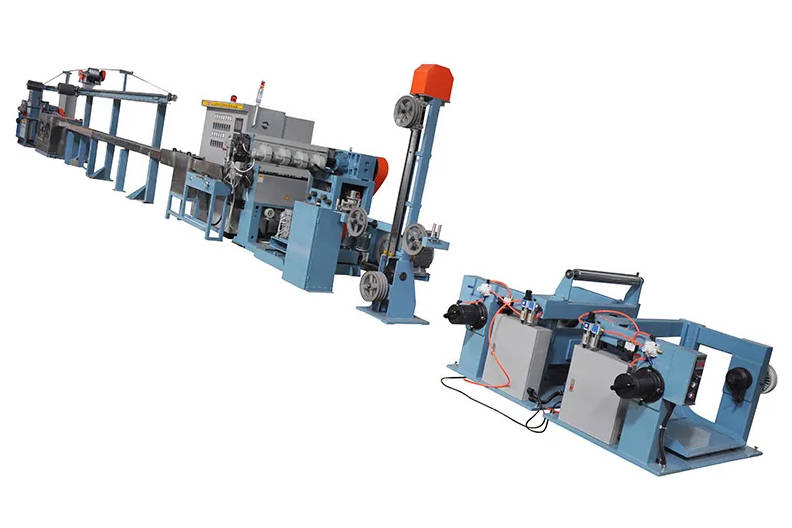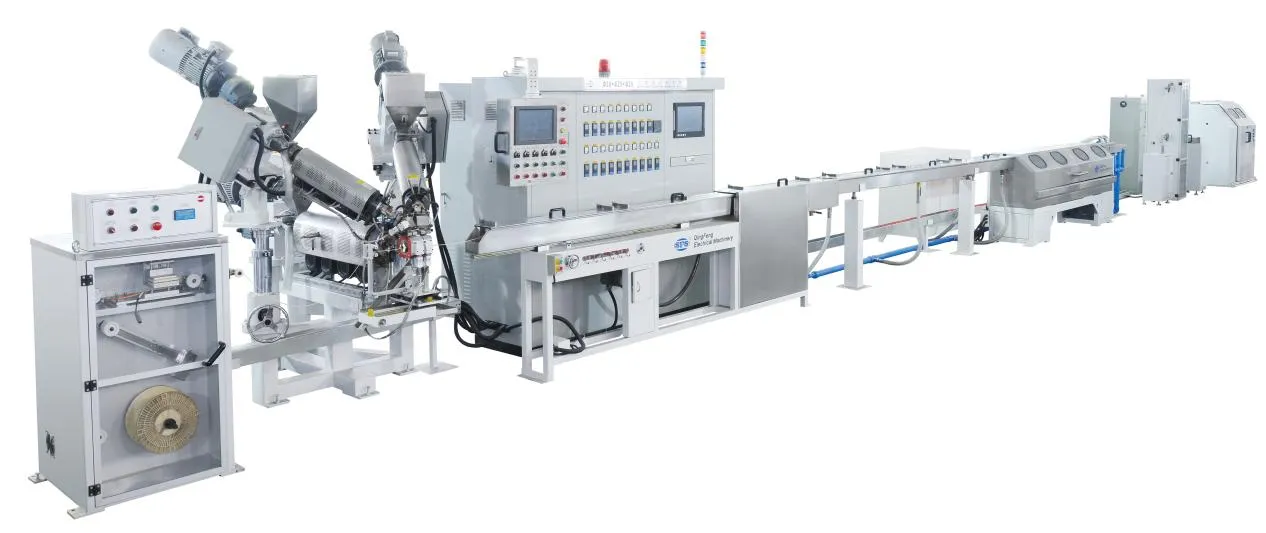
Selecting the right cross-linking technology is the single most critical capital decision when configuring a cross-linked polyethylene (XLPE) production line. Silane cross-linking equipment and peroxide continuous vulcanization (CV) lines serve fundamentally distinct manufacturing tiers, production volumes, and voltage thresholds.
Silane lines use standard single-screw extruders and cure downstream in moisture baths or steam saunas, making them the industry standard for low-voltage power cables, building wires, and flexible plant setups with lower initial capital expenditure. In contrast, peroxide cross-linking requires specialized extrusion machinery coupled with pressurized continuous vulcanization (CCV or VCV) heating and cooling tubes, serving as the required technology for medium-voltage, high-voltage, and extra-high-voltage power cables.
This guide compares silane and peroxide cross-linking machinery across hardware specifications, workshop footprint, thermal control, application boundaries, and operational economics to help cable manufacturers specify the correct production setup.
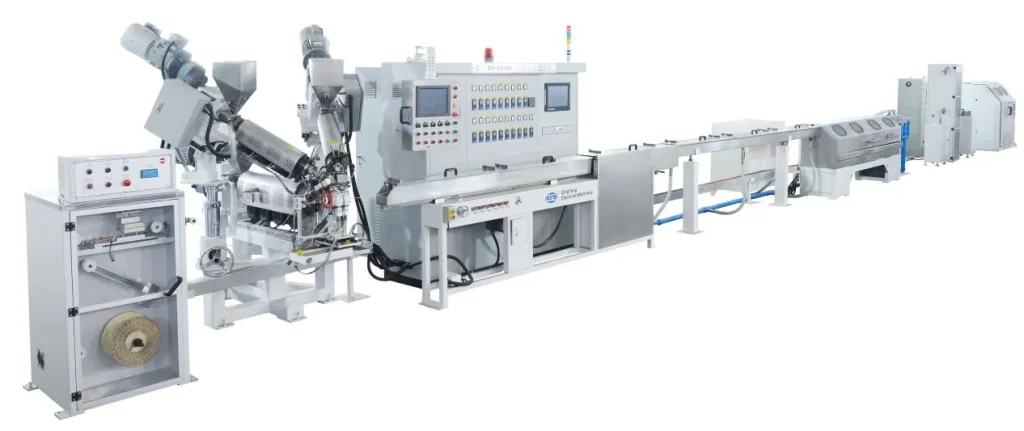
XLPE Cable Manufacturing: Choosing Between Silane and Peroxide Cross-Linking Lines
Cross-linked polyethylene transforms standard thermoplastic polyethylene into a thermoset polymer with superior dielectric strength, environmental stress-crack resistance, and elevated operating temperature ratings (typically 90°C continuous, 250°C short-circuit). However, the chemical mechanism chosen to initiate this molecular cross-linking governs every mechanical section of the extrusion line — the same property set that separates XLPE from PVC, PE and TPE insulation in day-to-day compound selection.
When cable engineers evaluate an XLPE extrusion line, they must choose between two distinct engineering paths:
- Silane Moisture Curing: Polyethylene grafted with vinyl silane molecules, extruded at atmospheric pressure, and cross-linked post-extrusion via ambient humidity, hot water immersion, or steam chambers.
- Peroxide Continuous Vulcanization (CV): Polyethylene compounded with organic peroxides (such as dicumyl peroxide), extruded under tight thermal windows, and cross-linked inside an inline pressurized catenary or vertical curing tube under high temperatures.
The decision dictates plant ceiling height, line length, auxiliary gas infrastructure, extruder screw geometry, and scrap generation during start-up. A third route, electron-beam irradiation cross-linking, sits outside this head-to-head comparison but is worth reviewing where wall thickness, throughput, and factory layout point away from both moisture curing and CV.
Process Overview: Silane Moisture Curing vs. Peroxide Continuous Vulcanization (CV)
The fundamental difference between these production lines lies in where and how the polymer cures: downstream in water, or inline inside a pressurized tube.
Silane Cross-Linking Lines: Two-Step (Sioplas) vs. One-Step (Monosil) Extrusion
Silane processing operates under two primary methods, each imposing distinct equipment requirements:
- Two-Step (Sioplas Method): Cable manufacturers purchase pre-grafted silane polymer base resin and a separate catalyst masterbatch. These two components are dry-blended immediately prior to entering the extruder hopper (typically in a 95:5 ratio). Because grafting has already occurred upstream, the extruder’s primary role is thorough distributive mixing and low-temperature pumping. Standard single-screw extruders with moderate length-to-diameter (L/D) ratios can handle Sioplas processing without risking premature cure.
- One-Step (Monosil Method): Base polymer resin, liquid silane, peroxide initiator, and organotin catalyst are metered, injected, and grafted directly inside the extruder barrel during the actual cable extrusion run. This eliminates the purchase of pre-grafted compounds but demands specialized, extended extruders (higher L/D ratios) equipped with gravimetric liquid injection systems, specialized mixing sections, and sophisticated melt degassing to prevent voids.
Both methods extrude a cable core that remains uncured upon exiting the cooling trough. Final cross-linking occurs off-line by immersing cable drums in hot water baths (70°C to 90°C) or curing saunas over several hours, driven by ambient moisture diffusion into the insulation.
Peroxide Cross-Linking Lines: The Dry Curing CCV/VCV Mechanism
Peroxide curing requires the polymer to melt, homogenize, and cross-link entirely inline without permitting moisture contact, which causes electrical micro-voids (water treeing):
- Low-Temperature Extrusion: Peroxide-formulated pellets enter a specialized extruder. The melt temperature must be kept strictly below the decomposition point of the organic peroxide to prevent premature cross-linking (“scorch”) within the extruder barrel or crosshead.
- Pressurized Curing Tube: The coated conductor passes directly from the crosshead into a sealed, pressurized catenary continuous vulcanization (CCV) or vertical continuous vulcanization (VCV) tube.
- Thermal Decomposition and Cross-Linking: High-pressure nitrogen gas (typically 1.0 to 1.6 MPa, depending on line design) blankets the cable to prevent surface oxidation and suppress volatile gas bubbles. Electrical heating zones or radiant gas tubes elevate the nitrogen temperature up to 300°C–400°C, decomposing the peroxide into free radicals that bridge the polyethylene chains.
- Controlled Cooling: The cable moves into a contiguous water- or gas-cooled lower section of the tube, still under nitrogen pressure, solidifying the crystalline structure without void formation before passing out through a mechanical end-seal.
Machinery & Hardware Comparison: Extruder Specs, Footprint, and Line Setup
Physical equipment differences between silane and peroxide lines affect everything from factory layout to thermal instrumentation. Both sit inside the same wider cable extrusion process of pay-off, melt extrusion, cooling, and tension-controlled take-up.
Production Line Layout Sequence
| Production Stage | Silane Extrusion Line (Horizontal Setup) | Peroxide CCV Extrusion Line (Catenary Setup) |
|---|---|---|
| Stage 1: Pay-Off | Pay-Off stand (single conductor payoff) | Heavy-duty dual pay-off stand (continuous feeding) |
| Stage 2: Extrusion | Single extruder (or co-extruder for skin/stripes) | Triple co-extrusion system (inner semi-con, XLPE, outer semi-con) |
| Stage 3: Curing & Cooling | Atmospheric water cooling trough | Pressurized nitrogen catenary tube (100–150 m heating & cooling zones) |
| Stage 4: Haul-Off | Capstan or belt caterpillar | Caterpillars / tension-regulating wheel haul-off |
| Stage 5: Take-Up | Standard take-up stand onto process reels | Heavy-duty automated take-up stand |
| Stage 6: Final Cross-Linking | Off-line curing tank or hot steam sauna | Completed inline inside the pressurized catenary tube |
Extruder Screw Design, L/D Ratio, and Temperature Control Precision
- Silane Lines: Extruders for Sioplas compounds generally feature a 25:1 L/D ratio with neutral barrier screws that emphasize homogenous color and catalyst distribution without excessive shear heating. Barrel heating uses standard ceramic or cast-aluminum heaters with air blower cooling zones, maintaining temperature tolerances of roughly ±1.5°C to ±2°C.
- Peroxide Lines: Peroxide extruders run shorter effective compression sections (often 20:1 to 24:1 L/D) designed with gentle, deep-channel flight geometry to minimize frictional shear heat. Because the thermal gap between polymer plasticization and peroxide scorch can be narrower than 10°C, peroxide extruders rely on precision liquid temperature control units (circulating pressurized water or oil through zoned jackets) to maintain thermal tolerances of ±0.5°C.
Line Footprint and Auxiliary Infrastructure Requirements
A silane line fits into standard single-story industrial warehouses. The extrusion axis is completely horizontal, requiring 40 to 60 meters of total line length and standard 4-to-5-meter ceiling clearances. The only required auxiliaries are standard recirculating chilled water troughs and off-line curing water tanks.
A peroxide CCV line requires a specialized catenary building layout. The pay-off, metering extruders, and triple crosshead are elevated on a mezzanine or mid-height tower (10 to 25 meters high). The catenary tube extends downwards across a horizontal floor span of 100 to 150 meters to maintain the natural catenary curve of the cable without touching the tube walls before solidifying. Vertical lines (VCV) for extra-high-voltage cables require dedicated vertical towers 40 to 75 meters tall. Peroxide lines also demand high-pressure nitrogen generation stations, nitrogen recycling systems, heavy-duty mechanical end-seals, and closed-loop heating controls.
Silane vs. Peroxide Hardware Comparison
| Engineering Parameter | Silane Moisture Curing Line (Sioplas/Monosil) | Peroxide Continuous Vulcanization Line (CCV/VCV) |
|---|---|---|
| Primary Voltage Range | Low Voltage (up to 1 kV; select MV to 10 kV) | Medium to Extra-High Voltage (10 kV to 500 kV+) |
| Typical Line Orientation | Completely horizontal, floor-level | Catenary suspension (CCV) or vertical tower (VCV) |
| Building Height Requirement | Standard factory clearance (4–6 meters) | Mezzanine/tower required (12–75 meters) |
| Line Length Requirement | 40–60 meters | 100–160+ meters |
| Extruder Configuration | Single extruder (or co-extrusion for skin/stripes) | Triple co-extrusion (conductor screen, insulation, insulation screen) |
| Screw Cooling / Barrel Temp Control | Air-cooled barrel zones, tolerance ±1.5°C to ±2°C | Liquid-circulated jackets, precision tolerance ±0.5°C |
| Cross-Linking Medium | Hot water bath or steam room (post-extrusion) | Pressurized high-purity nitrogen gas (inline) |
| Auxiliary Infrastructure | Water curing tank or steam chamber | Nitrogen generation plant, gas heating units, high-pressure end seals |
| Capital Cost (CAPEX) | Low to Moderate | High to Very High |
Application Boundaries & Voltage Ratings
Cable cross-section, insulation wall thickness, and electrical stress thresholds dictate which equipment architecture can be used.
Cross-Linking Technology by Voltage Class
| Voltage Class | Insulation Thickness Range | Recommended Equipment Technology | Key Engineering Rationale |
|---|---|---|---|
| Low Voltage (< 1 kV) | 0.7 mm – 2.0 mm | Silane Extrusion Line (Sioplas / Monosil) | Fast moisture diffusion; lowest capital and running cost for thin walls. |
| Medium Voltage (6 kV – 35 kV) | 2.5 mm – 8.0 mm | Peroxide CCV Line (Silane limited to ≤ 10 kV) | Triple co-extrusion prevents micro-voids; moisture curing thick walls risks treeing. |
| High Voltage (66 kV – 220 kV) | 9.0 mm – 25.0 mm | Peroxide CCV or VCV Line | Dry curing under pressure prevents voids; strict roundness and non-contact curing. |
| Extra-High Voltage (220 kV – 500 kV+) | > 25.0 mm | Peroxide VCV (Vertical) Line | Eliminates core sagging from gravity; zero-moisture dielectric purity. |
Low Voltage Cables (< 1 kV)
Silane cross-linking dominates low-voltage building wire, control cables, overhead bundled conductors, and low-voltage power distribution. Because insulation walls on 1 kV cables are relatively thin (0.7 mm to 2.0 mm), moisture diffuses rapidly through the matrix, completing full cross-linking in hot water within hours. This is conventional insulating core wire extrusion territory. Utilizing an expensive peroxide CCV line for 1 kV cables is economically unviable due to line start-up waste, high energy consumption, and high capital depreciation.
Medium Voltage Power Cables (6 kV to 35 kV)
This is where the technologies overlap, though peroxide CCV lines remain the engineering standard. Medium-voltage cables require semi-conductive inner conductor screening and outer insulation screening. Modern peroxide cable extrusion lines use triple-extrusion crossheads, applying inner shield, XLPE insulation, and outer shield in a single pass to yield void-free, contamination-free interfaces.
While silane can produce up to 10 kV–35 kV cables in certain markets, moisture curing thick insulation layers (> 4 mm) takes substantially longer because moisture diffusion rate decreases exponentially with wall thickness. Furthermore, any microscopic moisture remnants trapped within the insulation matrix can trigger treeing degradation under high electrical field stress.
High and Extra-High Voltage Power Cables (66 kV to 500 kV+)
High-voltage and extra-high-voltage transmission lines exclusively use dry-cured peroxide CCV or VCV equipment. Thick wall profiles (up to 30 mm+) make external moisture diffusion impossible within reasonable production cycles. More importantly, absolute dielectric purity, minimal void size (often specified under 5 to 15 microns), and precise roundness (concentricity) demand the non-contact, nitrogen-blanketed curing environment provided by vertical or catenary vulcanization tubes.
Commercial Evaluation: Capital Investment vs. Long-Term Operating Costs
Evaluating silane versus peroxide lines requires balancing machinery cost, factory space, and long-term operating overhead — starting with what actually drives the cost of a cable extrusion line.
Capital Expenditure (CAPEX)
- Equipment Acquisition: A complete silane extrusion line costs a fraction of an equivalent-output peroxide CCV line. A peroxide line includes multiple precision extruders, a triple crosshead, automated catenary control sensors, high-pressure nitrogen heating tubes, and complex capstans.
- Civil Engineering & Plant Construction: Silane lines require no specialized civil engineering beyond a level concrete foundation. Peroxide lines demand high towers, deep catenary pits, or specialized structural mezzanines, significantly raising upfront facility costs.
Operating Expenditure (OPEX)
- Raw Material Pricing: Pre-compounded peroxide XLPE resin is typically cheaper per ton than pre-grafted silane (Sioplas) compound because of simpler manufacturing logistics. One-step Monosil silane systems offset compound costs by purchasing raw base resin and liquid additives, but require tighter dosing oversight.
- Energy Consumption: Silane lines consume far less energy during extrusion because they operate at lower barrel temperatures and use atmospheric water cooling. Peroxide lines consume significant electricity or gas to maintain pressurized nitrogen curing tubes at 350°C–400°C for hours, alongside the continuous operation of high-pressure gas compressors. On the peroxide side, energy-saving extrusion line configurations offset part of that fixed thermal load.
- Start-Up and Scrap Rates: Silane lines stabilize process conditions quickly, yielding low scrap during product transitions. Peroxide CCV lines have long internal path lengths (often exceeding 100 meters between the extruder and haul-off); commissioning, ramping line speed, and transitioning cable sizes can generate significant scrap cable before the curing profile stabilizes.
How to Choose the Right Extrusion Line: A Decision Framework for Cable Makers
Cable manufacturers should evaluate technical parameters against production programs before finalizing machinery orders. A structured cable extrusion line buying guide helps sequence that evaluation before commercial negotiation begins.
Decision Matrix for Machine Selection
| Production Priority | Recommended Equipment Configuration | Critical Facility Requirement | Key Trade-Off |
|---|---|---|---|
| Low-voltage cables (< 1 kV), small-to-medium batches | Silane Sioplas Extrusion Line | Standard 4–6 m clear-height factory floor | Requires space for water curing tanks or steam rooms |
| High-volume low-voltage building wire (continuous runs) | Silane Monosil Extrusion Line | Dedicated resin/liquid additive dosing systems | Higher extruder L/D and operator dosing control required |
| Medium-voltage power cables (6 kV to 35 kV) | Peroxide CCV Line with Triple Crosshead | 12–25 m tower height, 100–140 m horizontal floor length | High capital cost and higher startup scrap per run |
| High & extra-high voltage cables (66 kV to 500 kV+) | Peroxide VCV (Vertical) Line | 40–75 m dedicated vertical tower structure | Massive civil infrastructure investment required |
Technical Parameters to Verify with Your Machine Manufacturer
- Polymer Rheology & Thermal Limits: Confirm melt index (MFI/MI) specifications for target resins. Ensure the extruder drive system and screw profile prevent shear-induced degradation.
- Concentricity and Wall Control: For medium-voltage triple co-extrusion lines, review the crosshead flow distribution channels to ensure balanced melt flow and verify compatibility with online X-ray or ultrasonic wall thickness measurement systems — the measurement side of concentricity and wall thickness control.
- Curing Tube Length and Catenary Control: On peroxide lines, cross-reference line speed goals against heated and cooled tube lengths to confirm that cross-linking and core cooling will complete before reaching the water seals.
- Line Automation & Tension Regulation: Ensure pay-off and take-up dancers provide sensitive tension control to prevent conductor elongation or distortion, particularly when drawing stranded or compacted copper and aluminum cores.
Shortlisting starts with a written specification. Share your voltage class, insulation wall range, target line speed, and available building height, and our engineers will confirm which architecture fits: send your XLPE line requirements for a configuration review.
Key Takeaways
- Core Application Split: Silane extrusion lines are the industry standard for low-voltage (< 1 kV) wires and cables, while peroxide CCV/VCV lines are required for medium-voltage, high-voltage, and extra-high-voltage power distribution.
- Footprint and Facility Differences: Silane lines run on standard flat factory floors with 40-to-60-meter lengths; peroxide CCV lines require 100-to-150-meter spans alongside 12-to-25-meter catenary towers or 40-to-75-meter vertical towers.
- Process Mechanism: Silane lines extrude uncured cable for off-line curing in moisture or steam baths; peroxide lines cross-link the polymer inline inside high-temperature, high-pressure nitrogen tubes.
- CAPEX vs. OPEX: Silane setups offer significantly lower initial equipment and building investment; peroxide lines have higher capital requirements and scrap rates, but process lower-cost bulk resin formulations for large-scale utility cable projects.
Frequently Asked Questions (FAQ)
Can a standard PVC extrusion line be retrofitted for silane XLPE production?
Yes, many standard PVC extruders can run two-step (Sioplas) silane XLPE compounds with minor modifications. The process generally requires a dedicated low-compression screw, adjusted barrel heating zone profiles, and an adapted water-cooling trough. Extruding one-step (Monosil) formulations on a standard PVC extruder is not recommended, as Monosil requires liquid dosing ports, a higher L/D ratio for thorough grafting, and specialized melt degassing.
What causes premature scorching in XLPE extrusion lines, and how is it prevented?
Premature scorching is the unintended cross-linking of the polymer inside the extruder barrel, adapter, or crosshead before the insulation coats the wire. It is caused by excessive shear heat, prolonged residence time in dead spots, or barrel temperatures exceeding the peroxide decomposition point. Scorching is prevented by using low-shear screw profiles, liquid-cooled barrel zones with tight thermal tolerances (±0.5°C), streamlined crosshead tooling, and matching extrusion speed to material dwell time.
Why is nitrogen used instead of steam in modern peroxide CCV curing tubes?
Early peroxide cross-linking lines used high-pressure steam for thermal transfer, but micro-moisture penetrated the molten XLPE, leaving residual micro-voids that triggered electrochemical treeing and premature cable failure in service. Modern peroxide lines use dry curing with high-purity nitrogen gas pressurized to 1.0–1.6 MPa. Nitrogen provides uniform radiant thermal transfer, prevents polymer surface oxidation, and suppresses void formation without introducing moisture.
Which line type is better suited for small-batch, multi-specification cable orders?
Silane extrusion lines are far better suited for small-batch and variable-specification manufacturing. A silane line can be started, purged, and stabilized quickly with minimal material scrap. In contrast, an inline peroxide CCV line requires extensive heating and pressurization cycles, and its long internal path creates substantial cable scrap during line starts, stops, and dimensional changes.